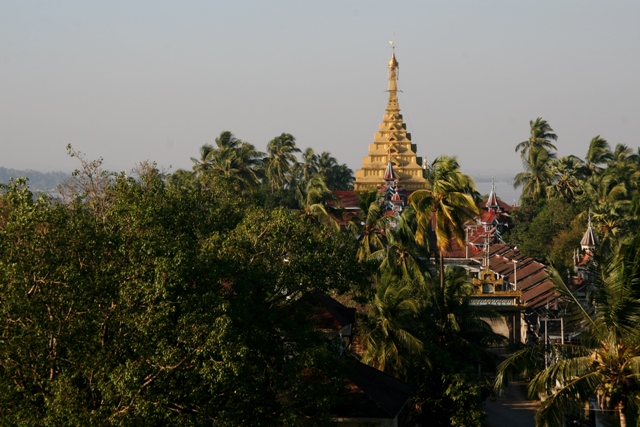
‘By the old Moulmein pagoda lookin’ lazy at the sea
There’s a Burma girl a-settin’ and I know she thinks o’ me’
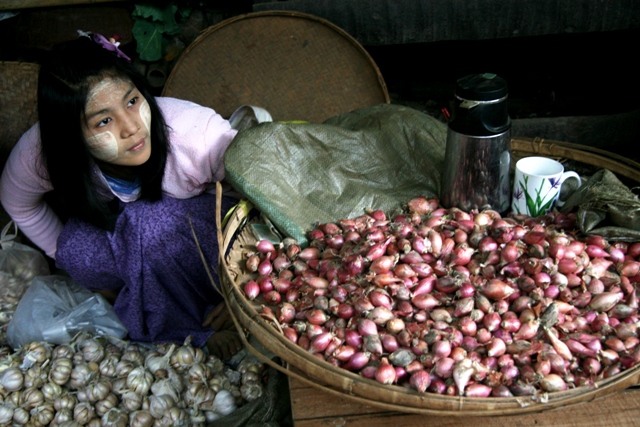
These words by Rudyard Kipling form the opening lines of the Road to Mandalay, an evocative poem that manages to capture the mysterious spirit of the East as seen through Western eyes. The work holds such an important place in the colonial canon that it comes as a surprise to discover that Kipling only spent a total of three days in Burma (now known as Myanmar). What is more, he never actually set foot in Mandalay itself. He did, however, briefly visit the southern coastal city of Moulmein (now known as Mawlamyine or Mawlamyaing) and it was the sight of a beautiful Burmese girl climbing the hill on her way to the city’s Kyaikthanlan Paya pagoda that inspired Kipling’s muse in this instance.
Kyaikthanlan Paya is the most prominent of a number of glistening Buddhist stupas that line the high ridge bisecting the city. Having arrived in Moulmein by means of a nine-hour train journey from Yangon in which the buckled rails made us bounce in our seats like cantering equestrians, a leg stretch seemed in order and there was just enough time to pay a visit to the pagoda before darkness fell. As things turned out I did not walk all the way up to the top as halfway up to the temple complex an elderly gentleman stopped to offer me a pillion ride on his motorbike. Such events are not out of the ordinary in Myanmar; after just a couple of days in the country I was already aware that thoughtful yet undemonstrative gestures like this were commonplace.
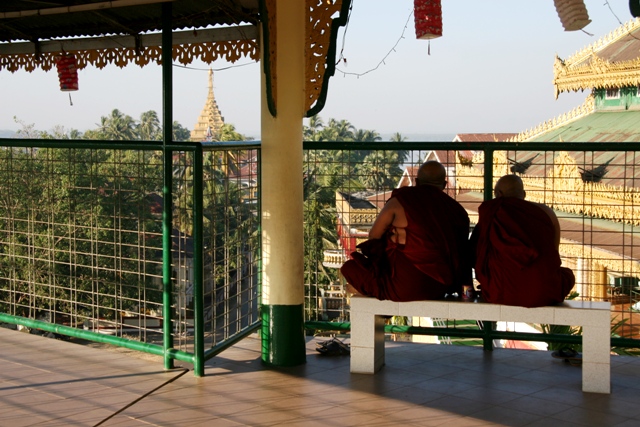
Watching the sun set over the sea from the viewpoint beneath the temple I met another old man who seemed delighted when I told him I was English. I am not sure if this was because he simply approved of my nationality or whether he was just pleased to have the opportunity to use the English he had learned long ago in school. Either way, the warmth seemed entirely genuine. ”It is a pleasure to see you here. I do hope we can meet here again”. (We did, the following day).
As previously mentioned, Kipling did not spend long in Moulmein – just enough time to pen his famous poem and take a fancy to a local beauty. The novelist George Orwell, on the other hand, had a far stronger relationship with the city. Orwell’s mother’s family came from Moulmein and it was also here that he underwent training with the Burma Police Force. This and subsequent Burmese experience would provide raw material for Burmese Days, his first novel and a damning account of British colonial life in which most of the colonial characters seems to be alcoholic, racist or both.
 Moulmein also provides the background for Orwell’s 1936 memoir Shooting an Elephant, a work that opens with the arresting line:
‘In Moulmein, in Lower Burma I was hated by large numbers of people – the only time in my life that I have been important enough for this to happen to me.’
 East of Elveden
Stourbridge Lion, thanks for liking my post. I am interested in your name as I was actually born in a town called Stourbridge on the edge of the English Black Country (West Midlands).
Moulmein is an incredible city-a living museum – I would like to see it placed on the UNESCO world heritage list.
Thank You. This helped my research into Orwell’s life and his development as a human being and writer
I would love to visit Moulmein. My 3 x great-grandmother was born there.