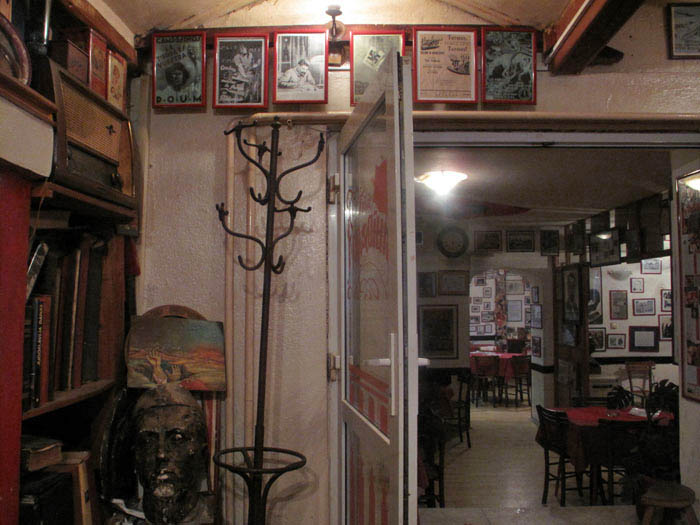
There is a bar in Belgrade called the World Traveller’s Club. It is in the basement of an apartment block in the city centre and to gain entrance you are required to ring the door bell at street level and state your business over the intercom. These days the club, which is alternatively known as the Federal Association of Globetrotters, is just one of many quirky bars in the city – homespun decor, art school daubings on the walls, miscellaneous furniture that includes Singer trestle sewing machines for tables, posters of iconic foreign destinations like Paris and Rome. The bar, as it proudly declares on its menu, was established in 1999. The date is significant.
In 1999 Belgrade was the capital of a land still known as Yugoslavia, a much depleted country that by that stage of the breakup consisted of just Serbia, Montenegro and Kosovo. Internationally, the country was considered as a pariah state thanks to the continuing ultra-nationalist regime of Slobodan Milošević. 1999 was also the year that NATO bombs fell on Belgrade and other Serbian cities. It was neither a good place to be nor somewhere that was easy to escape from – a Yugoslav passport, once a document that allowed easy access to both West and Eastern bloc, no longer held any currency. Such a document would get you nowhere.
It goes without saying that not everybody in Serbia was happy with Milošević’s stubborn and didactic rule. Most young people in Belgrade just wanted to do what young people did everywhere – live, love, make mistakes, have fun, travel. Many of these were still possible to some extent but travel was clearly out of the question. As a reaction to this difficult state of affairs a few people came together to create the World Traveller’s Club, a safe welcoming environment where people could meet to travel in their imagination if not in real space. Initially membership was by invitation only. These days anyone can visit although the bar’s original purpose no longer holds much significance other than a reminder of difficult times.
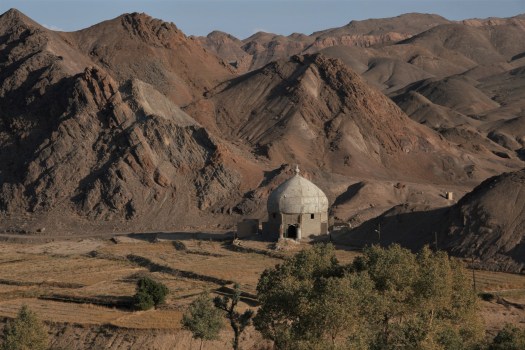
Turn the clock back thirty years, back to a time when foreign journeys required a wider leap of the imagination. In the pre-Internet age any inspiration for travel for its own sake was dependent on books, photographs and the anecdotes of others. In the 1970 film Performance, the Turner character, a reclusive rock star played by Mick Jagger as a caricatured version of himself, reads aloud from a Persian text, The Old Man of the Mountains. A postcard is displayed entitled The Mountains of Persia. Both text and image represent a sort of paradise – that which is unattainable, a dream destination for the two men thrown together in self-isolation in Turner’s Notting Hill Gate basement. Turner is living as a recluse, hiding from fame and perhaps the fear that his powers are diminishing; Chas, the James Fox character, is keeping a low profile to avoid the attention of fellow gangsters. The idealised mountains of Persia represent a sanctuary where both men might manage to escape their past lives.
The curtailment of free movement as in late 1990s Yugoslavia is hard to imagine these days. Many of us in the developed world take travel for granted almost as a birthright. This is especially true in an age in which jet travel is both cheap and easily available, and a journey, a holiday or even an off-the-peg adventure, can be booked with the click of a return key. Now, suddenly, in the light of a rapidly worsening pandemic, we need to think anew. We must accept that for a while at least, probably some considerable time, we are not going anywhere. Perhaps now is the time to form our own fraternities and sororities of imagined exploration? Any globetrotting must be virtual and digital. For the foreseeable future wanderlust is going to be just that, a lust for something unattainable. In this respect I am lucky I suppose. For a number of reasons, in recent years I have come round to thinking that it is just as fruitful to explore my own backyard as it is any exotic far-flung destination. I have grown weary of airports and the mechanical human processing that takes place, the tiresome, albeit necessary, security measures. As B. B. King sang of another sort of love affair, The Thrill Is Gone. The notion of ‘slow travel’ and all that it represents has for me become something that has gone beyond simply an attractive-sounding travel franchise. These days I really do prefer to slow down, to cover a smaller area, to discover the beauty of the local, to chart the quotidian. Less is undoubtedly more but that is easy to say for someone like me who already has the T-shirts, the passport stamps, the photographs, the anecdotes, the well-thumbed guidebooks on the shelves.
In the plague-year situation that the world now finds itself in to complain about restricted movement seems, at the very least, churlish. As we enter what seems like late capitalism’s final closing down sale (‘Everything Must Go!’) we have become, as the columnist Marina Warner has recently written, ‘a nation of shopfighters’. While shoppers squabble over toilet paper in supermarket aisles and some wealthier hoarders, like newly arrived Beaker folk mocking the simple ways of those who still rely on cupped hands, purchase additional freezers for the storage of their panic-shopped supplies, we should maybe reflect on what we (or, rather, some of us) have become. It is an opportunity perhaps to show a little more respect to the land that we walk upon, for the earth that feeds us; a little more kindness to those we share it with. For the time being we can just look out of the window and dream. At the other end of all this the mountains of Persia will still be there.
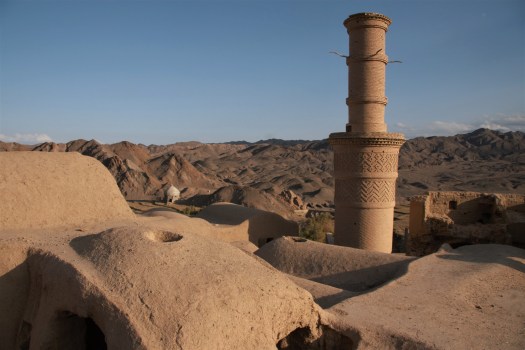
Photographs: Karakhanad, Yazd region, Iran 2008 ©Laurence Mitchell
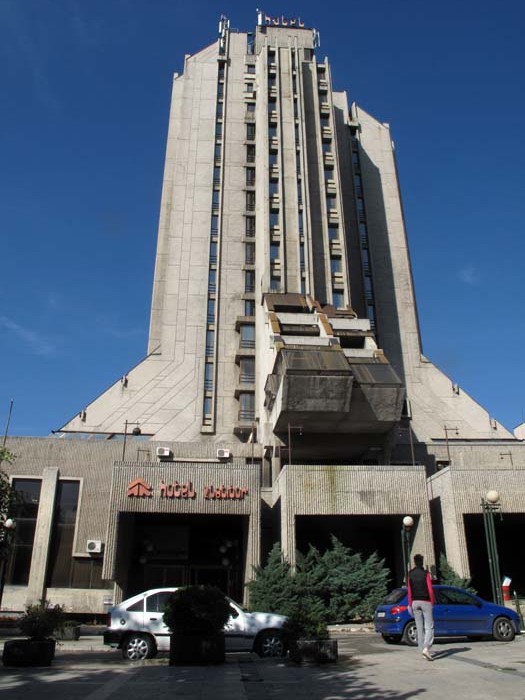
 The small city of Kruševac in south-central Serbia is probably best known for its fortress and 14th-century church, a fine example of the highly decorative Morava school. This was Prince Lazar’s capital in the late 14th century and it was from here that the Serbian army under the command of Prince Lazar set off to fight the ill-fated Battle of Kosovo in 1389. The Turks won yet it still took another 60 or so years for the city to fall under Ottoman control. Later on Kruševac became known as the ‘city of the sock-wearers (čarapani)’ because of an incident during the First National Uprising when Serbian rebels removed their boots to slip silently into town at night unheeded by the Turkish guards. Today Kruševac is an easy-going sort of place that, church aside, serves as a textbook case of Tito-era urban planning with its extensive use of concrete and scattered high-rises that loom like grey termite mounds over the city centre.
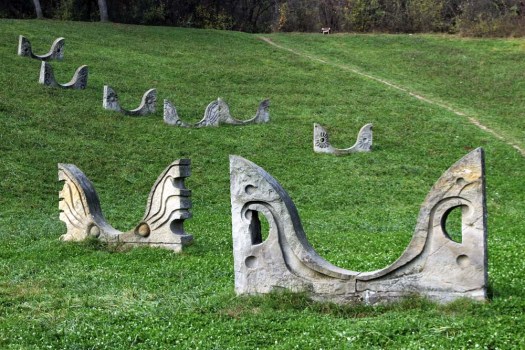
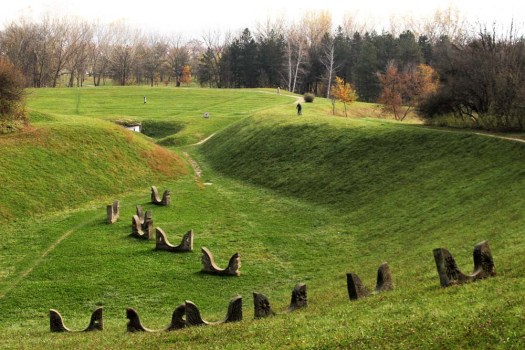
  This was my third visit in a decade and on this occasion I was prompted to seek out something that I had hitherto not even been aware of. A short distance out of town to the south lies a monument park dedicated to the victims of Nazi shootings during World War II. This was close to a former German prison camp and the scene of mass shootings between 1941—4, most especially in the summer of 1943 when over a thousand Serbs partisans and civilians were executed mostly by Bulgarian and Albanian troops. The Slobodište Memorial Complex, designed in the early 1960’s by architect, politician, one-time Belgrade mayor and anti-nationalist critic of Slobodan Milošević, Bogdan Bogdanović (1922—2010), occupies the same low hill just outside the city where the killings took place. The monuments of the complex serve as focus for a location already tainted with dark memory and collective suffering.
  The monument park is reached on foot by way of a route through Kruševac’s outskirts. The city edgeland arrives suddenly: a roundabout, a small airfield marked by a jet fighter on a plinth, an out-of-town retail hangar with supersized advertising depicting super-fit sportsmen. As elsewhere in Serbia, the edgeland is the realm of Roma – the poorest of the poor in this none-too-wealthy country – who, as always, are involved in the recycling business. Perpetually sorting through waste – paper, metal, plastic – skilfully assessing its value, their make-do shanty shelters seem barely separated from the middens of 21st-century detritus that they live among.
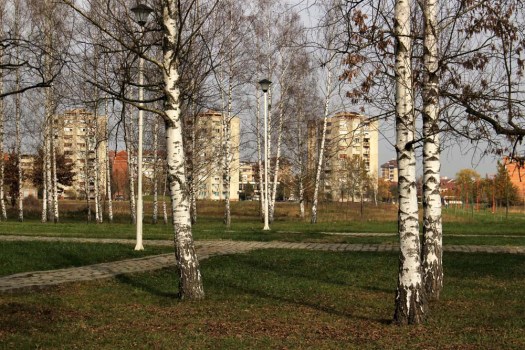
 At first there is nothing to see other than landscaped grassy mounds in the distance. Walking through a birch plantation I am entertained by the head-cracking antics of a Syrian woodpecker that hammers away remorselessly at a tree stump. Crows in all their variety – rooks, jackdaws, magpies and jays – call harshly, their voices like creaking tree trunks in a gale. I make for the grassy mound ahead and from the top can see a curved chain of stone sculptures stretched up the hollow of a hillside. The monuments resemble birds – owls to be precise – buried up to their beaks in the earth, but rising from rather than sinking down into it. They might also be angels. As I walk closer to investigate I notice a man with a bicycle at the top of the rise who is waving and beckoning to me. We manage some sort of rudimentary conversation using an inelegant polyglot mixture of German, Serbian and what might be Russian, and I learn that he lives locally in one of the housing estates that fringe the park and uses its pathways as a shortcut to the shops.
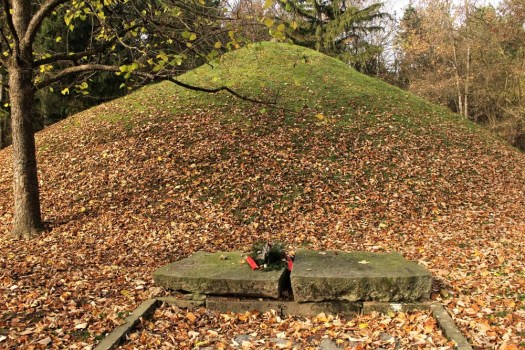
  Conversation, and commonality of language, exhausted the man cycles off and I turn round to trace the pathway back to its beginning. What is actually supposed to be the entrance to the memorial complex – the ‘Gate of the Sun’ – serves as my exit: an incomplete arch reminiscent of an Andy Goldsworthy dry-stone creation. Flanking the entrance just beyond this are two pyramidal mounds like Neolithic cairns. In front of each is a low stone funerary slab upon which rest wreaths and polythene-wrapped flowers. Whether or not these are actual burial mounds or merely a symbolical representation does not really seem to matter – this whole site is a memory field of death and the act of remembrance is the important thing. And remembered it is: memory is honoured; this site still holds melancholic charge for townsfolk and visitors alike despite its mundane use as a place for cycling, exercising and walking dogs.
 There is one more monument to see: the cenotaph. I find a curious, vaguely zoomorphic statue that brings to mind a Mayan glyph, or a totem – or perhaps another owl. It stands alone and inscrutable in front of some administrative offices that have been landscaped into the naturalistic contours of the park. Within one of the offices I spot a man working on a computer. I cannot decide whether I am envious of his workplace or not. No doubt it is peaceful enough tucked away in the folds of this green domain but the heft of dark memory weighs heavy here – a place to visit certainly but not one in which to repose.





 East of Elveden