Of Whales and Ancestors: Ostend, Norfolk

The very mention of the village of Happisburgh in Norfolk brings to mind all manner of prehistoric associations and connections with long-extinct ancestors. The early years of this current century have revealed exciting local evidence of the presence of earliest hominins in northwest Europe: Homo antecessor (‘Pioneer Man’) – near million-year-old clues in the form of flint tools and muddy footprints. Early humans walked these shores in the early Pleistocene, except it wasn’t so much a shore then as a river estuary: the Thames in an earlier incarnation when it flowed further north than its current course. Political boundaries were yet to exist, 800,000 years ago; the land mass that was Britain was still connected to Eurasia.
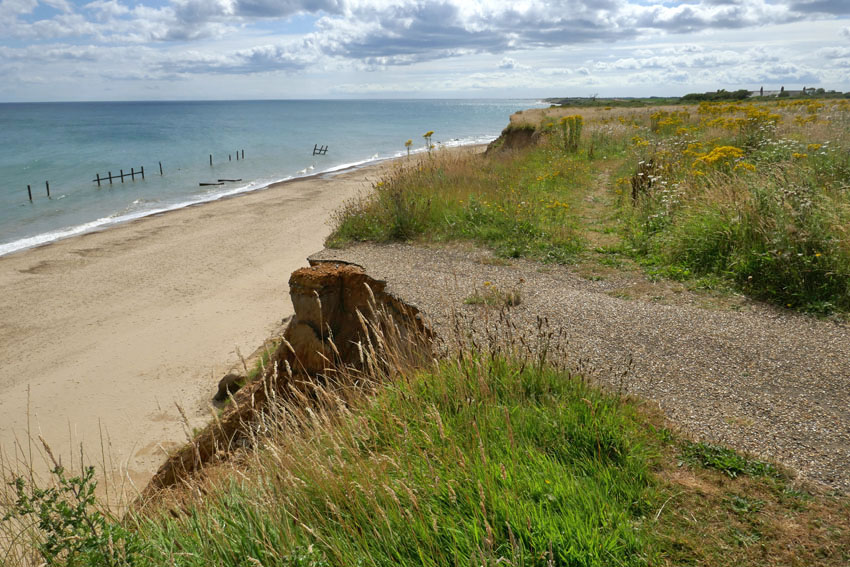
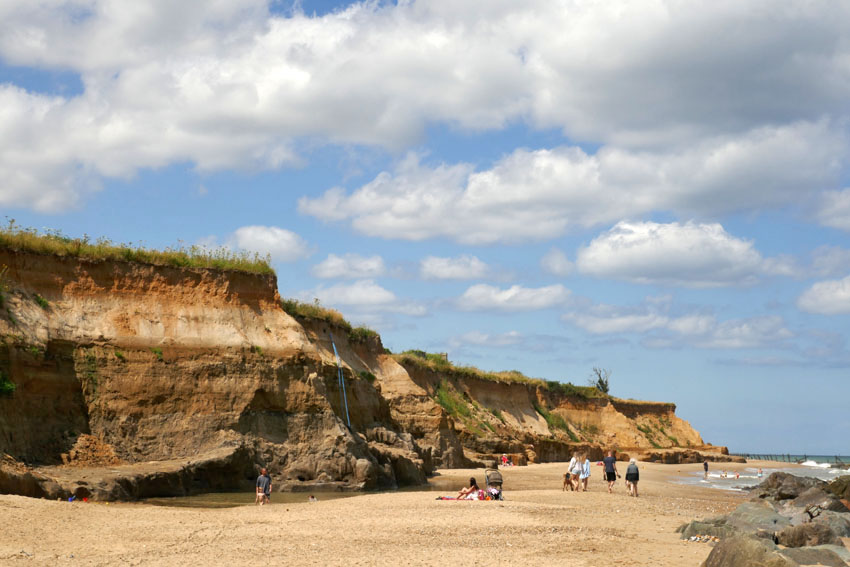
Prehistory aside, Happisburgh (pronounced ‘Haze-bruh’ to those who know) is also well known for other reasons. Its fame precedes it, although notoriety might be a better term. Nowhere on this coastline is the menace of coastal erosion witnessed more emphatically, although the near-vanished village of Dunwich on the Suffolk coast, once a thriving medieval port, might come close. For Dunwich the damage wreaked by the ever-invading North Sea is the past; in Happisburgh it is the present and future. Continually losing territory to the North Sea, there is visible evidence of the dynamic shifting shoreline to be seen everywhere here. Cliffs can be witnessed crumbling on a regular basis. Houses that were once located comfortably inland now perch perilously close to cliff edges; some have already succumbed and their remains litter the beach. Roads and tracks can be seen dramatically truncated along the cliff edge – streets that have become roads to nowhere, roads that lead to oblivion.

Even the village’s longstanding icons – the 15th-century St Mary’s church with its commandingly tall tower, the second highest in the county, and the equally imposing red-banded Trinity lighthouse built in 1790, Norfolk’s oldest – are both numbered in their days and probably won’t see this century out. The writing has been on the wall for a long time now – this northwest stretch of the Norfolk littoral is, after all, a fast-eroding coastline where such things can only be expected. Even so, the terrifying spectre of irreversible climate change does nothing but hasten the inevitable. Bold efforts have been made to ameliorate the threat: large chunks of alien geology have been transported here to be deposited on the beach – stone barriers to hold back the tide – yet somehow it feels like the wrong sort of folk tale: a village boy taking up a slingshot against a giant ogre, a near-futile King Cnut-like gesture.

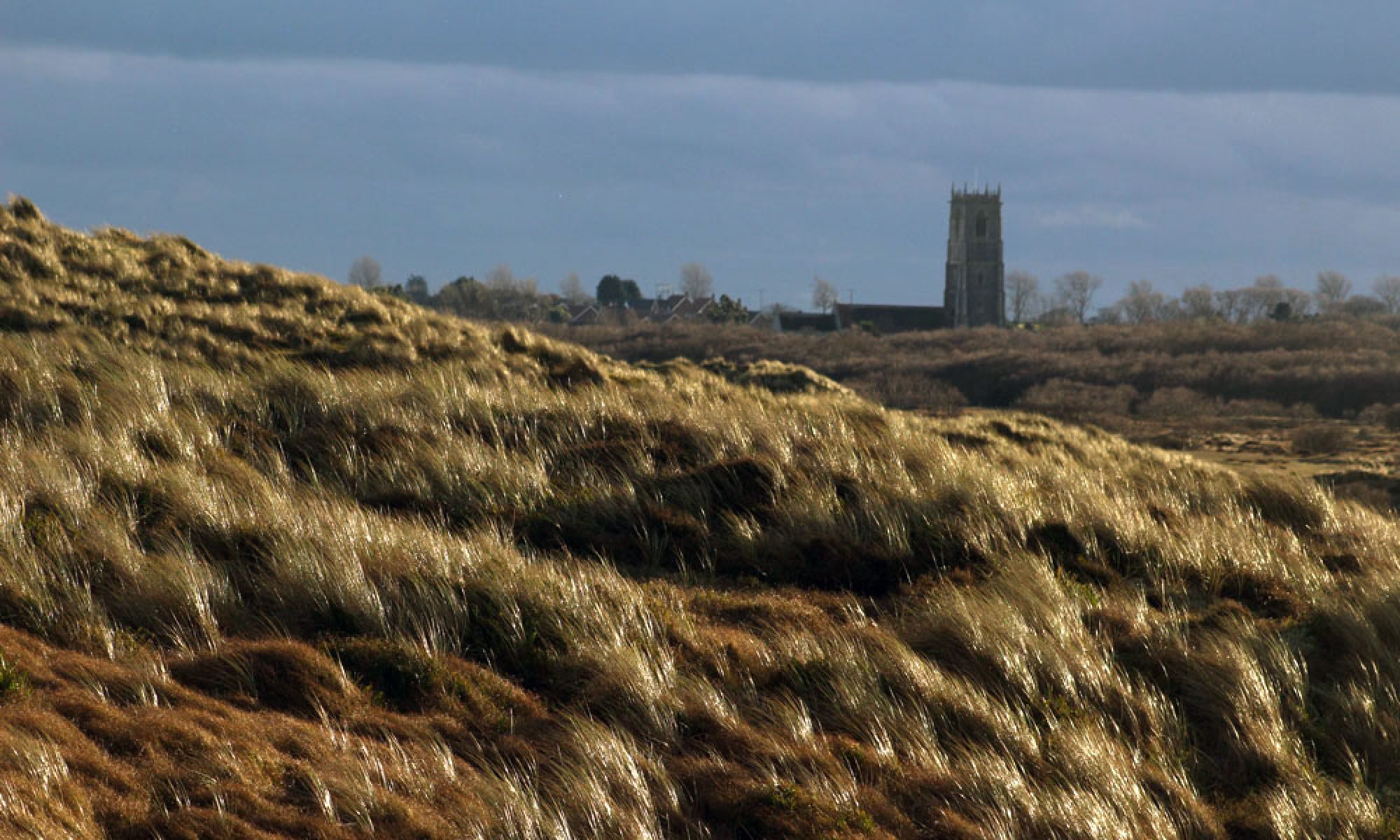
So, there is plenty to say about Happisburgh but what of Ostend, its immediate neighbour to the north? Walking the coast here recently in preparation for a new book on short walks in Norfolk, I tried to find out more about the small settlement that shares its name with the better known Belgian resort. Information was elusive, other than it belonged to the parish of Walcott and was effectively an area of holiday properties appended to the south of that village. The name intrigued me, though, and I wondered whether there was a historical connection as there are several Waterloo farms scattered around Norfolk that commemorate the final victory over Napoleon close to the Belgian town of that name. Until 2001, when it was finally demolished, there used to be an early 17th century house in the village was called Ostend House. There may possibly be a connection here but was it always called Ostend House, or did the name come with the rebuild that took place in the 19th century?

Looking further for information, Wikipedia informed me that in June 2002 a rare Cuvier’s beaked whale was stranded on the beach here. This was the same species of whale that Kathleen Jamie describes being on display in Bergen’s Whale Museum. The Bergen whale was found choked by plastic bags that the unfortunate animal had probably mistakenly recognised as squid, its prime food source. As I had only just (twice) read Jamie’s latest book Cairn,which describes her return visit to the Norwegian museum, there was an immediate connection for me here, although it was nothing to do with the name of the place.

The whale was named by the French scientist Georges Cuvier (1769—1832)*, a polymath who was the first to coin the term ‘extinction’. In 1796 Cuvier presented a paper to the National Institute of Science and Arts in Paris, where he compared the anatomy of living and fossil elephants to prove that extinction was a fact and proposed that the now-extinct elephants had been wiped out by periodic catastrophic flooding events. Although a proponent of catastrophism in geology, Cuvier rejected the idea of organic evolution. As an essentialist he believed that plants and animals were created for particular roles and niches in the world environment and subsequently remained unchanged throughout their existence. In Cuvier’s thinking, as soon as one species became extinct as the result of geological upheaval, another would be divinely created to replace it. It would be Charles Darwin, of course, who would set the record straight some 65 years later with the publication of his On the Origin of Species. What Darwin would have made of the 21st-century discovery of evidence of a long-extinct ancestor, Homo antecessor, on a sea-battered English shoreline we can only imagine. Evolution to extinction: such a surprisingly short distance of time and space linking the two.

*[Alas, Cuvier’s name has also been linked with scientific racism, although we might excuse him for being, as the cliché goes, ‘a man of his time’. Of course, modern-day racists should not be forgiven in the same way – they are not men (or women) of their time. We might, I suppose, call them dinosaurs but to do that would be a disservice to palaeontology.]
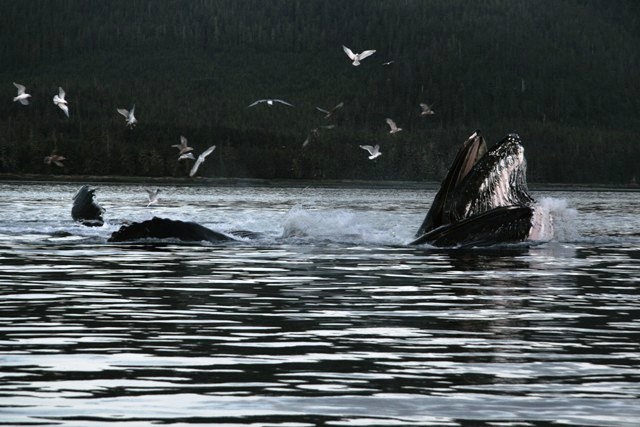
Blowing bubbles in the Clarence Strait

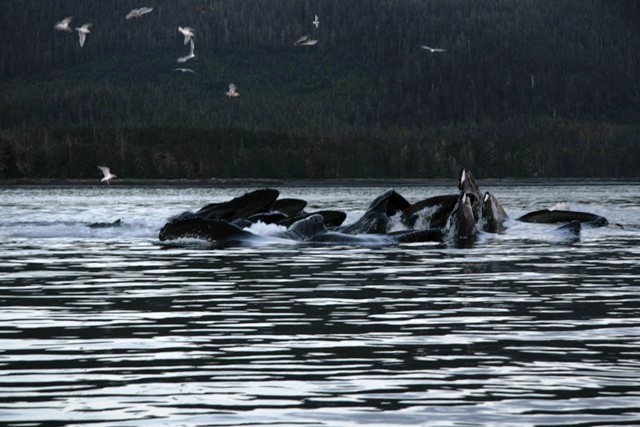
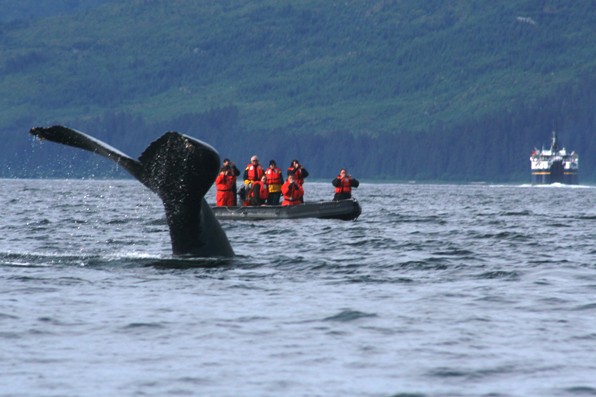
After Petersburg, a squeeze through the self-explanatory Wrangell Narrows took us south into the Clarence Strait, prime hump-backed whale territory. A group of hump-backs were soon spotted off the stern and we took skiffs out for a closer inspection. We had seen a number of them a couple of days earlier in Glacier Bay, but not like this.  Here, a group of ten or more were ‘bubble-netting’ for herring. This rare co-operative feeding behaviour involves a group of whales diving deep and producing bubbles from their blow-holes to create an underwater curtain of bubbles that traps the small fish that the whales feed on. Herrings hate bubbles and will do all they can to avoid passing through them and so what the cunning whales do is  to create a net of them that traps the disoriented fish before they rise en masse to the surface with mouths agape to scoop them up. Gulls – Bonaparte’s Gulls mostly, I think – take advantage too, grabbing those fish that manage to escape the whales’ enormous gaping jaws. In fact, it is excited gulls that tend to give away the location of the any imminent bubble net. It is a magnificent spectacle: ten 50 foot whales all hitting the surface together is an unforgettable, quite humbling sight; a phenomenon that gives new meaning to the term awe-inspiring. In less than an hour, we saw it happen four or five times

Southeast Alaska’s Clarence Strait, west of Prince of Wales Island, is one of the best locations to see this behaviour. Nevertheless, it is still very rare. Karl, our guide, reckoned that of, say, 25,000 hump-backed whales in the North Pacific maybe just 100 practised bubble-netting in groups like this. It has only ever been observed in southeast Alaska. We had just seen 10% of the world’s cetacean elite doing this very thing – a rare privilege indeed.

Petersburg

Petersburg. No, not that one – this Petersburg is in the Alaska panhandle, south of Juneau, north of Ketchikan. This is the first time in a week there has been any phone signal or internet access; the first time since leaving Juneau almost a week ago that there has been any sort of town in fact. Petersburg is named after its Norwegian founder Peter Buschmann who settled here just over a century ago to found a fish canning business. The town still has a Scandinavian character, with Norwegian-style rose-mailing prettifying its streets.

The Alaska Inner Passage cruise began in Juneau last Friday. Getting to Juneau was fun – taking 34 hours of travel time between leaving my front door in Norwich and checking in seriously jet-lagged at the hotel in Juneau. Three flights, one overnight coach journey, a long layover in Anchorage and at least of couple of hours sitting on runways awaiting permission to take off. The biggest chunk of the travel was the flight between Frankfurt to Anchorage, which instead of flying west across the Atlantic as you might expect, headed almost due north into the Arctic Circle and arced west close to the pole. It is, after all, a three dimensional world and flight routes don’t necessarily follow Mercator’s projection. Flying non-stop Frankfurt to Anchorage takes 9½ hours and because of time zone changes you arrive in Alaska thirty minutes before you left. But, if this was the secret of eternal youth then it certainly did not feel like it.

We flew over Denmark, southern Norway and then the North Sea before curving west over the northern edge of Greenland and the Canadian Arctic to hit the north Alaska coast and pass over the Denali National Park before our descent to Anchorage. Just north of Bergen, the cloud lifted to reveal the glimmering sea beneath us, with little flecks of white that I thought might be fishing boats…or whales. Is it possible to see fishing boats from 36,000 feet up? Like a living atlas unfolding, under the clear blue skies of northern Greenland it was easy to see where solid rock gave way to the pack ice of the North Pole – nothing but mountains, ridges, snow, ice and water beneath. Halfway across Alaska we flew right alongside the peak of Mount McKinley, which loomed proud above the clouds, the highest mountain in the USA, before descending over glorious golden lake country down into Anchorage. I like to think that I saw my first Alaskan bear on the final descent – it may well have just been a rock but it is perfectly feasible.

Once US immigration decided that I was respectable enough to enter their country there was a whole afternoon to kill in Anchorage. I took the local bus into town – a modest grid of low rises against an impressive mountain backdrop, with a handful of shops selling tacky souvenirs in the city centre that advertised their presence with stuffed grizzlies on the sidewalk. These were not the bears I fancied I had seen from the air. The city has something of a frontier feel about it, with small clutches of native Alaskan drunks and shifty-eyed men with baseball caps and ZZ Top beards. A surprising number of blacks and Hispanics too – but perhaps it was my use of public transport that skewed this impression. Public transport in the US tends to be mostly the preserve of the poor and disadvantaged.

Where Anchorage was fairly humdrum, Juneau was pretty and quaint, with wooden houses climbing up steep streets beneath tall bluffs. Anchorage may have been a place that shot and stuffed its bears but Juneau, with its liberal nurturing atmosphere, was a town that seemed more likely to cherish them. Juneau was wet too, pouring that first night with pounding rain that looked as if it would never stop. Thankfully, it did, and the rain was followed by four days of glorious Indian summer sunshine – ‘a bluebird summer’ as they say here.

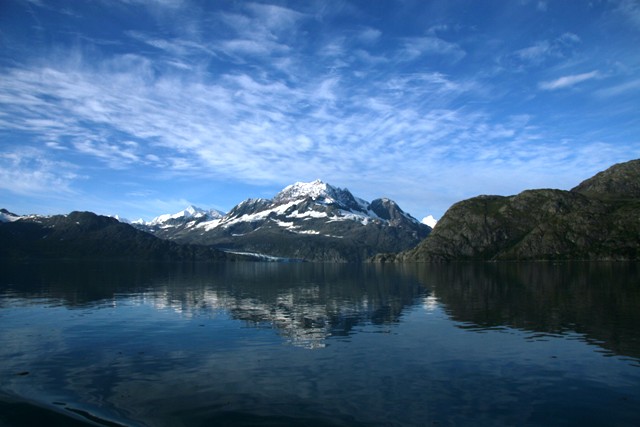
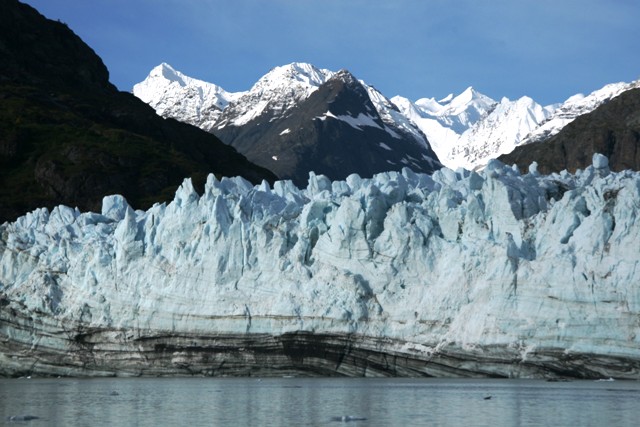
Since embarking at Juneau last Friday I have experienced the whole gamut of classic southeast Alaska experience: walking in temperate rainforests thick with velvety moss; hikes alongside waterfalls and even on glaciers like that at Baird Glacier yesterday afternoon. There have been hot springs and bald eagles; sea lions, countless orcas and hump-backed whales – one even appeared blowing a steamy plume whilst we were out paddling kayaks. There have been bears too – some black but mostly brown – and a couple of close (but not too close) encounters at forest streams and on beaches where they greedily snatch up migrating salmon from the mouths as streams as easily and as casually as if they were picking flowers.