Another Place

IMG_5282

To reach Another Place you have to start in Liverpool. At least that is what we did, taking a Crosby-bound number 53 bus from the city’s Queen Square terminus. Leaving the Victorian magnificence of the city centre behind, the route leads through the edgelands of north Liverpool, in sight of huge abandoned red-brick warehouses that fringe the wide silver Mersey below. Away from the revitalised city centre and the heritage revamping of Albert Dock, this is a zone of substandard housing and broken dreams; a place where most of the pubs are boarded up and semi-ruined now that the dockers who once would have drank in them no longer have wage packets to fritter. The whole area seems partly abandoned to buddleia and the memory of better days although, here and there, like red-brick phoenixes, are signs of identikit housing development: new-build semi-detached homes with small gardens and big aspirations.

IMG_5244

Things seem to degenerate at the southern fringe of Bootle where the principal pub lacks not only clientele but also a roof. Narrow Victorian terrace streets slope away from the main road, their grim countenance softened by the names of flowers: Daisy Street, Woodbine Street, Harebell Street, and even a Pansy Street, which is perhaps a problematic address for a burly Scouse docker. After passing through Bootle, whose main centre of social interaction appears to be a bar located in the lower storey of a massive concrete complex that looks like it has been transported wholesale from Bratislava or New Belgrade, things start to look up, socio-economically speaking. Waterloo, where we alight next to the Merseyrail station seems altogether more prosperous, with a handful of smart cafes and a long marine parade of white-painted houses equipped with dormer windows to peer over the dunes to the beach and sea beyond.
IMG_5212

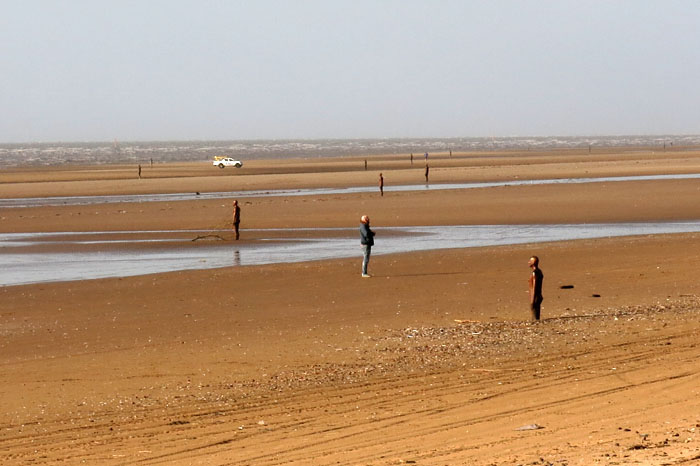
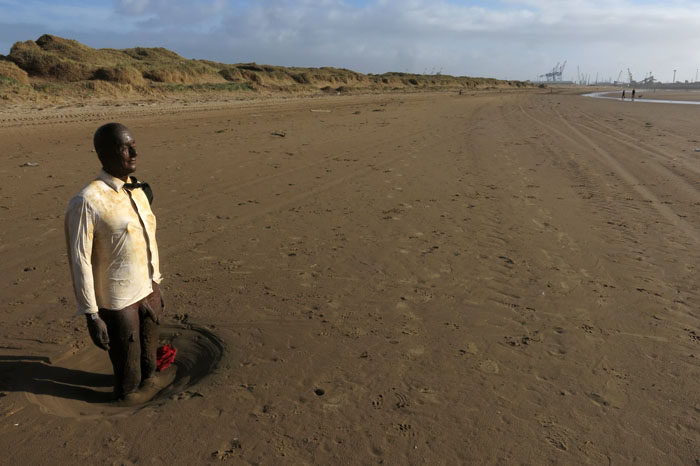
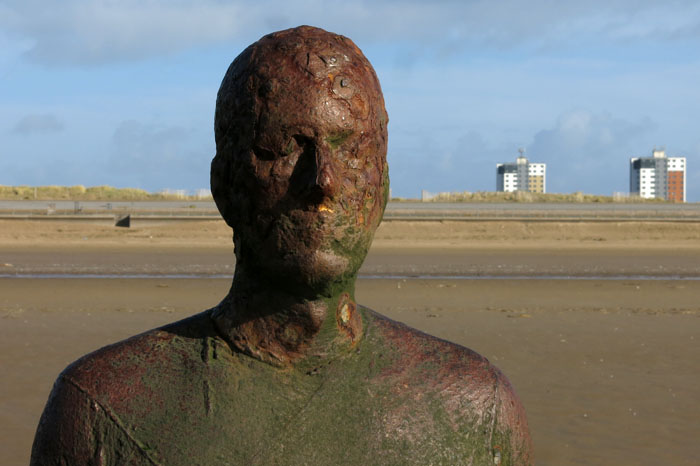
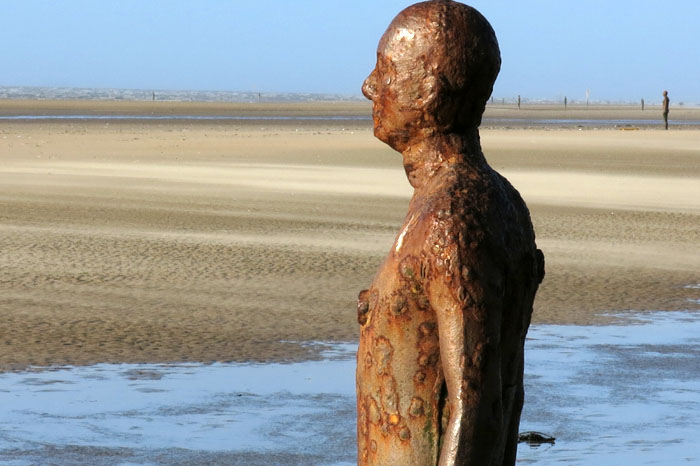
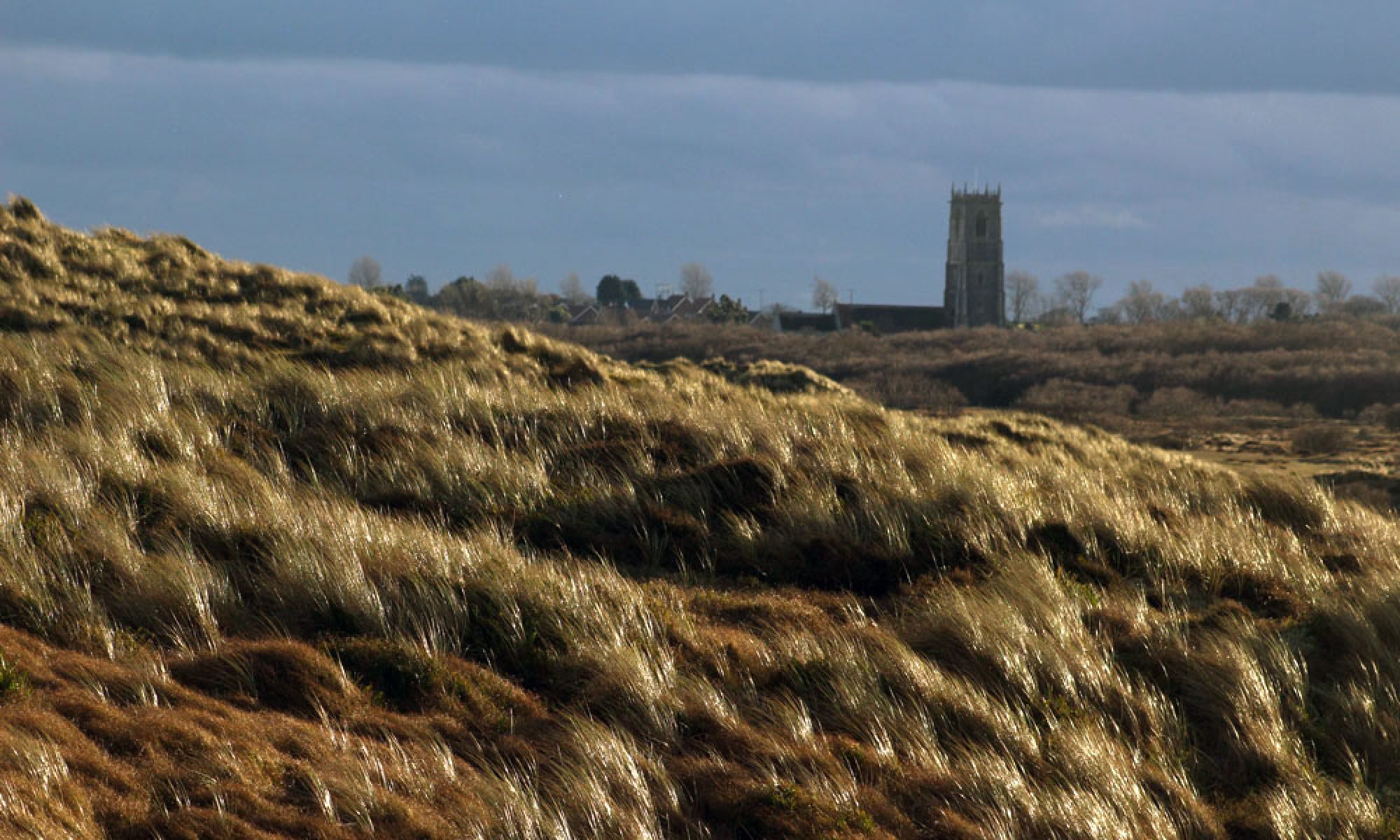
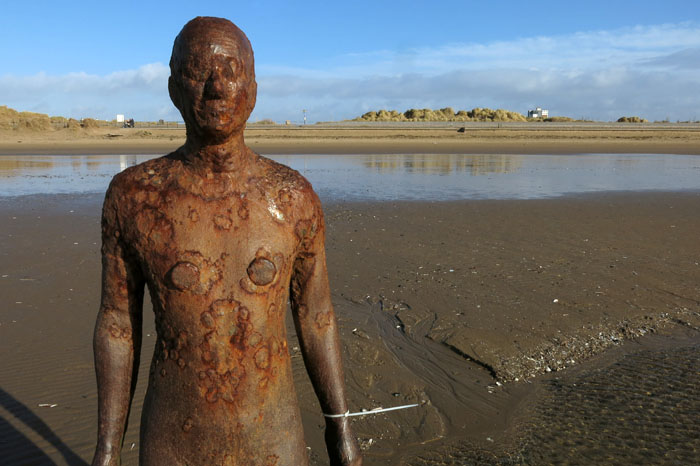
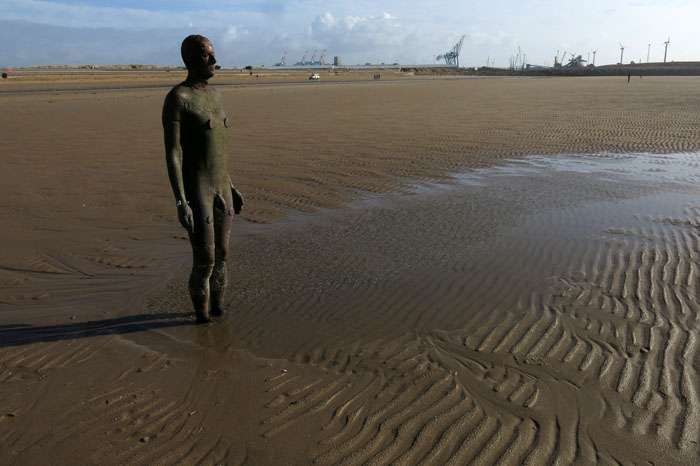
At the end of South Road, the road gives way to a track past a man-made lake behind sand dunes. Oyster catchers, gulls and ducks have taken refuge here and have arranged themselves in tightly-packed groups to brace against the bitterly cold north-westerly wind blowing across the Irish Sea. Climbing slightly to reach the dunes and a coast path, the beach and sea are revealed. As are several of the one hundred life-sized cast iron sculptures that dot the foreshore here between Waterloo and Blundellsands, and which constitute the Antony Gormley landscape installation that is Another Place (although here they are more prosaically referred to as simply ‘The Iron Men’). It is a bright, if brutally windy, afternoon and there a few people about, strolling on the beach, walking their dogs, weaving nonchalantly between the iron men that punctuate the beach like sentinels.IMG_5249

IMG_5182

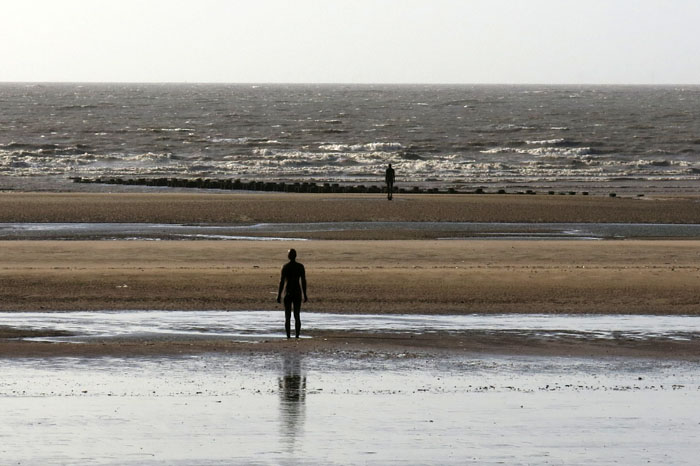
The Gormley figures (modelled on the artist himself) stretch as far as the eye can see, each one staring out to sea isolated from the others: a statement on the human condition that refutes the John Donne position that ‘no man is an island’. Here, it would appear, every man is. The beauty of the figures is that, seen from afar, it is sometimes hard to distinguish those which are iron from those which are human. Covered and uncovered by each successive tide, the installation clearly points towards the relationship that exists between man and nature. Perhaps, silhouetted against the backdrop of Liverpool Dock’s cranes, it also alludes to the historical connection that links man and the seafaring trade in these parts?IMG_5177IMG_5326IMG_5260IMG_5259
IMG_5265

The Tarka Trail

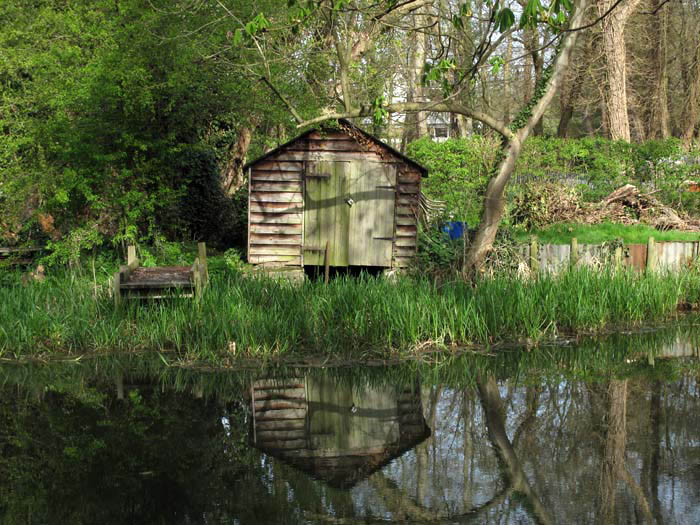
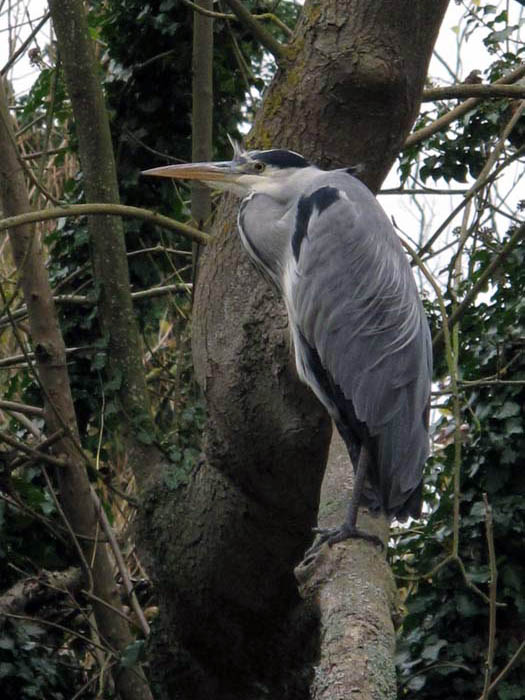
There’s a walk through Norwich’s western edgeland that Jackie and I must have done a hundred times. It begins close to a supermarket at Eaton, Norwich’s wealthy southern suburb, and follows the bank of the meandering River Yare upstream towards the broad at the University of East Anglia before the river veers west towards its central Norfolk source. A peaceful walk, frequented by just the odd suburban dog-walker and jogger, it is the epitome of the countryside in the city or, rather, its leafy urban fringe. Drooping willows frame the water, small fish swim, birds tweet in the bushes and reedbeds; herons and kingfishers are regularly sighted along the river. The houses on the opposite bank, with their expansive back gardens and private river frontage, give rise to occasional bouts of envy but on the whole we are simply happy to have the opportunity to walk somewhere like this so close to home.

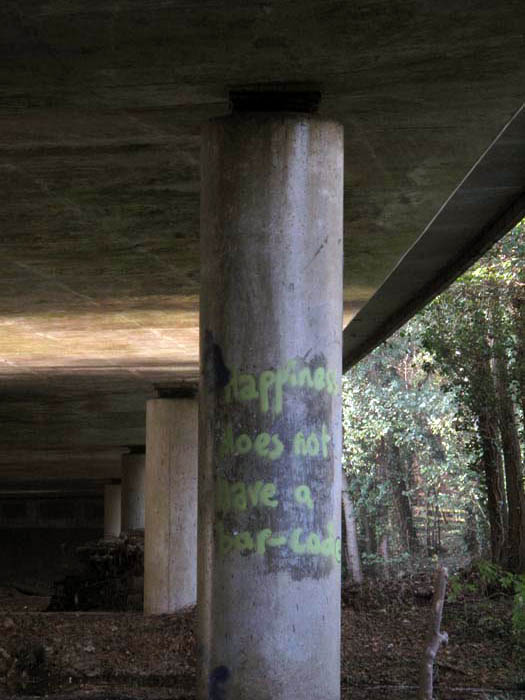
From the car park where the walk begins, a path leads to the river next to the medieval bridge that once marked the principal route into Norwich from the south. There is an attractive white wooden mill house here, a gushing weir and a NO FISHING sign. The path follows the river under a flyover that carries the bulk of traffic into the city these days – at weekends, a constant buzz of cars speeding into Norwich for retail therapy. Compared to the fine curves and warm sandstone of the nearby bridge, this has all the charm of a multi-storey car park: quotidian concrete and murky, permanently shaded water sheltering that ubiquitous creature of the urban waterway – a supermarket shopping trolley. A Ballardian microcosm, this edgeland non-place provokes an interruption in the pastoral flow of the walk; a frontier to be crossed (or underpassed) before continuing along the riverbank beyond. The smooth round pillars that hold up the flyover are splattered with spray-can ciphers – warnings and portents perhaps? A couple spell out ANARCHY, or words to that effect. Another graffito, more considered, pronounces HAPPINESS DOES NOT HAVE A BAR-CODE.

On Monday, our walk took an unexpected and delightful turn when we spotted a solitary otter at the mill pond near the bridge. Oblivious to the sign prohibiting fishing, the animal was busy hunting – diving and then resurfacing with just its head showing above the water like a small sleek Labrador. We knew that otters were frequently seen in the area by early-worm fishermen but we had never seen one here ourselves. This time, we were privileged. We watched in silence as the animal worked its way along the water’s edge, shaking the reeds at their base and leaving tell-tale trails of bubbles as it swam underwater. It eventually disappeared somewhere near the weir, just before the flyover, and we remarked on how lucky we had been to have had such a good view.

Five minutes later, I was just about to say something sagacious like, ‘It could be a year before we see one again’, when another otter –  probably the same, earlier one displaced further upstream – surfaced beneath a drooping willow. The animal progressed through the reeds at the river’s edge for some time before swimming to the opposite bank, foraging there awhile before returning midstream to dive once more with an effortless flex of its back. We followed it upstream for a full half hour, the otter hyperactive for most of the time – diving for fish, snuffling through vegetation, occasionally sneaking a look back at the two humans and one small dog that were politely in pursuit. We drew so close that we could hear teeth crunching bone as the animal munched the fish it had caught, the otter’s noisy chewing just one aural ingredient in a soundscape that included other familiar echos of the urban fringe in May: small birds chirruping, an overenthusiastic cuckoo (the first heard of the year), chiffchaffs chiff-chaffing, a background thrum of cars on the flyover and the distant eye-ore of the Cambridge train’s air-horn.

We lost track of the otter somewhere in the wider stretch of the river that leads to UEA Broad. It did not matter: our unexpected encounter had been far in excess of anything than we might have hoped for. It didn’t even matter that I did not have my camera with me: if anything, it was liberating to simply observe without the nagging distraction of having to keep a digital record.

Walking back to the car park, I made a short diversion back to the bridge on the off chance that the animal had returned there. No sign. Turning to leave, a metallic blue bullet flashed close to the water and darted beneath the arch of the medieval bridge: a kingfisher, often spotted here but hitherto unseen on this red letter day for wildlife. Happiness does not have a bar-code. True enough.