 On a dismal February afternoon in Norwich, taking a walk is done as much for exercise as it is for any other more worthy or creative reason. The raw, grey day makes the city seem gloomy, uninviting even, but at least it is an opportunity to leave the house for a while and check if the world is still turning. Uncertain where to go – whether to explore new streets or let my feet follow repeated steps – I choose to follow a familiar route: down to the river then eastwards, crisscrossing by bridges the fluvial divide that separates the city’s southern half from Norwich Over the Water, its Anglo-Saxon core.
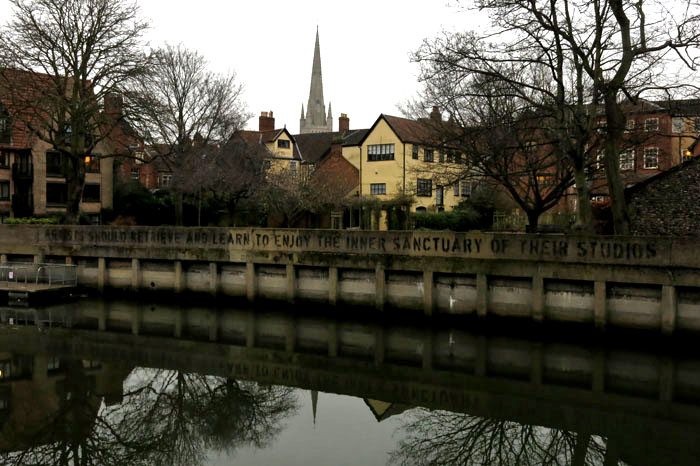
 Low cloud and a dull pewter sky has already put a lid on what remains of the day. The thin gruel that is the late winter light seems to be sucked in by the black river water with just a ghost of a reflection. Such paucity of photons means that serious photography is out of the question. I venture past the Norwich School of Art where brightly lit Victorian windows silhouette busy students in the act of creation – painting, sketching, etching, shaping, cutting and pasting in earnest. On the river wall, a little further on, a legend is stencilled in bold upper case: ARTISTS SHOULD RETRIEVE AND LEARN TO ENJOY THE INNER SANCTUARY OF THEIR STUDIOS. Whether a piece of work itself or merely a well-placed instruction to would-be artists in unclear, but it seems like sound advice. Either way, there’s an avuncular tone to the words that suggests a concern about privilege and responsibility.
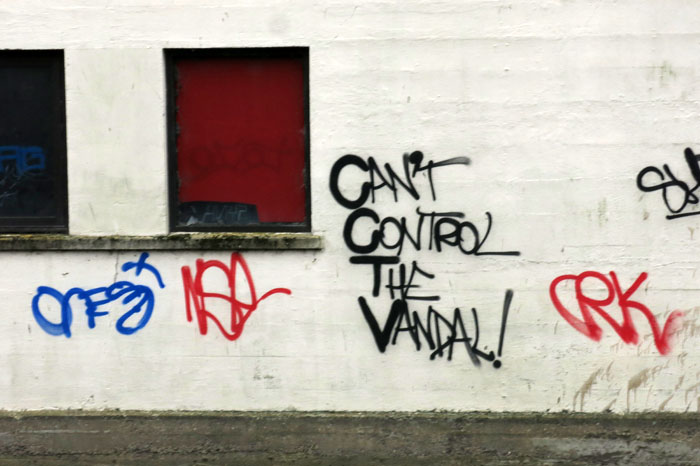
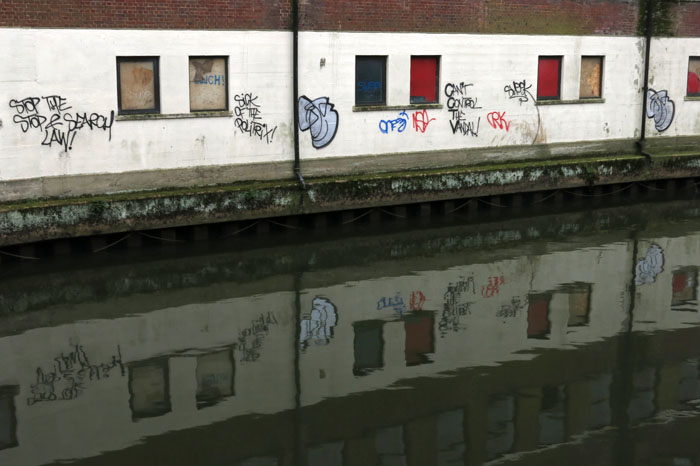 Further west along the river I had already witnessed daubing of a more untutored stripe: a graffito that taunted the efficacy of urban CCTV with the ironic legend: CAN’T CONTROL THE VANDAL, its capital letters redefining the acronym, alongside an anarchist declaration of SICK OF THE POLITRIX! This is both social comment and poetry of a sort. Mostly though, the urban graffiti is not political or culture-busting but just simple tagging – guerrilla spray painting that derives from some atavistic urge to mark territories and serves much the same purpose as a dog’s instinctive leg-cocking.
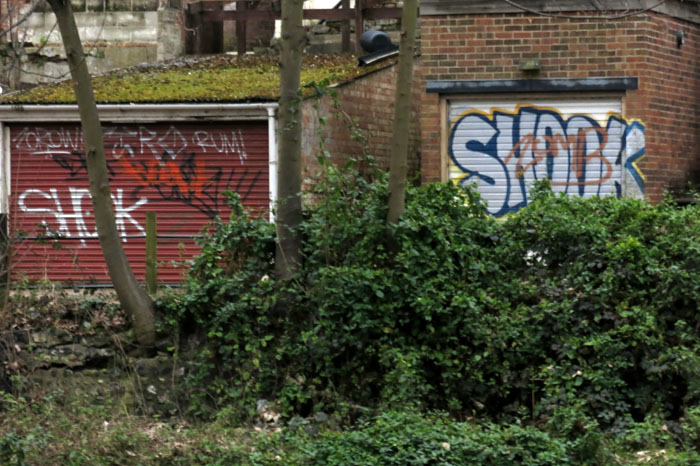 One of the most ubiquitous taggers is ‘Shook’, who if nothing else certainly gets around. Shook’s five-letter cipher can be seen all over the city – north and south, east and west, on walls and bridges, on fences and lampposts. I suspect that Shook has a bicycle. Or perhaps even a rail pass – I once even saw his tag on a wall approaching Cambridge station, well outside his usual homeboy patch. Shook, although enthusiastic and clearly determined, is no Banksy. True, he has no sanctuary to enjoy – the streets are his studio – but I wish he (I can only presume his gender) would exercise a little more imagination and realise that mere territoriality is not the be-all and end-all. Shook, it’s time to raise your game.

 Beyond the printing works, a
 East of Elveden