North-South divide?

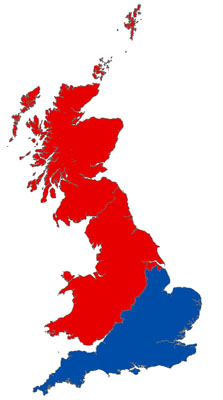
Back in 2007, Danny Dorling of the University of Sheffield wrote a piece on the nature and geographical extent of the so-called North-South divide in Britain. This was nothing new: as most of us already knew, the north-south socio-economic divide was not simply a matter of drawing a horizontal line through Watford, nor was it a case of delineating the southern boundaries of Yorkshire, Lancashire and Cheshire. Rather, it was more complex – a meandering line between the River Severn to the southwest and the Humber to the northeast.

According to Professor Dorling, the transition from north to south is not as gradual as one might expect, and shows little sign of that psychogeographic favourite, a borderline ‘zone of liminality’. The imagined divide is, in fact, a fractal line sharply defined by all manner of factors – voting patterns, house prices, wealth, health (average life expectancy is a year less north of the line), life chances, Oxbridge university access, language – particularly vowel sounds – and even preferences for flat or sparkled beer. Of course, the line roughly follows distinct features of physical geography too – the division between upland and lowland Britain, and pastoral and arable farming – features that have stongly influenced British history and culture. The divide also delineates the territory colonised by Saxon invaders and follows uncannily close to the route traced by the Roman Fosse Way.

I was reminded of this theoretical divide twice this week. First, by an article in the Big Issue written by Professor Dorling to accompany a feature on George Orwell and then by a BBC Radio 4 programme, the second part of a documentary called North and South: Across the Great Divide presented by Ian Marchant, in which the writer travelled to various places either side of this imaginary line to investigate what local people thought of the notion.

What was pleasing was that Marchant looked closely at some of my own old stomping grounds. I was born in Stourbridge in the West Midlands and grew up in Redditch, a small town just north of the divide that became a new (and suddenly much larger) town just before I left (and which earned the dubious honour of once being dubbed ‘the most boring place in the known universe’). Marchant interviewed people in Henley-in-Arden, a posh, leafy Tudor-beamed town that lies just south of Redditch across the north-south frontier in Warwickshire. The view of the Henleyites was that people from Redditch tended to be more common, while that of the Redditchers was that they would love to live in Henley given half the chance but they simply could not afford to. Hardly groundbreaking stuff but, certainly, growing up in workaday Redditch, places like Henley – and Stratford upon Avon and Warwick – did seem to belong to another, altogether more glamorous world despite their relative proximity. But then, so did Worcester (which actually lies north of the line) and even some parts of Birmingham.

If this north-south orientation is correct then, having journeyed east and slightly north in adult life to move to Norwich from the West Midlands, I have actually crossed the divide – the Tudor line, as Dorling sometimes calls it – southwards. A geographical paradox perhaps – West Midlands to East Anglia, sort of north to kind of south. I still say bath not ‘barth’ but, there again, I do prefer my ale unsparkled.

Marchant ended the program in Gloucestershire’s Forest of Dean, a small but very distinct enclave, squeezed between the Severn and Wye, which stands at the most southerly ‘northern’ point of this cultural divide. I used to know this area quite well and was always impressed by its strong sense of place, wilful isolationism and warm-hearted yet tough natives. To me it always seemed somehow closer to the spirit of South Wales than to the rest of Gloucestershire. Despite having the same latitude as Watford, with working-class forestry and mining traditions, and hardly a trace of tweeness in its villages, there are plenty of stereotypical ‘northern’ characteristics on display here. The ‘Forest’, as natives always call it,  really does seem a very different place compared to the opulent sandstone villages of the Gloucestershire Cotswolds just across the River Severn.

In essence, the BBC4 programme is as much about social class as it is about geography but it raises some interesting points. You can listen again here. For a very different point of view, you can read what Simon Jenkins makes of Dorling’s analysis here. The fact that he scathingly dismisses the Sheffield professor as ‘geographer royal by appointment to the left’ might give you some idea as to what to expect.
Patience (After Sebald) – Walking The Rings of Saturn

About a year ago I wrote a post about an Aldeburgh Music weekend at Suffolk’s Snape Maltings that celebrated the life and works of the writer W G Sebald. A new film by Grant Gee, Patience (After Sebald), was also previewed on that occasion but it has taken a full year for it to have been finally been put out on general release in the UK. After such a long wait, ‘Patience’ might seem a wholly appropriate choice for a title but I finally got the chance to see the film last Sunday at a sell-out screening at Cinema City, Norwich.

The film is based on what is probably Sebald’s best known work, The Rings of Saturn, which  describes a long meditative walk in the Suffolk coastal region. In German translation the book is subtitled ‘Eine Englische Wollfahrt – an English pilgrimage’, but this is misleading as The Rings of Saturn is not really about pilgrimage at all, nor is it a work that concerns itself that much with landscape, although the shingle and wide skies of coastal Suffolk do make a cameo appearance.

Although genres such as travel, history and memoir are appropriate up to a point, The Rings of Saturn is a work that boldly defies categorisation and which cannot easily be placed into any single literary pigeonhole. Sebald’s Suffolk odyssey is really as much an internal journey through one man’s mind as anything else. Far from the normal notion of travelogue, The Rings of Saturn is more a psychogeographic exploration of one corner of East Anglia. Certainly, the physical geography here is spectral, a melancholic landscape of ghosts, personal reflection and dark cultural memory. The term ‘Proustian’ might be used to define Sebald’s style to some extent but a better word would be Sebaldian: W G Sebald is one of those rare writers, like Dickens, Kafka and Ballard, whose name can be confidentally used as an adjective thanks to a distinctive mournful style and typically digressive, fragmentary narrative.

Part of the Sebaldian trope is to include images – black and white photos and line drawings – as part of the narrative flow; images, sometimes unsettling, that are tangential to the geography of the walk yet central to the narrative’s solipsistic digressions. Many of the book’s already familiar images are replicated in Patience (After Sebald), serving as a backdrop for talking heads like Robert Macfarlane, Iain Sinclair and Andrew Motion who have been recruited among others to give their personal take on Sebald’s oevre. Other images on display in the film are immediately resonant to those who have read The Rings of Saturn even though they do not appear as photographs within the pages of the book itself. A brief glimpse of a naked couple lying on a beach clearly represents the lovers that Sebald stumbled upon at Covehithe and, panicking, described as ‘like some giant mollusc washed ashore… a many-limbed, two-headed monster’. A shot of a distressed-looking plate of food undoubtedly refers to the joyless pub meal taken by the author in Lowestoft, which contained a fish that had ‘doubtless lain entombed in the deep-freeze for years’ along with tartare sauce ‘turned grey by sooty breadcrumbs’. Apart from an occasional colour inset frame showing a walker’s boots on the tarmac (the film-maker himself perhaps?), the images used are monochrome throughout, as grey as Sebaldian tartare sauce.

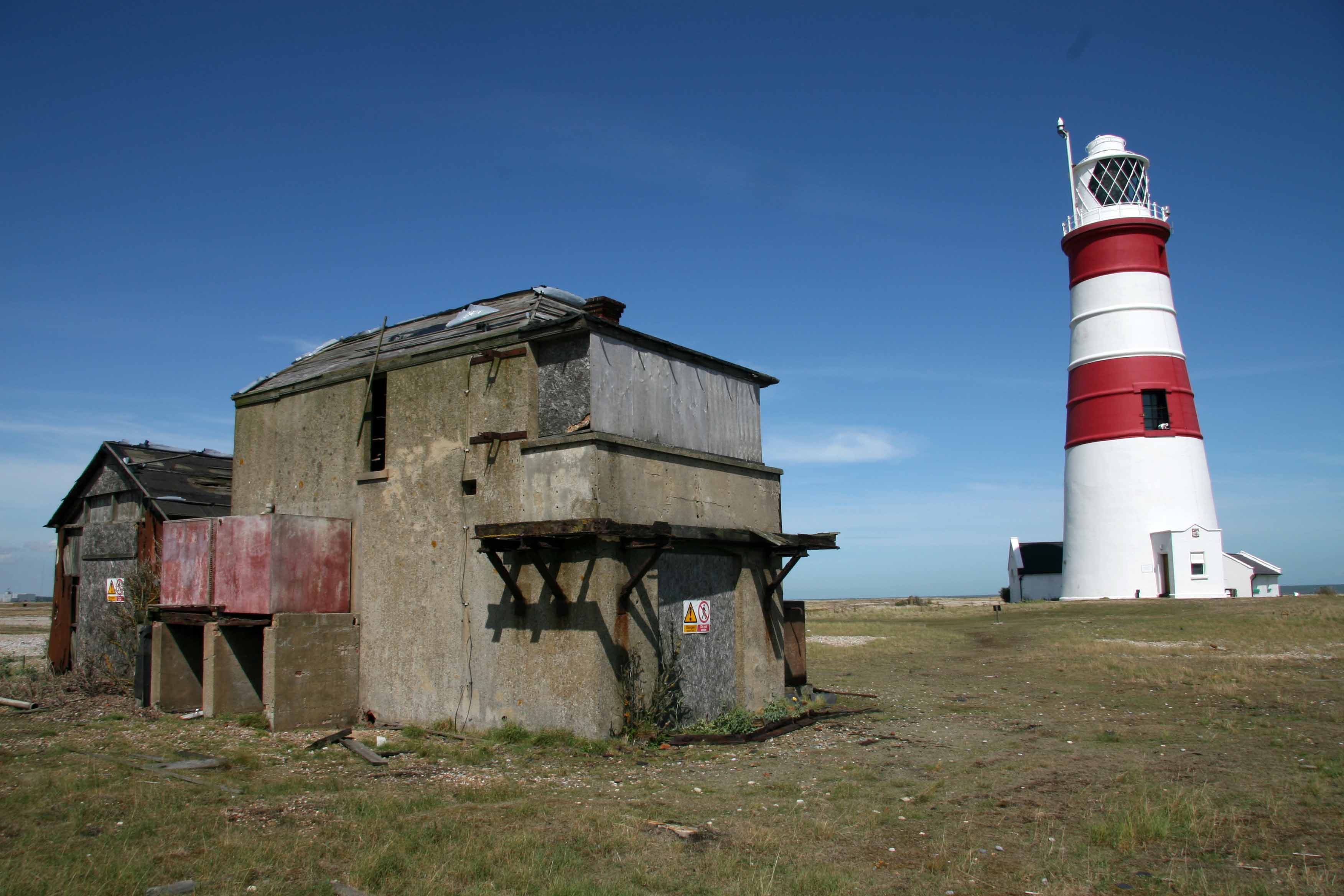
Also permeating the film are grainy 8mm-like shots of some of the locations that Sebald passed through on his long walk – places that get scant mention in The Rings of Saturn but which clearly inform its telling; places familiar to anyone who knows the Suffolk coast reasonably well – Southwold’s Sailors’ Reading Room, Boulge church, Yoxford, the ruins of Dunwich and the formerly top secret research pagodas of Orford Ness. If anywhere could be described as an archetypal Sebaldian landscape it would surely be Orford Ness.

Patience (After Sebald) complements Sebald’s book admirably. It encourages those unfamilar with his work to read The Rings of Saturn for the first time, while those already smitten can find nourishment in the distinctly Sebaldian imagery of the film and the generous personal accounts of the man himself. To be nitpicking, there are a couple of small details that some Sebaldophiles might find slightly incongruous – Andrew Motion reading his poem about the merman of Orford, perhaps, and a scene near the end that involves a puff of smoke at the roadside where Sebald died in a car accident. The latter I found quite thrilling although some might consider it borderline tacky – I can say no more.

Sometimes writers can seem to influence the reader’s view of landscape to such an extent that it is hard to come to it with innocent eyes. Once The Rings of Saturn has been read and absorbed, coastal Suffolk – in the right conditions – can easily transform into a Sebaldian landscape for those passing through it. Yet, as Robert Macfarlane recounts in Gee’s film, it is imposible to replicate Sebald’s journey exactly. Macfarlane’s own well-intentioned attempt to retrace Sebald’s steps was thwarted by sunny, distinctly non-Sebaldian weather and by simply having too much fun swimming at Lowestoft.

Even with fine weather and a light heart, it seems impossible for anyone who has read The Rings of Saturn and walked the Suffolk coast to not have some sort of Sebaldian connection. Whether we like it or not, his prose and dark historic musings have encouraged us to see the coastal landscape in a thousand shades of (tartare) grey whatever our proclivities. But we cannot replicate Sebald – and why should we? Even following those exact same footsteps, we all do our own walk, make our own pilgrimage. The psychogeographical dimension of any walk through any landscape is as dependent on the mindset of the walker as it is on the territory itself.

On a personal note, the book’s geography resonates more than I might ever have imagined: the site of the old Norfolk and Norwich Hospital where Sebald opens the text (finding himself there with a back problem a year after the completion of his Suffolk walk) is located immediately across the road from where I live.