A River Wensum Walk

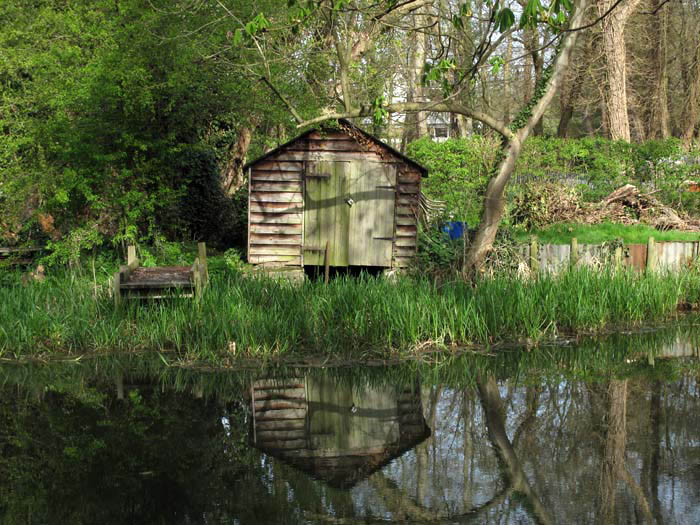
Early April in Norwich. It’s cool but the sky is blue and daffodils are glistening in Wordsworthian tribute to the bright spring sunshine. What better then than a morning stroll through the city along the banks of the River Wensum?

Like many cities – even London – these days, Norwich has largely turned its back on the river that runs through its centre. Once essential for transport and industry, the River Wensum that meanders through the city now seems to have little use other than as a backdrop for attractive new riverside apartments. Look a little closer though and you will still find plenty of reminders of Norwich’s medieval past along its course.

Hard to imagine now, but Norwich once held second city status in England and the banks of the River Wensum that dissect the city are still littered with traces of that period – medieval churches, priories, old bridges and defensive walls – as well as reminders of the city’s half-hearted dabble with Victorian industrialisation.

We begin our walk on St Benedict’s Street at St Lawrence’s Church. From the alley at the side of the church’s western gable you can see a little stone plaque set in the flint that depicts St Lawrence strapped to a grid iron, the means of his subsequent martyrdom. Understandably, he doesn’t look too happy about this but is blissfully unaware (well, perhaps not blissfully) that he will go on to become one of the earliest Christian martyr saints; indeed, the patron saint of comedians and chefs no less (and butchers and librarians too, apparently).

Descending the steps to cross Westlegate we pass the swish apartment block that in a previous incarnation used to be the Anchor Brewery. An enormous brick chimney once scraped the sky here – I still have a black and white photograph of it somewhere. As recently as thirty years ago Norwich used to be redolent of malt and hops (and chocolate too, from Rowntree’s, now Chapefield Shopping Centre) but its source did not originate from here as the Bullards brewery closed back in the 1960s.

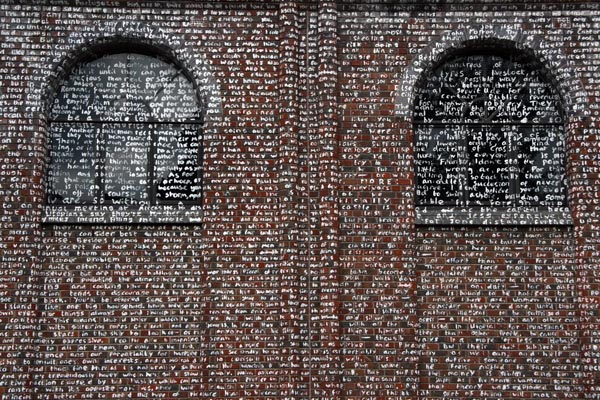
We cross Coslany Bridge over the Wensum and  follow the pedestrian access along the river’s north bank. Across the water stands the disused warehouse where the entire text of Thomas Moore’s Utopia is scrawled in white paint across the brickwork as if it were the work of a hyperactive 16th-century graffitti artist with a taste for political philosophy.

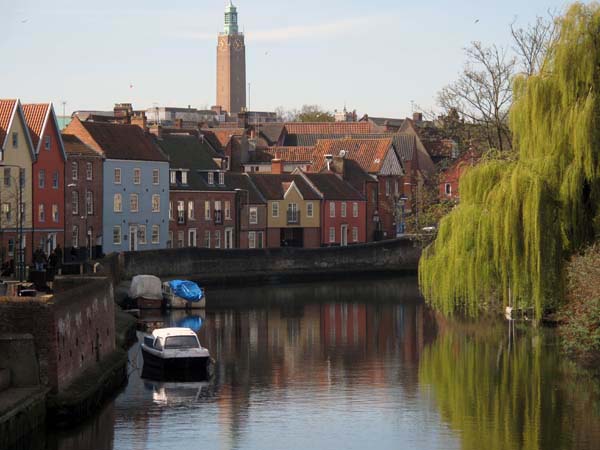
Crossing Duke Street by means of Dukes Palace Bridge, a brief detour via Colegate is necessary in order to reach Blackfriars Bridge by the Norwich School of Art before we arrive at Fye Bridge and Fishergate. Whitefriars Bridge comes next and the eponymous friary once stood on the site of the large edifice that looms before us: the Jarrolds Printing Works, built n 1834 and formerly a mill owned by the Norwich Yarn Company – a tall stately bulding with brickwork elegantly draped with Virginia Creeper and wisteria. Looking back, the clocktower on Norwich City Hall, which to my mind resembles a cut-price Marrakech minaret, rises into view beyond the weeping willows, newly in leaf, that sway dreamily over the torpid water beneath.

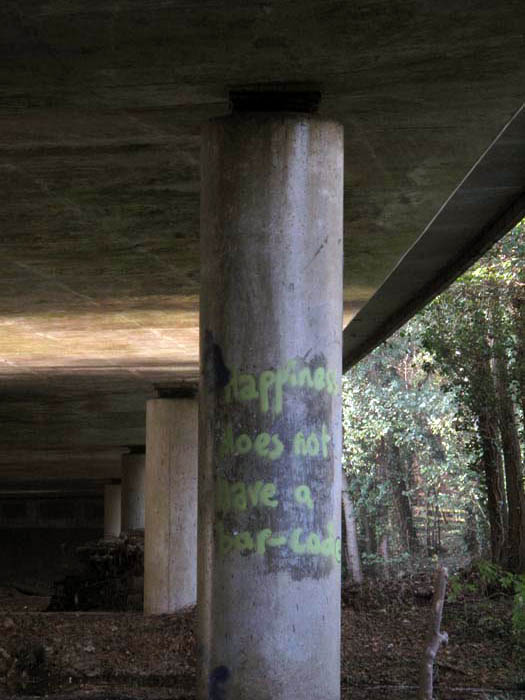
Beyond the printing works, a renga – a word map created by means of an ancient Japanese tradition of shared writing – strings a snake of words and phrases along green hoardings beside the river. A Renga for St James was created here on site in 2009 and utilises the local Norwich vernacular and reference points. Someone – a well-educated graffitist, who clearly understands the renga ethos – has scrawled ‘Perfidious’ above the word ‘Albion’, which in this instance refers to one of the few remaining wherries that used to ply East Anglia’s rivers.

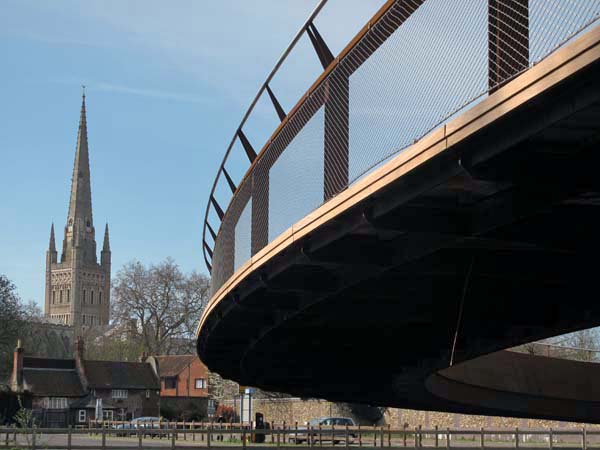
Continuing east the new bridge soon comes into sight. Peter’s Bridge, named after a former Jarrold’s chairman, has only been open a few months and, surprisingly, not a lot of people seem to know about it. Most of the Wensum’s bridges are so ancient that they are firmly embedded in the city’s psyche but there have been three new footbridges so far this millennium: this one, the 2009 Lady Julian Bridge close to the railway station, and the Novi Sad Friendship Bridge, opened by the Yugoslav ambassador in 2001, near Carrow Bridge (ironic, then, that NATO bombed and destroyed the far more substantial and economically important bridges of Norwich’s twinned Serbian city just two years earlier).

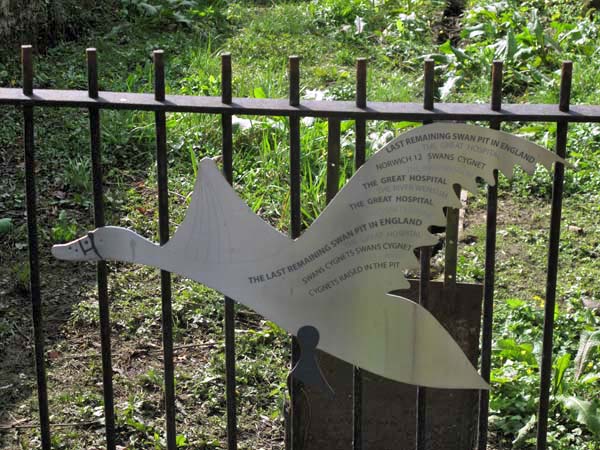
 Walking across this graceful, J (for Jarrold’s)-shaped footbridge, our riverside walk continues past Cow Tower towards Pull’s Ferry but before reaching this we pass what looks like a sluice leading into the river. This is, in fact, a rare 18th-century example of a swan pit, a tidal pool in which wild cygnets were kept and fattened for the table after having their wings clipped and beaks marked by their owners.

At Bishops Bridge, we leave the river behind to head for Cathedral Close and Tombland. A place called ‘Tombland’ next to a great church might reasonably be expected to be a place of the dead. But no, Tombland is Old English for ’empty land’ and this was the site of Norwich’s Anglo-Saxon market before the Normans came and shifted it to its present position next to St Peter Mancroft Church. Norwich Market has been operating there for over 900 years now and is still going strong, six days a week. Mind you, it did have a bit of an overhaul a few years back.

Patience (After Sebald) – Walking The Rings of Saturn

About a year ago I wrote a post about an Aldeburgh Music weekend at Suffolk’s Snape Maltings that celebrated the life and works of the writer W G Sebald. A new film by Grant Gee, Patience (After Sebald), was also previewed on that occasion but it has taken a full year for it to have been finally been put out on general release in the UK. After such a long wait, ‘Patience’ might seem a wholly appropriate choice for a title but I finally got the chance to see the film last Sunday at a sell-out screening at Cinema City, Norwich.

The film is based on what is probably Sebald’s best known work, The Rings of Saturn, which  describes a long meditative walk in the Suffolk coastal region. In German translation the book is subtitled ‘Eine Englische Wollfahrt – an English pilgrimage’, but this is misleading as The Rings of Saturn is not really about pilgrimage at all, nor is it a work that concerns itself that much with landscape, although the shingle and wide skies of coastal Suffolk do make a cameo appearance.

Although genres such as travel, history and memoir are appropriate up to a point, The Rings of Saturn is a work that boldly defies categorisation and which cannot easily be placed into any single literary pigeonhole. Sebald’s Suffolk odyssey is really as much an internal journey through one man’s mind as anything else. Far from the normal notion of travelogue, The Rings of Saturn is more a psychogeographic exploration of one corner of East Anglia. Certainly, the physical geography here is spectral, a melancholic landscape of ghosts, personal reflection and dark cultural memory. The term ‘Proustian’ might be used to define Sebald’s style to some extent but a better word would be Sebaldian: W G Sebald is one of those rare writers, like Dickens, Kafka and Ballard, whose name can be confidentally used as an adjective thanks to a distinctive mournful style and typically digressive, fragmentary narrative.

Part of the Sebaldian trope is to include images – black and white photos and line drawings – as part of the narrative flow; images, sometimes unsettling, that are tangential to the geography of the walk yet central to the narrative’s solipsistic digressions. Many of the book’s already familiar images are replicated in Patience (After Sebald), serving as a backdrop for talking heads like Robert Macfarlane, Iain Sinclair and Andrew Motion who have been recruited among others to give their personal take on Sebald’s oevre. Other images on display in the film are immediately resonant to those who have read The Rings of Saturn even though they do not appear as photographs within the pages of the book itself. A brief glimpse of a naked couple lying on a beach clearly represents the lovers that Sebald stumbled upon at Covehithe and, panicking, described as ‘like some giant mollusc washed ashore… a many-limbed, two-headed monster’. A shot of a distressed-looking plate of food undoubtedly refers to the joyless pub meal taken by the author in Lowestoft, which contained a fish that had ‘doubtless lain entombed in the deep-freeze for years’ along with tartare sauce ‘turned grey by sooty breadcrumbs’. Apart from an occasional colour inset frame showing a walker’s boots on the tarmac (the film-maker himself perhaps?), the images used are monochrome throughout, as grey as Sebaldian tartare sauce.

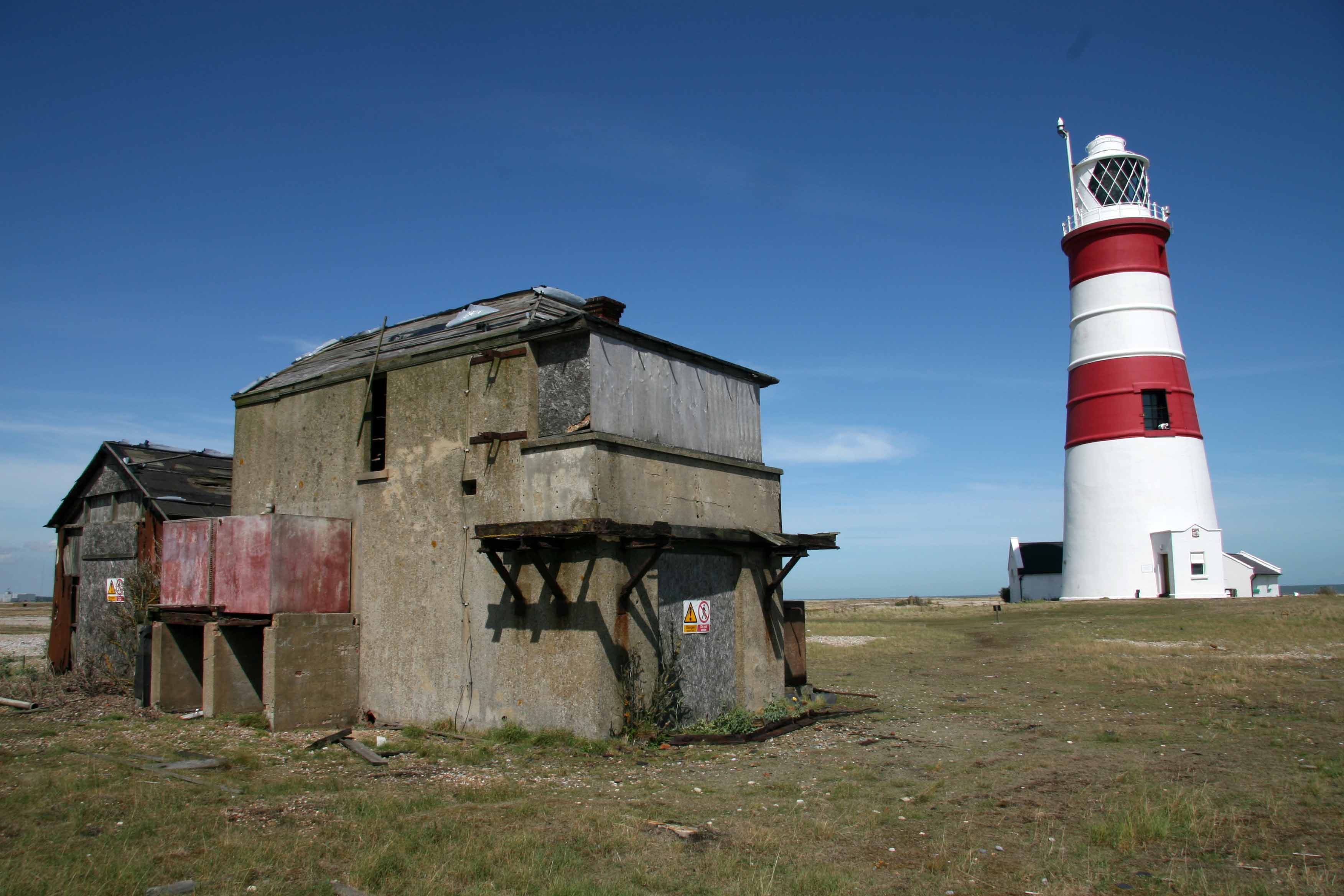
Also permeating the film are grainy 8mm-like shots of some of the locations that Sebald passed through on his long walk – places that get scant mention in The Rings of Saturn but which clearly inform its telling; places familiar to anyone who knows the Suffolk coast reasonably well – Southwold’s Sailors’ Reading Room, Boulge church, Yoxford, the ruins of Dunwich and the formerly top secret research pagodas of Orford Ness. If anywhere could be described as an archetypal Sebaldian landscape it would surely be Orford Ness.

Patience (After Sebald) complements Sebald’s book admirably. It encourages those unfamilar with his work to read The Rings of Saturn for the first time, while those already smitten can find nourishment in the distinctly Sebaldian imagery of the film and the generous personal accounts of the man himself. To be nitpicking, there are a couple of small details that some Sebaldophiles might find slightly incongruous – Andrew Motion reading his poem about the merman of Orford, perhaps, and a scene near the end that involves a puff of smoke at the roadside where Sebald died in a car accident. The latter I found quite thrilling although some might consider it borderline tacky – I can say no more.

Sometimes writers can seem to influence the reader’s view of landscape to such an extent that it is hard to come to it with innocent eyes. Once The Rings of Saturn has been read and absorbed, coastal Suffolk – in the right conditions – can easily transform into a Sebaldian landscape for those passing through it. Yet, as Robert Macfarlane recounts in Gee’s film, it is imposible to replicate Sebald’s journey exactly. Macfarlane’s own well-intentioned attempt to retrace Sebald’s steps was thwarted by sunny, distinctly non-Sebaldian weather and by simply having too much fun swimming at Lowestoft.

Even with fine weather and a light heart, it seems impossible for anyone who has read The Rings of Saturn and walked the Suffolk coast to not have some sort of Sebaldian connection. Whether we like it or not, his prose and dark historic musings have encouraged us to see the coastal landscape in a thousand shades of (tartare) grey whatever our proclivities. But we cannot replicate Sebald – and why should we? Even following those exact same footsteps, we all do our own walk, make our own pilgrimage. The psychogeographical dimension of any walk through any landscape is as dependent on the mindset of the walker as it is on the territory itself.

On a personal note, the book’s geography resonates more than I might ever have imagined: the site of the old Norfolk and Norwich Hospital where Sebald opens the text (finding himself there with a back problem a year after the completion of his Suffolk walk) is located immediately across the road from where I live.

The Writing on the Wall

Just up the road from where I live there is a large black-painted gable wall that bears the legend ‘PINK FLOYD’ in large bold white letters. Clearly, it was a gesture made using good quality paint as it has been there as long as I remember. For all I know it may even date back to the time of the original Pink Floyd line-up with Syd Barrett, although somehow
I doubt it – I rather think it is the work of a fan from the Floyd’s high-profile years of Dark Side of the Moon and after. Since that original graffito was daubed another paintbrush-wielding wag has come along to add a couple more brushstrokes and change the ‘I’ in ‘PINK’ to a slender ‘U’ thus rendering it ‘PUNK’, but this anarchic amendment  is not wholly successful, the paint being of insufficient quality to resist natural weathering. One might assume that this addition was made sometime around 1977 but here in Norwich there were individuals sporting orange Mohicans and tartan bondage trouser outfits well into the 1990s. Either way, the gable text seems to be of sufficient permanency that you can almost imagine archaeologists of the future puzzling over the meaning of its ‘Pi(u)nk Floyd’ cipher. Being archaeologists, they will probably attribute it as being of ‘possible
ritualistic significance’.

A little further up the road is a T-junction where the back of a one-way sign has been neatly and inquisitively stencilled: ‘WHY DO YOU DO THIS EACH DAY?’ Years ago, I used to turn left here every morning on my daily drive to work in North Norfolk. The graffito wasn’t there in those days but, had it been, I don’t think I could really have ignored it. It did, after all, pose the very question that was perpetually at the back of my mind and now it seems so significantly placed that I could almost believe that somehow I unconsciously put it there myself – I didn’t.

Putting to one side the familiar and shoddy tagging that seems the imperative of young men wishing to mark their territory like cock-legged dogs, graffiti seems to be at its most potent when a degree of passion is involved. Often it is the unintended permanency of a fleeting emotional state that renders it so evocative. One local piece of graffiti that immediately springs to mind, although I have long forgotten exactly where I saw it, was the legend ‘S. HEWETT IS A HOUR’ (sic), probably the work of a jilted teenage boy
who needs to work on his spelling. Inadvertently, by means of dyslexic subtext, this wounded individual has stated that ‘S. Hewett’, whoever she is, represents a fragment of time – perhaps she really was a waste of time as far as he was concerned. Although this declaration is undoubtedly passionate it seems odd that its author addresses the target of his fury by what seems to be a school register name rather than something more familiar. Maybe he is unknown and unrequited, rather than jilted, and just trying to spread rumours? These days, of course, he would do this by TXT. In contrast to this angry but passionate exclamation, another lovers’ tiff-style message I once saw scrawled on a wall in a neat feminine hand simply stated, ‘CHARLES I DESPISE YOU’. Such withering dispassion would be hard for anyone called Charles to ignore.

There is a fine line between urban wall scrawling and what might be considered ‘art’ but if you make the text 40,000 words long and legitimise it with an Arts Council grant then it may well become officially sanctioned. This is what the artist Rory Macbeth did in 2006, inscribing the entire text of Sir Thomas More’s 1516 work Utopia on the walls of a derelict building in central Norwich that was due for demolition. As Macbeth rightly states, ‘Most graffiti is utopian’. It should be remembered though that, in Greek, utopia actually means ‘no place’, and not ‘paradise’ as is often supposed.

Dancing about Architecture

St Peter Mancroft Church, Norwich, May 19

Yesterday’s BBC Radio 4 Today programme included a short feature on the 73 year-old American jazz bassist Charlie Haden. In the interview Haden discussed his musical history and how he had started out singing with his family in the Midwest but after contracting polio had taken up double bass and embraced the church of jazz. There was also talk of his political activities and his arrest by police in Portugal in 1971 just before the revolution there. The feature concluded by saying that Charlie would be performing in London this weekend. True enough, but it failed to mention that he would also be performing with his Quartet West at the Norfolk and Norwich Festival that same night.

St Peter Mancroft’s Church next to Norwich millennium-old Market Place is a wonderful place to hear music, even if its pews are unforgivingly Calvinist. Charlie Haden took the stage more or less on time and after introducing his fellow musicians announced that he hoped we would all be able to see them play in London too as there the band would be accompanied by a female singer or two and perhaps even a string section. He held his new Sophisticated Ladies CD aloft to indicate the 1940s and 50s material they would be performing with the fuller line-up – not here, though. Nothing against the Great American Songbook, female jazz singers or violins but I was quite pleased to hear him say, “Tonight, there’ll just be the four of us. We’ll be playing some beautiful music for you; some old and some new.”

The quartet set off on a series of four tunes, each one with plenty of space for solos. On the first composition Haden’s bass seemed a little lost and meandering, as if he could not quite find his way, but I sensed that it was a sort of practice lap for muscle memory as he tried out different progressions and constantly readjusted his tuning. By the fourth song of the sequence, the gorgeous First Song (For Ruth), he was really in his stride, playing a beautifully developed and poignant solo before handing over the creative reins to tenor man Ernie West. West, whom I have since learned was responsible for providing solo saxophone on many of Marvin Gaye’s 1970s recordings, has an impeccable technique, enviable musicality and what appears to be enormous stamina. A genial, gentle-looking man who seems able to breath through his ears, West moulded clusters of quicksilver notes into a procession of aural sculptures, each one rising like bubbles to float up to the hammerbeam roof and make the wooden angels on the mediaeval frieze smile. It was also around this time that the sun must have set outside, lighting up the sandstone pillars and high clerestory windows with a warm golden glow that seemed to give approval to the music rising from the nave. Fifteenth-century English Perpendicular architecture and 21st-century American music go surprisingly well together.

During a break to talk to the audience Haden announced that they would be playing something he had first recorded in 1957. “1957!”, he exclaimed, “Why, that’s way back in the 20th-century!” He was wrong in fact, by my reckoning Lonely Women was actually recorded with Ornette Coleman in 1959 and released on the iconoclastically modal (and prescient) The Shape of Jazz to Come, but why quibble? An angularly dark musical refrain led into more wonderful slow-cooked solos, from Haden, West and pianist Alan Broadbent, while new drummer Rodney Green kept time in the same sensitive and understated way he had been doing all evening.Ten, maybe fifteen, minutes elapsed before some sort of natural conclusion was arrived at. The audience, almost in shock, erupted into thunderous applause.

An encore was maybe too much to hope for but musicians that play in churches have nowhere to hide. “Thank you for listening so carefully. You’re good listeners; you’re an audience with good ears,” said Haden, genuinely moved. A lengthy, heart-aching Blue in Green ended the evening. More beatific tenor saxophone, more bass solos that sounded more like compositions in the making than mere exercises in dexterity, more lush piano that on occasions hinted at Bill Evans and at other times, Keith Jarrett without the self-importance. More rapturous applause. Haden was right: we did have good ears.

Norwich Wolves

Norwich Wolves. Not a Premier League football fixture (that should happen next season now that it looks less likely that Wolverhampton Wanderers will be relegated) but this year’s opening of the annual Norwich and Norfolk Festival. As with most years, some dramatic street theatre has been employed to kick off proceedings and 2011 sees the return of those wacky Basques, Deabru Beltzak, with the world premier of The Wolves, a  reworking of the Pied Piper of Hamelin.

On Friday and Saturday night this weekend, a strange procession started and ended at Millennium Plain. This involved three giant fire-breathing wolves, an ambulant keyboardist inside a giant wolf’s head and several hundred willing followers. Dramatic stuff indeed, and good to see so many Norwich citizens turn out to enjoy this European-flavoured extravaganza.

Norwich Underground

Norwich’s network of underground passageways is the stuff of legends. Many of them may be the work of over-active imaginations but others undoubtedly do exist as relics of the city’s medieval glory days when a little subterranean expediency came in handy in times of religious persecution or civil war. Of course, even those that exist solely in folk memory still make for a good story.

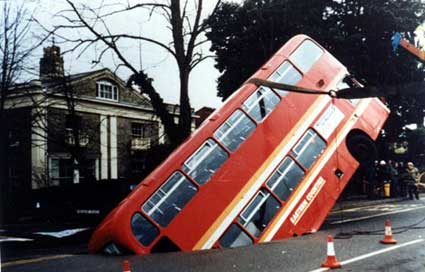
The city’s bedrock is pitted with less glamorous tunnels too. Chalk and flint mining was a Norwich tradition for centuries and both materials were necessary for building the extensive city’s walls and numerous churches of what was England’s second largest city in the medieval period. As a result, certain areas of the city have long been synonymous with subsidence problems. A reminder of this came to the fore in 1988 when a double-decker bus was unexpectedly swallowed-up by the earth on Earlham Road close to the Roman Catholic Cathedral of St John the Baptist. Thankfully no-one was hurt. This bizarre event made for some entertaining postcards and even gave the opportunity for the chocolate manufacturer Cadbury’s to promote one of its products using a photograph of the unfortunate bus alongside the slogan, ‘Nothing fills a hole like a Double Decker’.

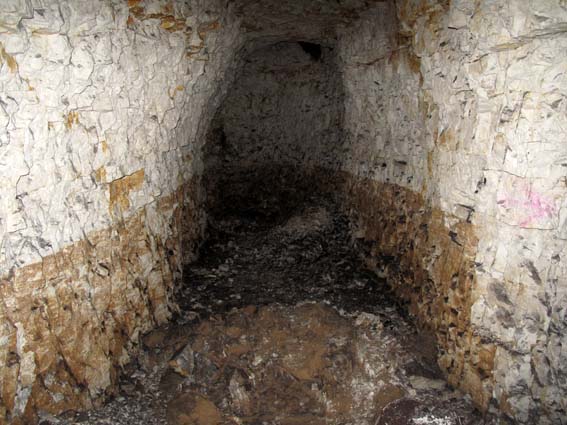
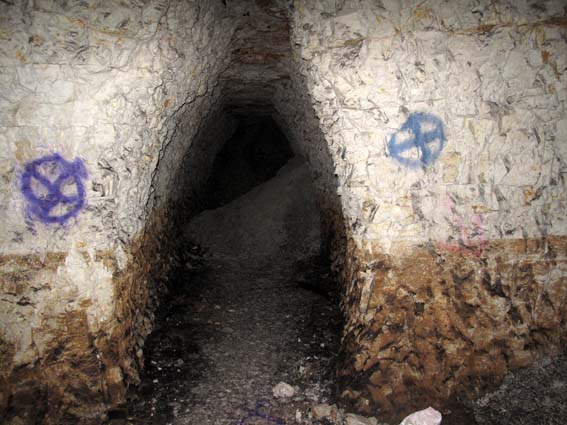
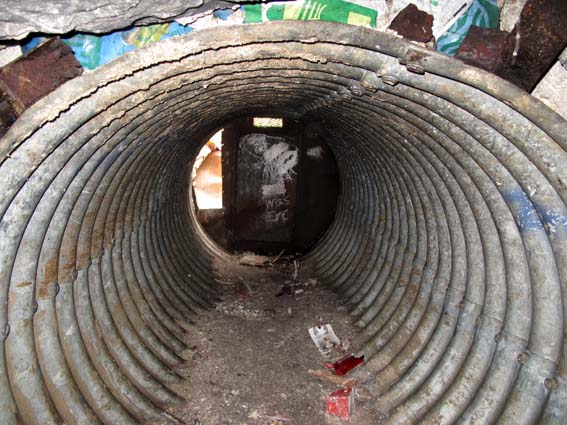
Walking recently in a formerly unexplored corner of a familiar haunt at the city outskirts I stumbled upon an entrance to this chalky underworld. Long sealed-up with steel to deter would-be intruders, this one had been recently prised open – by shadowy urban explorers, no doubt, keen on charting this unmapped terrain. Resistance was futile – there was no way to turn down such a serendipitous opportunity.

Just a few metres beyond the entrance the absolute darkness is intimidating – the light of torches too feeble to identify much more than where the tunnel floor is and highlight spray-painted ciphers marking dead ends and potential exit routes. The photos taken here with flash were made by simply pointing and hoping for the best: a strange turn of events in which the results reveal detail unseen by dim yellow torchlight at the time of their taking.

A troglodyte world such as this is a starkly alien environment that can bring out the most atavistic of fears. Past underground visits have been to well-lit caverns filled with phantasmagorical stalactites and stalagmites, or tropical caves in south-east Asia populated by strange blind fish and albino insects — beautiful unthreatening spaces. My only previous mine experience was a terrible, yet fascinating, place on the other side of the world: a Bolivian silver mine at over 4,000 metres altitude at Cerro Rico (‘rich hill’) near Potosí, where visitors are expected to bring along gifts of Coca-Cola, bags of coca leaves and sticks of dynamite – the necessities of a Bolivian mining life. The miners in turn offer their own gifts to El Tío (‘The Uncle’), the spirit of the underworld – a pact with the Devil that permits them to scratch a dangerous living from the earth for their short tough lives. Since this visit I have always afforded miners the greatest respect.

It might seem odd that a short excursion beneath the ground just a mile or so from home can feel almost as alien an experience as a visit to a Bolivian silver mine – even without a cheek-wad of coca leaves and the necessity of appeasing ‘The Uncle’. There again, the juxtaposition of a jarring new experience in a wholly familiar setting is always going to be disturbing.

W.G.Sebald, In Memoriam

The UEA-based German writer, W. G. (‘Max’) Sebald, died just over nine years ago in a car accident close to his home south of Norwich. One of his most famous books, and certainly the one most closely connected with the East Anglia region, is The Rings of Saturn, published in 1999. Superficially a post-illness walking tour of east Suffolk, this labyrinthine unclassifiable work delves tangentially into deep history to discuss episodes as wide ranging as the import of silkworm cultivation into Europe, the writings of 17th-century Norwich polymath Thomas Browne, Nazi concentration camps in Croatia and the scurrilous private life of the Suffolk-based translator of Omar Khayyam.

Focusing unhealthily on the dark, isolated and horrific, Sebald’s writing is hardly what one might describe as ‘feel-good’; indeed, it is often gloomy to the point of verging on the morose. His literate, hang-dog style can almost seem self-parodying on occasion, especially when it circles down to earth to confront the quotidian as in the case of an hilarious description of a disappointing dinner in Lowestoft – only Sebald could disparagingly describe the ‘breadcrumb armour-plating of the fish’ and sachet tartare sauce ‘turned grey by sooty breadcrumbs’. Although he veered towards the hyper-melancholic, his writing was always elegant and elegiac, not to mention meditative, lapidary, dream-like and solipsistic. Interweaving memory, fiction and observation along the course of his walk, there is a Proustian quality to his writing that questions the transience of life and suffering.

Clearly, The Rings of Saturn has sufficient devotees for others to want to walk in Sebald’s footsteps, seeking out the Suffolk landscape that inspired such beautiful gloom along the eastern reaches of the Waveney Valley and the Suffolk coast between Lowestoft and Dunwich – a landscape that seems oddly devoid of people in Sebald’s book. Aldeburgh Music at Snape Maltings recently held a weekend devoted to a celebration of Sebaldia that involved the American rock chanteuse Patti Smith no less. It remains to be seen whether the film Patience (After Sebald) by Grant Gee that was also screened during the weekend will be available to general view in the near future.

Here’s a short film and a piece in the Guardian.

Cromer New Year, 2011

Many of us feel a need to mark the turning of the year in some way other than simply customary overindulgence on the eve of the old year – an outing to some favoured spot on New Year’s Day perhaps? For those of us who live in Norwich, the North Norfolk coast usually fits the bill. It is not just a matter of blowing cobwebs away or walking off the previous night’s hangover, although certainly that may be an element of it, but more a way of welcoming the New Year and bidding farewell to the cultural interregnum that is the week after Christmas. The last week in December may not strictly be a month of Sundays but it can sometimes feel like it.

Christmas and New Year have long been syncretised with ancient rituals that used to mark the winter solstice, the turning point of the year that heralds the long-awaited lengthening of days. The trouble is these days, as with any public holiday, the Christmas break (should that be ©hristmas?) is largely seen as just another retail opportunity to sell you stuff you really don’t need. New Year’s Day seems different though – especially now that the ‘January sales’ tend to begin on Boxing Day – and has the feel of a day with a tad more community spirit than most. It may be cold January but, venturing outdoors, you get the impression that families are more likely to go out for a walk together on this day than any other in the year. Naturally enough, this phenomenon may also have some connection with New Year resolutions that involve fitness, family togetherness and fresh resolve to avoid couch potato blight. Personal New Year favourites tend to be a walk along the shingle bank at Cley-next-the-Sea, a five-mile circuit centred on Horsey that takes in Horsey Mere and a seal-friendly stretch of the northeast Norfolk coast, or the cliff walk between Overstrand and Cromer. This year, we chose the latter: a seaside amble along the beach from Cromer to Overstrand then a return to Cromer by way of the cliff path.

On a dull winter’s day the north Norfolk seascape can appear almost monochromatic. It is necessary to make adjustments in order to fully appreciate its understated, charcoal-sketch beauty. Scandinavians, fully at home with cold northern light, are good at this; Brits, however, our eyes forever enviously half-cocked on the promise of Mediterranean sun, are not so adept. Whatever the time of year, the north Norfolk coast is a liminal landscape: just sea, sky and sand. Head due north from here and there’s nothing but cold dark water until you reach the Arctic pack ice – nothing but notional maritime territories: Humber, Dogger, Forties, Viking. Horizontal layers of grey stratify the landscape: murky water; shining banks of cloud that weigh heavy on the horizon; sand and pebbles in the foreground. Look behind you and the cliffs behind are crumbling: too soft to win the fight in any sea versus land standoff. The aural landscape is hardly brighter: just the usual coastal din of argumentative gulls and overexcited dogs, the swash of waves and the grate of pebbles.

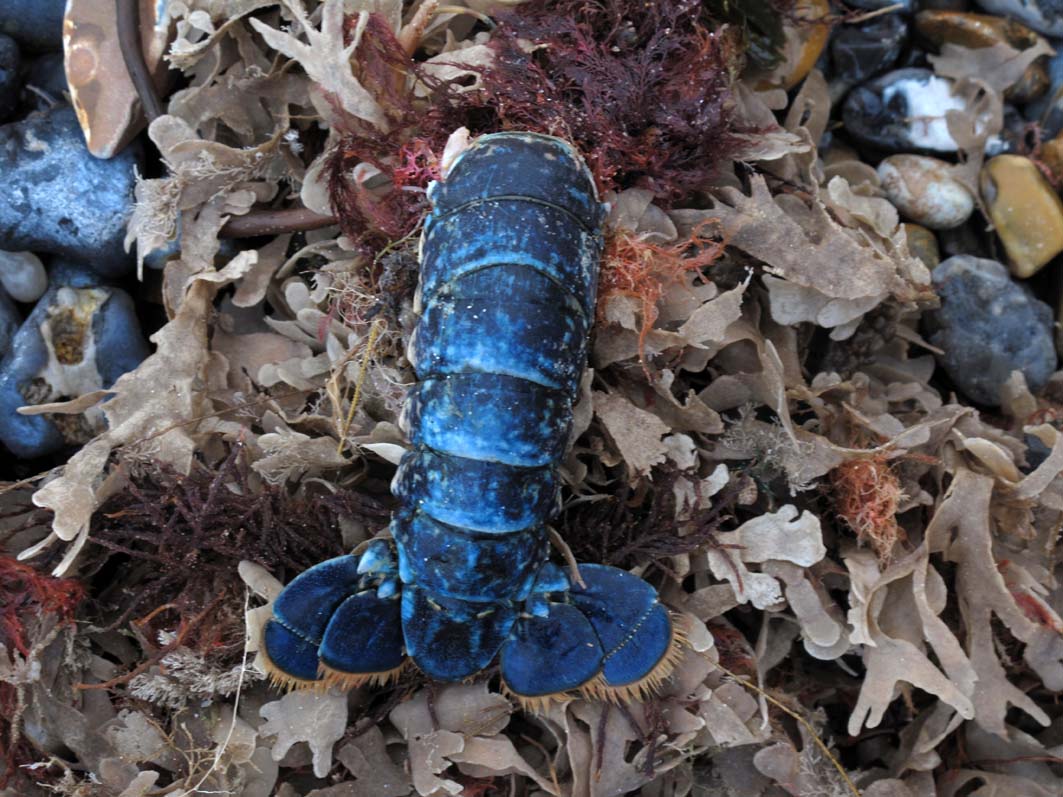
Crunching east along the pebbles, keeping a casual eyen open for the ochre glint of amber (never found), a steely blue jewel  nestled in seaweed reveals itself. The object, a detached lobster tail – or, rather, thorax – is so intensely blue that it seems to suck in light like a tiny dead star fallen to earth. The cerulean richness seems unworldly in this colour-bleached landscape. Separated from carapace and succulent flesh, its isolation renders it all the more precious. Precision-engineered to allow the most delicate of movements, it is a tail designed for swimming, dancing and mating displays, a tail for lobster love.

Returning along the cliffs next to the golf course the path is lined with thickets of sea buckthorn. In other years these have been so weighed down with squishy orange fruit that they dazzle the eye but this winter the berries, following a savagely cold December, are little more than a withered memory, with few to be seen on the bushes, thinned by frost action and hungry birds. Archaeological evidence suggests that sea buckthorn berries once played an important role in man’s diet but the truth is that, while they may be nutritious, they are also unbelievably astringent eaten raw, like bitter acid on the tongue. Freezing and cooking are supposed to reduce their unpalatable quality so we must conclude that Norfolk’s early settlers made some sort of jam out of the fruit.

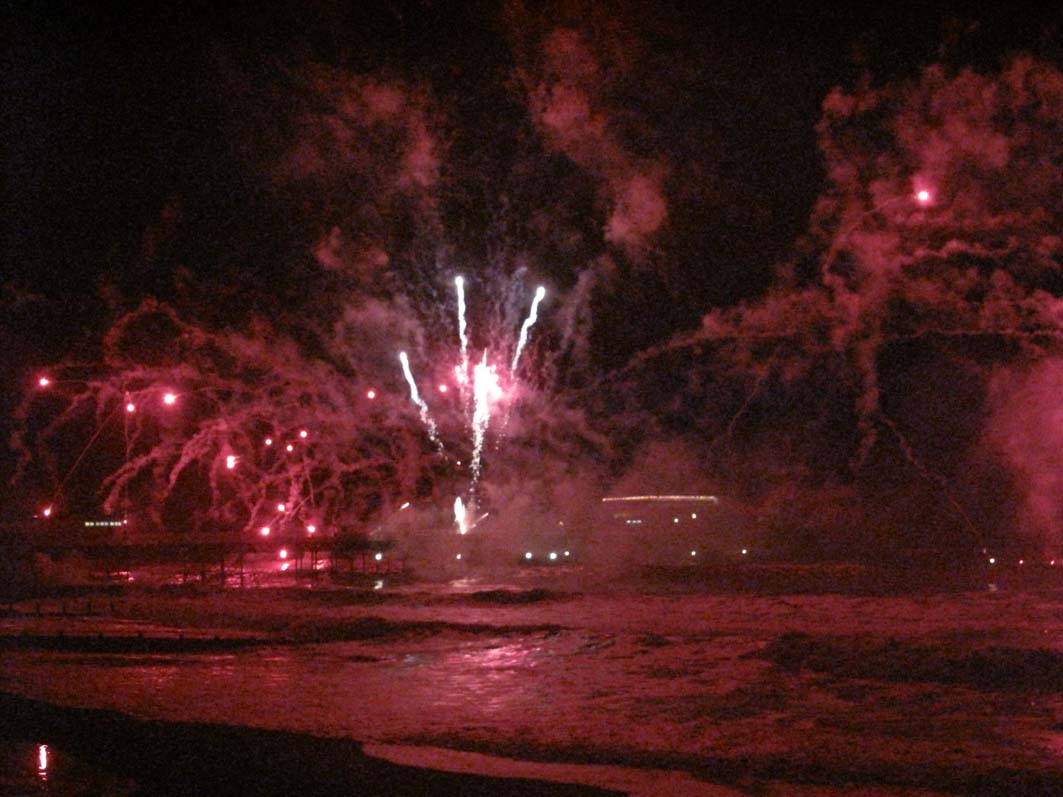
Since the millennial year, Cromer has staged a New Year firework display that is said to attract at least half the town’s population and the same again from the county beyond. This year, we stayed to watch. By well before the time that darkness fell, it was impossible to find a seat in the Rocket Cafe above the Lifeboat Museum – the perfect viewpoint for the event. Instead, we stood among the crowd by the seawall facing the pier, while others positioned themselves up the steps that lead up to the main promenade. The display, when it finally began after what seemed like a long, cold late-afternoon wait, was a wonderfully explosive affair – a lengthy and varied display that made the annual Lord Mayor’s Procession event in Norwich look like a damp squib in comparison. As the last cracks of pyrotechnic thunder echoed against the sea wall, and the final salvo of rockets stabbed at the sky, I wondered what Cromer’s offshore crabs made of all this unexplained cacophony. Were they all scurrying northwards along the seafloor heading for the relative peace of Dogger Bank?