
It began with a dislocation. A couple of weeks’ residence north of the border in the house of friends who had chosen to trade the Scottish late winter for the Antipodean summer. It was an opportunity for some writing time away from the usual distractions, with the bonus of optional walks along the Firth of Forth to stretch legs and imagination. The house, in a village a dozen miles east of Edinburgh, was situated midway between the railway station and the Forth shore – a ten minute walk to either. And if I needed a dose of cultural inspiration then I could easily catch the train into Auld Reekie and stay for as long as was necessary.
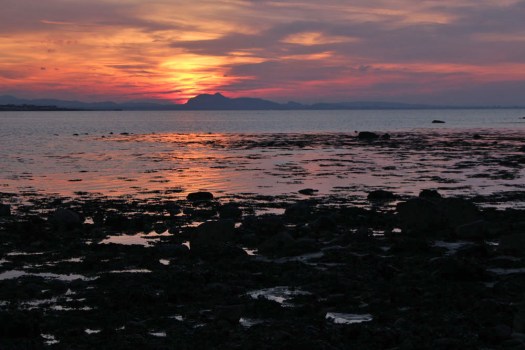
Travelling north by train, I don’t think I was even aware that the ‘Beast from the East’ was brewing trouble far away in continental Russia, and I had been installed in the house for a few days before the repeated warnings started to slowly filter into my consciousness. In those first few days of settling in, I usually worked until early afternoon before going out for a walk along the shore before it got dark. The first of these outings was at low tide. I walked westwards along the tide-ribbed sand, picking my way across shallow channels of water to head in the direction of Edinburgh, the city clearly visible ahead around the curve of the estuary. The twin-peaked bulge of Arthur’s Seat nudged the skyline in the distance, looking every bit the extinct volcano it was. Beyond it, the outline of Edinburgh Castle stood out amidst a hazy tangle of high-rise blocks and the spidery cranes of the docks at Leith. Across the calm, dark water of the Forth were the low hills of Fife. Beyond these, beyond the horizon, the jagged peaks of the Scottish Highlands rose stealthily in the imagined yonder of my mind, unseen yet a presence nevertheless.
The foreshore, glimmering in the low-slung sunshine of late afternoon, was dotted with waders preoccupied with probing the estuary mud. Periodically some perceived threat would alarm them sufficiently for them to fly off in groups before they settled somewhere else to resume feeding. A mixture of redshanks, oyster catchers and curlews, each bird provided their own distinctive piping call to create a wistful shoreline soundscape. In the shallow water close to shore, groups of wigeon huddled together companionably, elegant feathers rustling in the breeze. Out to sea, just about identifiable at this range, small rafts of goldeneye and eider bobbed dozily in the waves lost in sea duck dreams.
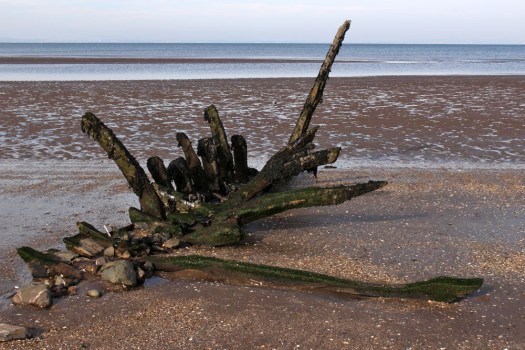
Approaching Port Seton I came upon the wreck of a boat sticking out of the sand, its remnant ribs blackened by salt and age. I wondered about the boat’s history; how long it had been wrecked and abandoned here; what of the lives of the men that had once made up its crew? Time and tide had reduced it to a stark sculpture of salt-soaked wood, a skeletal marker for a vessel that had once sailed the Forth and provided a livelihood: a monument to past lives, or perhaps a warning, a cautionary memento that spoke of the power of the sea.
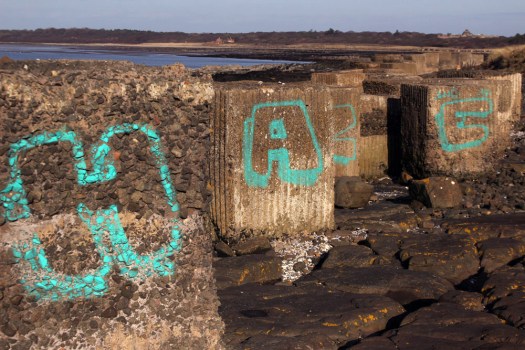
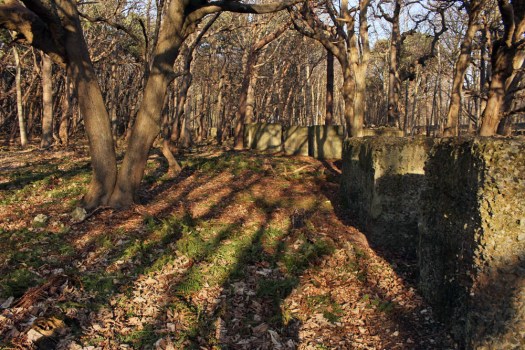
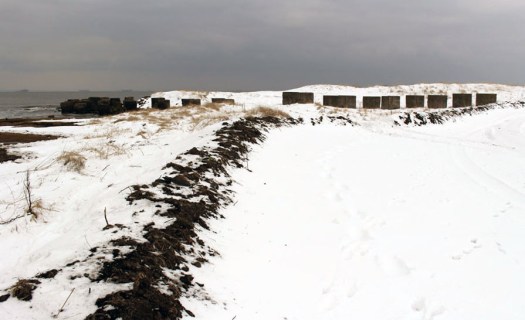
On the day before the storm arrived I headed in the opposite direction for my afternoon walk, across the headland of Ferney Ness in the direction of Aberlady Bay through the curious woodland of the Gosford estate. The sky was greyer today; the Fife shore across the water less well-defined, the ships out in the Forth no longer highlighted by sunshine but hunkered down in the water. The signs were there: a change was coming. Large concrete cube blocks lined the shoreline – tank trap defences dating from the last war; an incomplete wall to chaperone the meeting of land and sea. The blocks continued even through the woodland, weaving through the trees like a broken causeway, an accidental land art installation that marched like a concrete-laying behemoth ever eastwards.
The ‘beast’ made landfall on Tuesday but the full extent of its might was not fully apparent until the following day. On Wednesday and Thursday it snowed all day without stopping… and then some more – Snow had fallen, snow on snow, as the famous carol goes. The world outside quickly started to lose its familiar topography – the edges of roads blurred then disappeared, footpaths and gardens lost their definition as they submitted to an ever-thickening cover of white. The world had been transformed; made pure, made ice, filtered of colour and tone to leave it monochromatic, but mostly white. The whole notion of travelling far became laughable – in a world without edges there is nowhere else to go. By Friday it seemed almost as if the world had always been like this… and always would be. Frozen in space, frozen in time, this was a world where eternity was cold and white.

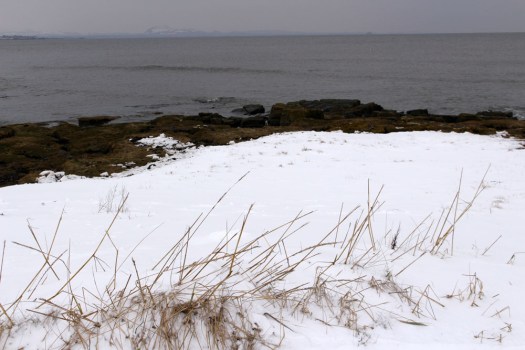
During a break in the snow showers I ventured down to the Forth shore and found the same transformed world. Stems of straw-coloured grass poked thinly through the snow on the dunes as if grasping for air. Another landfall other than that of the storm had taken place – the fresh arrival of wind-blown thrushes from Scandinavia. The sea buckthorn bushes behind the dunes were flurried with activity, noisy with bird chatter, their branches weighed down with feeding fieldfares that threw themselves up into the air at regular intervals to make a quick fly-over of the beach before returning to the shelter of the bushes and the winter-bleached berries that sustained them. In the trees of the golf links behind, there were hundreds – perhaps even thousands – more of the thrushes perched in the higher branches, occasionally flying up en masse into the air on a whim before returning to the tree. The tide was on the turn and the narrow ribbon of sand and seaweed between the water and dunes held an improbable number of birds frantically sifting through the tide line detritus for something to eat: an odd mixture of redwings and golden plover along with a few lapwings and turnstones. This unusual parliament of birds appeared to coexist peacefully enough, out of the necessity of hunger if nothing else, but it all seemed strange and topsy-turvy: the harsh weather had brought about a dislocation, a disavowal of familiar habitat to leave an absence somewhere else.
As if experiencing the aftermath of an apocalyptic event, I felt a parallel sense of dislodgement from the world. Telephone calls to my wife and emails to the house’s owners heightened the sense of dislocation as our communications triangulated between Scotland, Norfolk and Australia. There were absences too – of me at home in Norfolk, of my friends in the house in Scotland. The snow globes of our everyday lives had been given a severe shake up and we were all dislocated, unwittingly or otherwise, from our habitual places in the world. Digital technology has resulted in the world we live in becoming a shrunken globe of instant communication, yet the heavy snow and the enforced lack of mobility that the storm wrought resulted in a sudden reduction of the possibilities the world had to offer. In an instance, while horizons had drawn closer, the world beyond had become vast once more.
Life went on as normally as possible. I spent the days indoors writing and editing work, glancing occasionally out of the window to see if it was still snowing. I occasionally ventured out to trace a route to the village shop to buy food basics from its panic-shopped shelves. I followed my own boot prints back on the return journey – Crusoe and Man Friday on a snow-desert island. In the evenings, I cooked a meal and drank a glass or two of rationed wine. I watched the TV weather forecasts and listened to Landfall by Laurie Anderson and the Kronos Quartet, a newly purchased CD that turned out to be uncannily apposite. The music helped to extricate an ear worm: Harry Lauder’s Keep Right On To The End Of The Road, which had been put there by way of googling for something I was writing (don’t ask… not yet anyway). There again, the Lauder song was appropriate too.
After five days of snow, wind and reduced horizons, the thaw began. Local trains started to run once more and I was able to get into Edinburgh, where I had the pleasure of meeting up with fellow bloggers Murdo Eason and Brian Lavelle. Meeting with folk whose interests overlapped with my own, my sense of dislocation eased – I was back in the world, the familiar world of brick and stone and street signage, once more.
Before I returned home I went back for a final look at the shore. The snow had largely melted by now, although there were still frozen pockets of it on the dunes. The beach birdlife was much depleted: the usual redshanks and curlews were there but only a handful of redwings remained. The sea buckthorn bushes had also fallen silent now, although I could make the silhouettes of a small number of fieldfares that remained in the trees on the golf course. Thousands of birds had vanished overnight from this same locality in the brief transition from freeze to thaw. Their abrupt departure had left a void; an emptiness in the soul of this place, a sudden absence that was almost heartrending.
Thanks to Murdon Eason and Brian Lavelle for taking the trouble to slog through the Edinburgh slush to meet up with me. Both have excellent blogs that are well worth investigating, From Hill to Sea and Edinburgh Drift. They have collaborated together to produce the highly recommended book + CD Language of Objects.
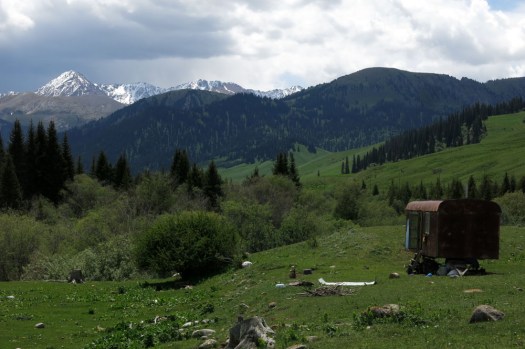
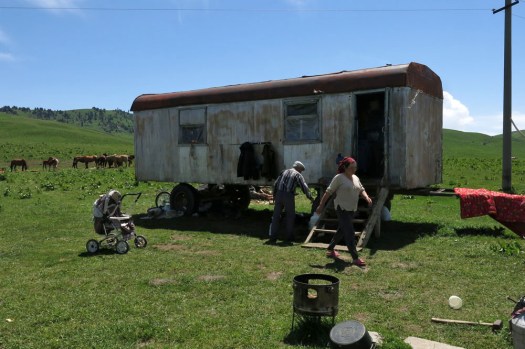
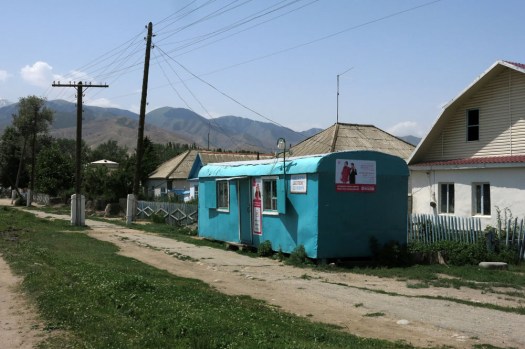
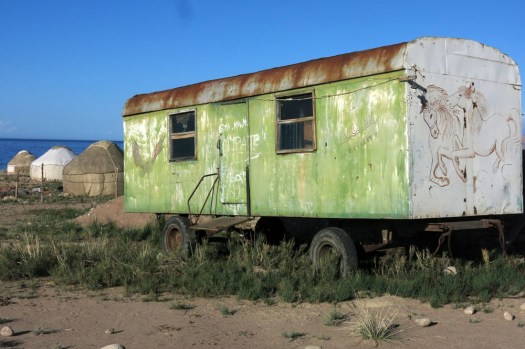
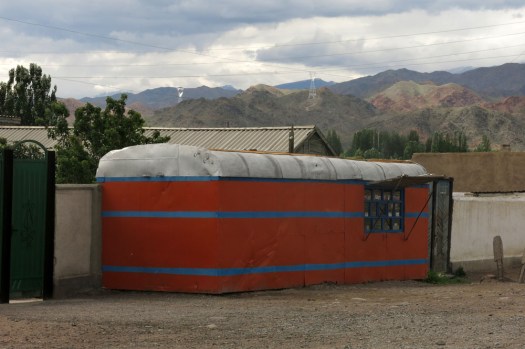
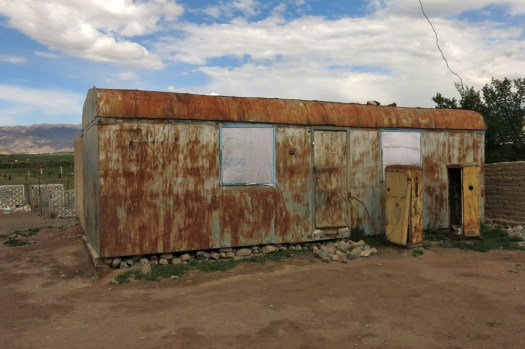
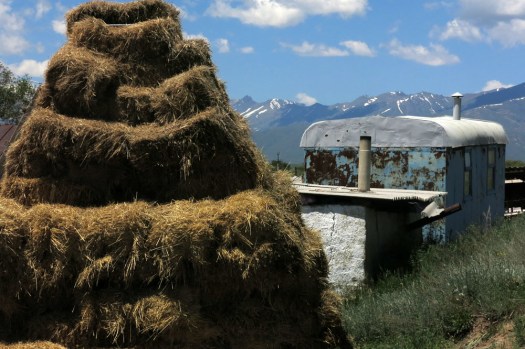
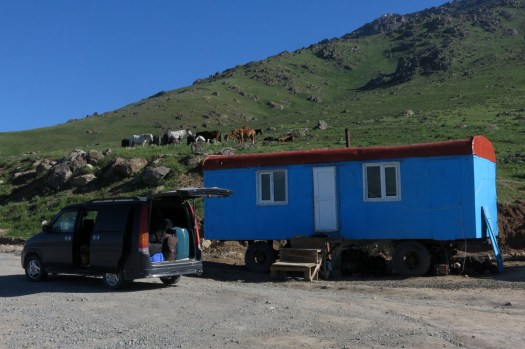
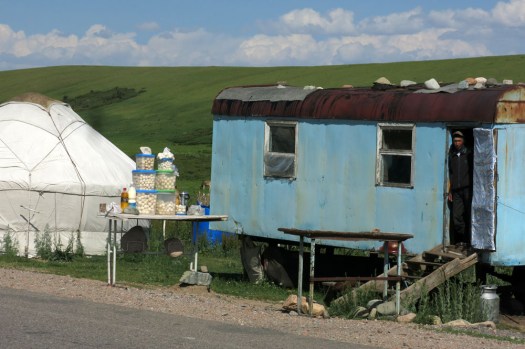
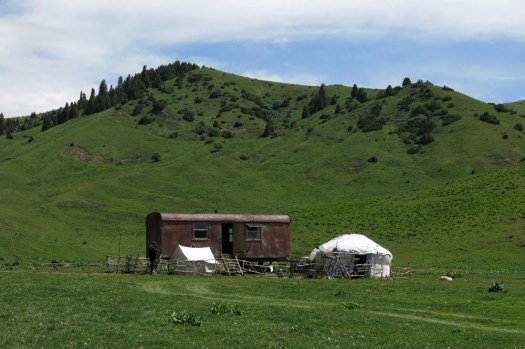 Kyrgyzstan does not have much of a railway system. A branch line from Moscow extends down from Kazakhstan to Bishkek, the Kyrgyzstan capital; another offers an excruciatingly slow service to Balykchy on Lake Issyk-Kul. Another line extends from Jalal-Abad in the south into Uzbekistan, although trains no longer run on this one. All of these routes date back to Soviet times but even then, Kyrgyzstan, or the the Kyrgyz Soviet Socialist Republic as it was in those days, sat on the outer fringes of the USSR, closer to China than to Moscow. All the more surprising then that, wherever you go in post-independence Kyrgyzstan, you tend to see Soviet-era railway carriages re-located and re-purposed as dwellings, shops, storerooms and even roadside tea-houses. What is most striking is how these are often located far away from a railway line or anything that even resembles a serviceable road. Bump along a rough stony track up to an isolated jailoo (alpine meadow with summer grazing) and the chances are that the nomadic family you meet there will have use of a rusting railway wagon parked somewhere near their yurt. Yurts are ubiquitous in the mountains in summer, and so central to the Kyrgyz way of life that the tunduk, the circular wooden centrepiece of the roof, appears on the national flag. But recycled decommissioned railway wagons have their part to play too, even if rusted metal is less aesthetically pleasing than white felt. In poor countries undergoing rapid transition like Kyrgyzstan, such a resource is too useful to be wasted.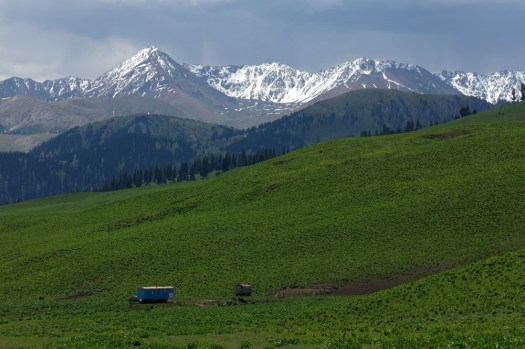

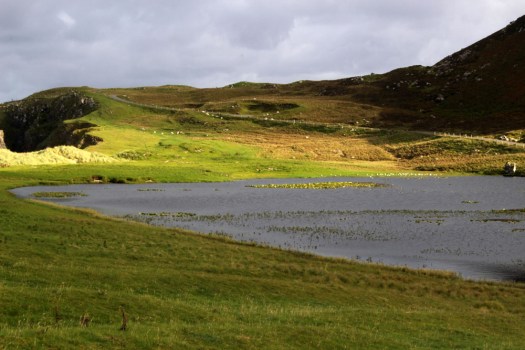 Just three main roads radiate out of Stornoway, the capital of the Isle of Lewis. One heads across mountains towards Tarbet and Harris to the south; another goes east past the island’s airport and along the Eye Peninsula to come to halt at the lighthouse at Tiumpan Head, while a third leads across the island’s moorland interior to reach its west coast. A little way along this last road is the turn-off to Tolsta, a minor road with the most unexpected of endings. The road passes bungalow settlements and sea-facing graveyards as it leads north. In Hebridean terms, this is relatively densely populated terrain — one settlement merging into the next in a loose sprawl known collectively as Back. This stretch of Stornoway’s hinterland might elsewhere be termed green belt were it not a fact that pretty well anywhere on Lewis and Harris could be described as ‘green’.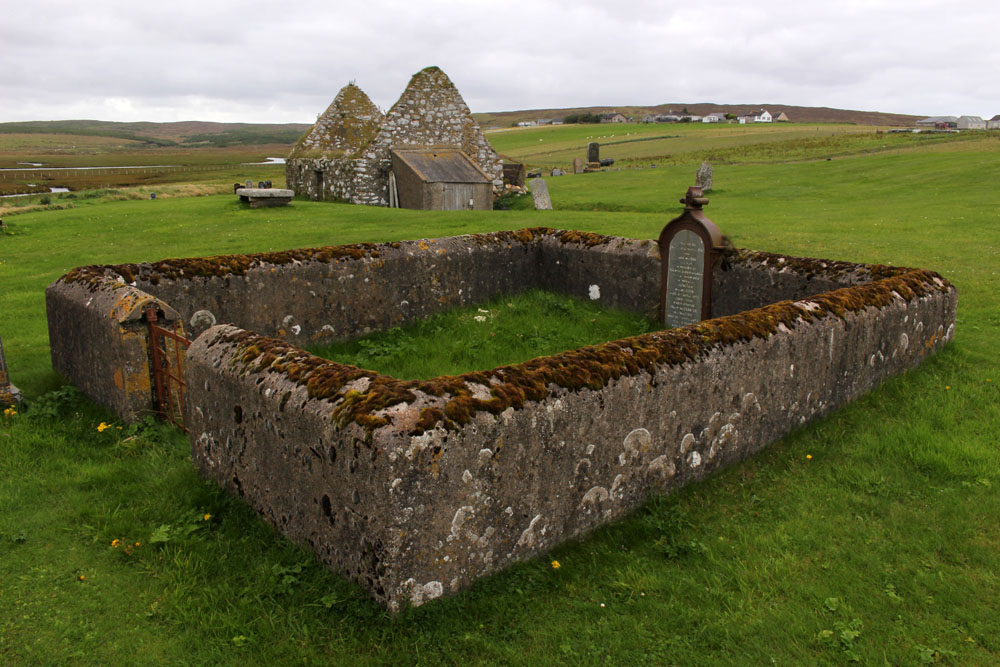
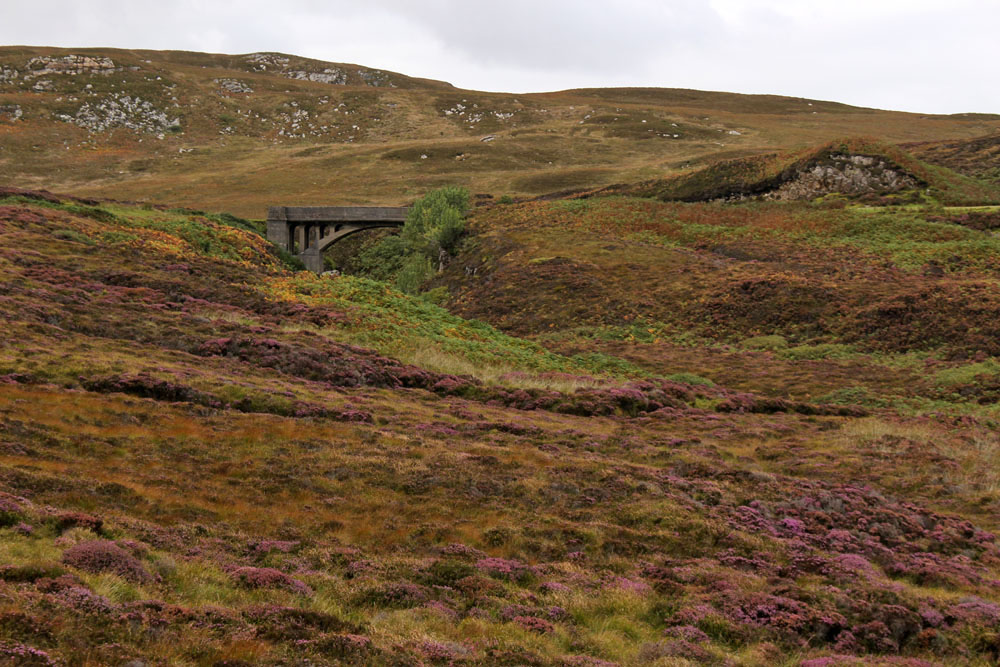

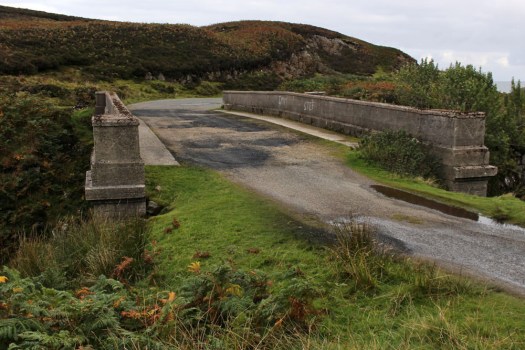
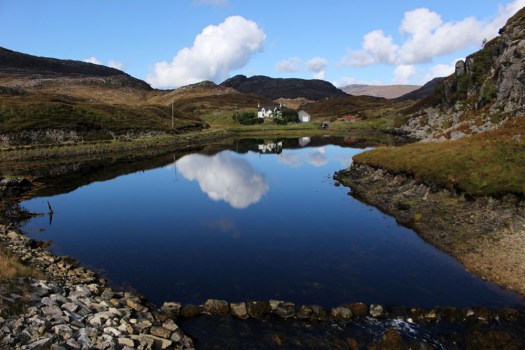

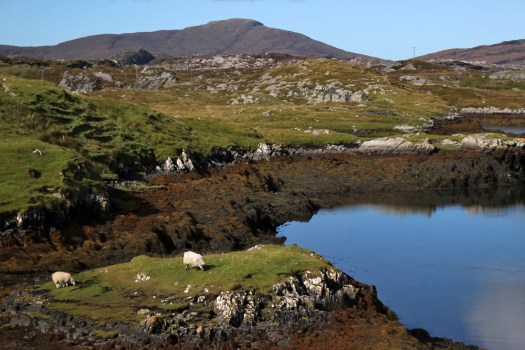
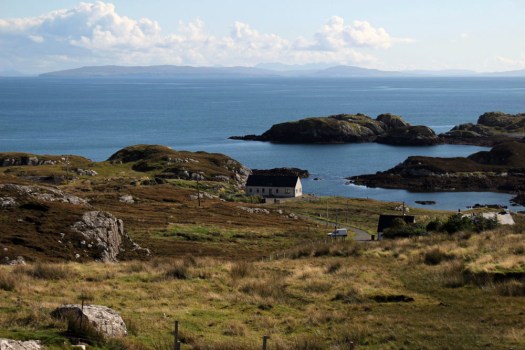


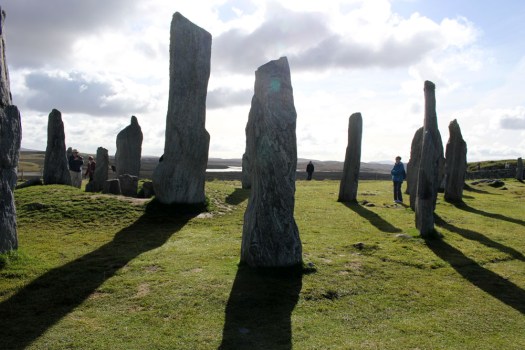
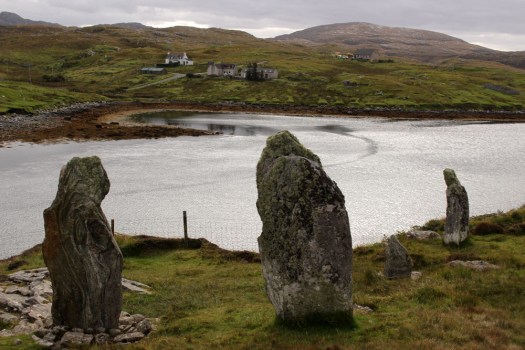
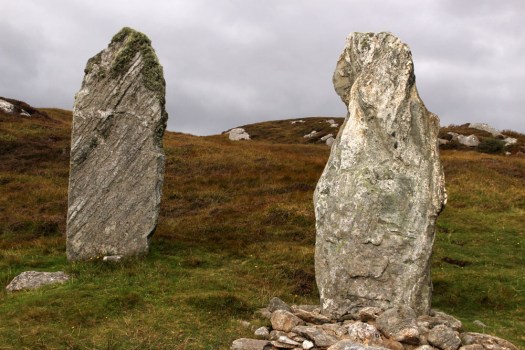
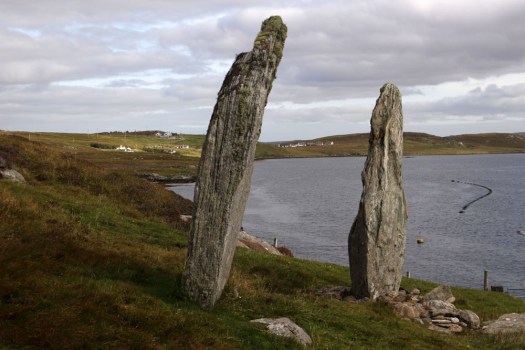
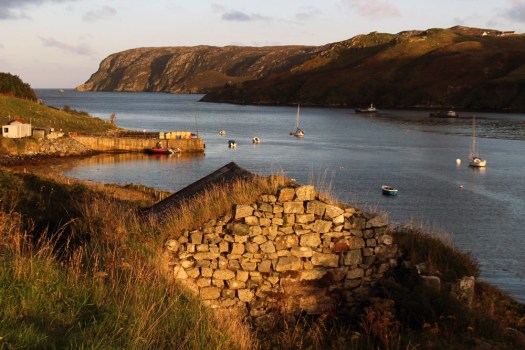 Eleven miles east of the main road, six from the nearest shop (closed on the Sabbath), two miles from the open sea as the raven flies. Glen Gravir – a slender thread of houses stretching up a glen, just four more unoccupied dwellings beyond ours before the road abruptly terminates at a fence, nothing but rough wet grazing, soggy peat and unseen lochans beyond. This was our home for the week, a holiday rental in the Park (South Lochs) district of the Isle of Lewis in the Outer Hebrides.
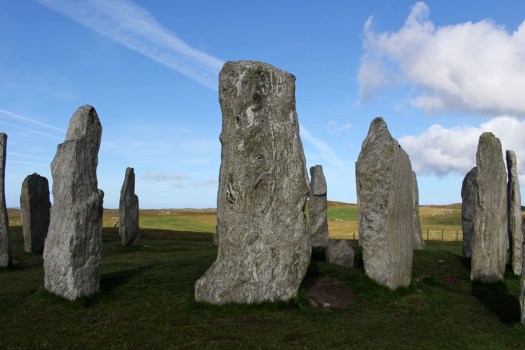
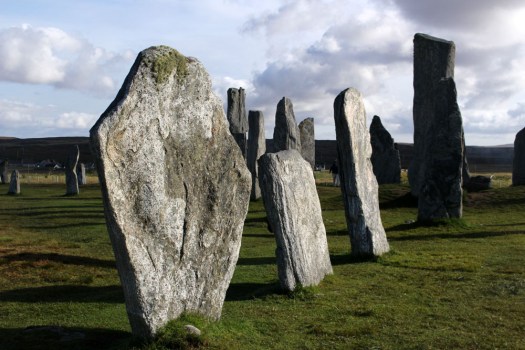
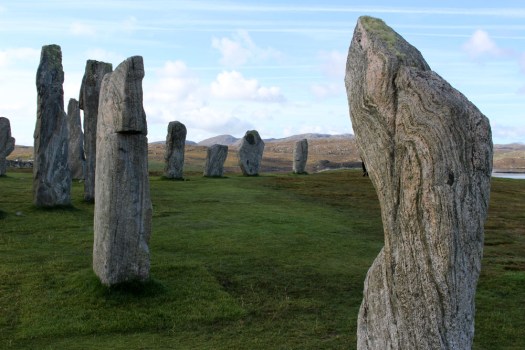
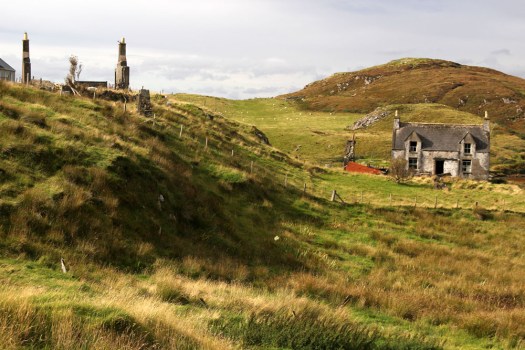
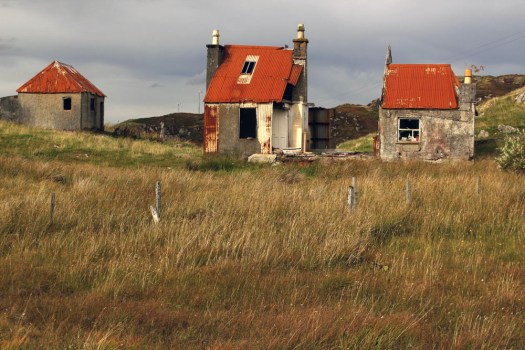
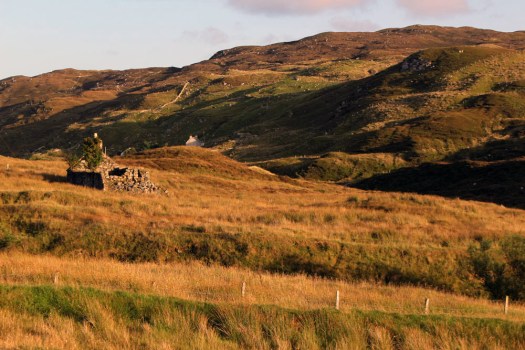 Gravir, of which Glen Gravir is but an outpost, is large enough to feature on the map, albeit in its Gaelic form, Grabhair. The village – more a loose straggle of houses and plots – possesses a school, a fire station and a church but no shop. A road from the junction with Glenside next to the church winds its way unhurriedly downhill to the sea inlet of Loch Odhairn where there is a small jetty for boats. Some of the houses are clearly empty; others occupied by crofters and incomers, their occupants largely unseen. Others are long ruined, tenanted only by raven and opportunist rowan trees, with roofs absent and little more than chimney stacks and gable walls surviving. It is only a matter of time before the stones that have been laid to construct the walls will be indistinguishable from the native gneiss that underlies the island, surfacing above the bog here and there in outcrops like human-raised cairns. Lewisian gneiss is the oldest rock in Britain. Three billion years old, two-thirds the age of our planet, it is as hard as…well, gneiss. It is the same tough unyielding rock that five thousand years ago was painstakingly worked and positioned at the Callanish stone circle close to Lewis’s western shore; the same rock used to build the island’s churches, which occupy the same sacred sites, the same fixed points of genii loci that had been identified long before Presbyterianism or any another monotheistic faith arrived in these isolated north-western isles.
 Ancient hard rock (as in metamorphic) may underlie Lewis, but religion is another bedrock of the island. Despite a respectable number of dwellings the only people we ever really see in the village are those who come in number on Sunday. The Hebridean Wee Free tradition guarantees a full car park on the Sabbath when smartly and soberly dressed folk from the wider locality congregate at Grabhair’s church, which, grave, grey and impressively large, is the only place of worship in this eastern part of the South Lochs district.
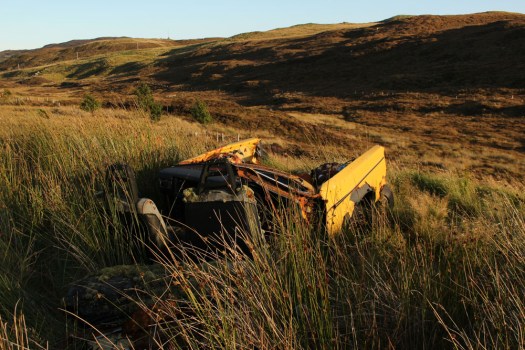
 At the bottom of the lane beneath the hillside graveyard next to the church are a couple of recycling containers for villagers to deposit their empties and waste paper. Larger items of material consumption are left to their own devices. Rain, wind and thin acidic soil are the natural agents of decay here. Beside the roadside further up from our house lie four long-abandoned vehicles in various stages of decomposition. Engines are laid bare; bodywork and chassis, buckled and distressed, rust-coated in mimicry of the colour of lichen and autumn-faded heather. Cushions of moss have colonised the seating fabric. The rubber tyres remain surprisingly intact, the longest survivor of abandonment. Sharp-edged sedges have grown around the rotting car-carcasses as if to hide them from prying eyes, preserving some modicum of dignity as the wrecks decay into the roadside bog, all glamour expunged from a lifetime spent negotiating the island’s narrow single track roads. On Lewis, vehicles die of natural causes, not geriatric intervention.
 Our cottage was rented as an island base: a place to eat, rest and sleep before setting off each morning on a long drive to visit one of Lewis’s far flung corners. Happily, it feels like a home, albeit a temporary one – a domestic cocoon of cosiness with all the modest comforts we require. Its small garden is a haven. As everywhere on the island, tangerine spikes of montbretia arch like welder’s sparks from the grass. Rabbits scamper about on the lawn, colour-flushed parties of goldfinches feed on the seed heads of knapweed outside the kitchen window. Robins, wrens and blackbirds flit around the trees and shrubs that envelop the cottage – non-native plants that have adapted to the harsh weather conditions of this north-western island, softening an outlook that on a grey, wind-blown day, with a gloomy frame of mind, might be considered bleak.
 Most days on our jaunts around the island we would see an eagle or two, golden or white-tailed, sometimes both. The majority of these sighting are in more mountainous Harris, or in that southern part of Lewis that lay close to the North Harris Hills, but on our last day on Lewis we see a white-tailed eagle fly over Orinsay, a village relatively close to where we have been staying. An hour later we spot another bird swoop along the sea loch at Cromore, a coastal village that lies a few miles to the north. It might well be the same bird. White-tailed eagles are very large and hard to miss, and their feeding range is enormous. But that is exactly how Lewis seems – enormous, almost unknowable despite its modest geographical area. A place larger than the shape on the map – a mutable landscape of rock, sky and water that does not easily lend itself to the reductionism of two-dimensional cartography.


 The Japanese have an expression – shirin-yoku (‘forest bathing’) — which refers to time spent in a wood or forest for purposes of health and relaxation. Scientific field studies have demonstrated that spending even a short time among trees promotes a lower concentration of cortisones, lower pulse, lower blood pressure, decreased levels of stress and improved concentration. In Japan activities such as shirin-yoku are part of the culture and hold an important place in the national psyche. Modern Japanese culture is still rooted in ancient nature-worshipping Shinto beliefs that are expressed in a variety of ways. Perhaps the most striking of these for westerners is the annual celebration of the
 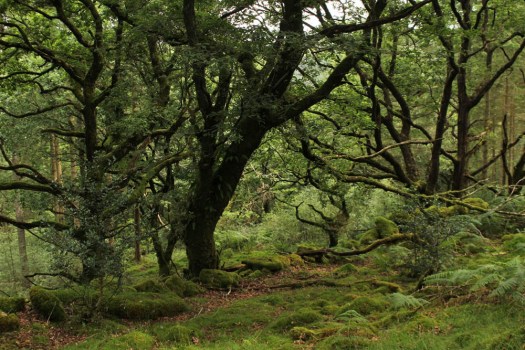 The forest, the greenwood, comes with cultural baggage. It is sensed to be a place of ‘the Other’, a place of wild things, of decay, of hidden danger; of runaway fugitives, mythical outlaws — Robin Hood being prime example — deserted children (Babes in the Wood), ghosts and malevolent spirits. There is no denying that some tracts of woodland are downright spooky, places where dark forces can be felt to be at large. Traditional children’s literature does not help much in mitigating this irrational if primal fear. In fact, it nourishes it — one of the very first books I remember reading as a small child was Winkie Lost in the Deep, Deep Woods, the very title of which suggests some sort of unspoken dark menace. As an archetype, a forest is perceived as an eldritch zone where wicked witches live alone in eerie hovels, where red-cloaked little girls are preyed upon by egregious wolves, and large gatherings of ursine cuddly toys attend sinister secret picnics. Go into the woods (today) and you might well be ‘sure of a big surprise’. In adult life the same fear is perpetuated as a trope of the horror genre — the psychological terror of The Blair Witch Project springs to mind. The forest is a place where bad things happen — a place to bury the bodies. Be afraid. Even Japan with its devotion to sakura and forest bathing traditions has its fair share of indigenous forest demons. The country even has its own haunted forest, Aokigahara, at the foot of Mount Fuji, which has the unenviable reputation of beings the world’s second most popular choice as a place for suicide.
 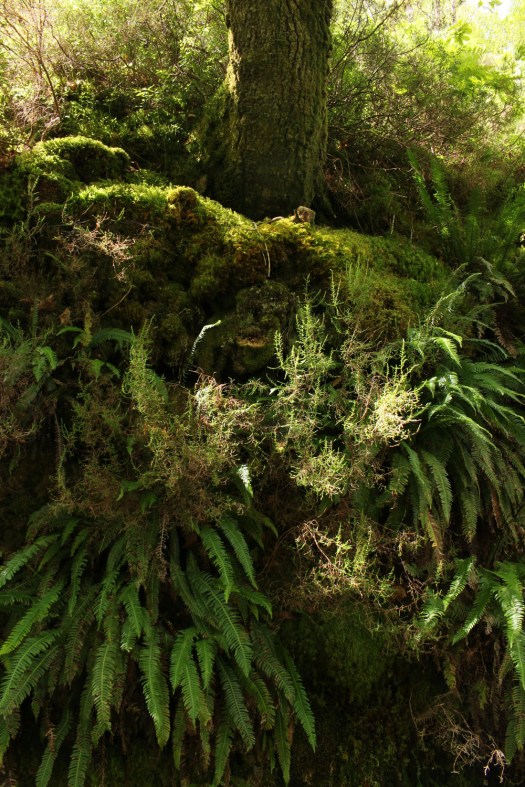 But let us embrace a positive outlook and view woodland as a place of wonder and nurture rather than fear and loathing, a place to breathe in the beneficial volatile oils emitted by trees and enjoy their beauty. Where better to delve into the greenwood in Britain than a tract of temperate rainforest that has hardly changed since the last glacial period? Coed Felinrhyd in North Wales has stood largely untouched since from this period and, although tracts of this woodland have been partially managed over the centuries, other parts have remained undisturbed for around 10,000 years. Coed Felinrhyd, owned by the Woodland Trust, is just a fraction of the remnant temperate rainforest found in this damp corner of Wales: a 90-hectare tract of woodland on the southern side of the narrow Ceunant Llennyrch gorge through which the mercurial Afon Pryser, a tributary of the Afon Dwyryd, flows. Coed Felinrhyd’s particularities of relief and climate, tucked away in a sheltered, virtually frost-free gorge close to the Welsh coast in a region where it rains on average 200 days a year, ensure that the ecosystem here is in many ways unique. Scarce plants and ferns thrive in the understory, rare lichens and mosses cloak the trees. But this is more than simply remarkable ecosysytem, this is also a place where geography and legend intertwine – the forest receives a mention in the ancient Mabinogion myths written down in the 12th century and is said to be the location where two warriors once fought to the death.
  The entrance is a little hard to find, hidden away just beyond the entrance to the Maentwrog power station on the Blenau Ffestiniog to Harlech road. A Woodland Trust notice board by the gate gives background information on Coed Felinrhyd and a signpost points out the direction of a well-defined trail that circuits the forest. The trail climbs steeply at first, then more gently before levelling off. The first thing to be noticed, other than the towering oaks that stretch in every direction, is moss. Although ferns are almost as prolific, sprouting like green shuttlecocks wherever they can secure a foothold, it is moss that is everywhere cloaking every surface — on the bark of trees, on the rocks that line the pathway, on the dry stone walls that partition the woodland; on any surface where moisture can collect. Even most of the tree stumps are upholstered with velvety jade cushions of moss, their cut surface having been rapidly colonised by the feathery fronds of bryophytes. Each of these is a pedestal-raised forest in miniature, a Lilliputian lost world — this small tract of woodland contains a million tiny moss forests within it. Some of the tree stumps have been cut mischievously into the shape of a chair or a four-legged stool, the work of a rogue woodsman with a sense of humour and an artistic streak. A few of are fresh enough to not yet sport the forest’s inevitable green uniform, although no doubt soon they will.
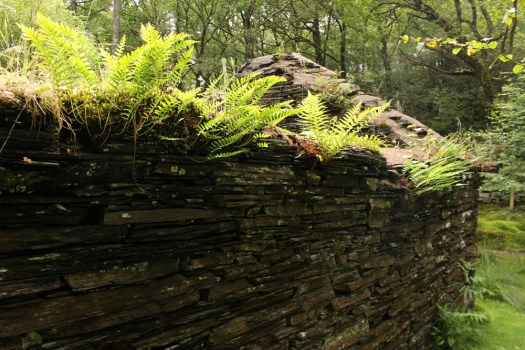
  Having reached a plateau in the woods we come across a ruined slate barn beside the trail, its roof long gone and ferns sprouting like bunting on top of the walls where the eaves should be. Long abandoned, the building is probably at least two hundred years old and a remnant of the old farming practice of ‘hafod a hendre’ in which shepherds would remain on higher pasture with their flocks during summer. The track continues past clumps of trees that seem to emerge directly from the moss-carpeted boulders at their base. The blanket of moss and lichens that covers both gives the impression that both tree and rock are born of the same material, something primal and green that is neither strictly vegetable or mineral but something in between.
 Descending back down into the valley we arrive at a dry stone wall that has a gate which leads into Llennyrch, a neighbouring tract of forest of similar pedigree to Coed Felinrhyd. We follow the wall to the left and the sound of rushing water becomes gradually louder as the gorge reveals itself. A small viewing platform gives a glimpse of the waterfall of Rhaeadr Ddu that plummets down onto the rocks below although the view is partly obscured by the dense foliage. The river is still some way beneath us but we draw closer to it as the path gradually descends. Finally we come to Ivy Bridge, which, true to name, is enveloped by long trails of ivy that hang over the edge almost touching the water and rocks beneath. Beyond the bridge, on the other side of the river, the unsightly machinery of an electricity substation can be discerned beyond a fence; beyond this, unseen from this position, lies the Maentwrog power station.
 After two hours of slow walking, looking, taking photographs and what can only be described as mobile ‘forest bathing’ we are back where we started. It suddenly occurs that we have met absolutely no one on our walk even though it is a relatively bright day with little threat of rain. No hikers or dog walkers, no botanists or tree-huggers, no Celtic warrior ghosts. And, to the best of our knowledge, no malevolent woodland sprites either.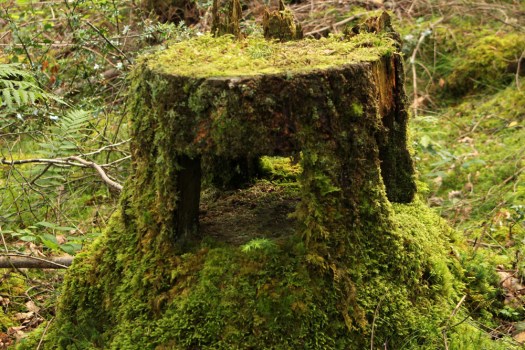




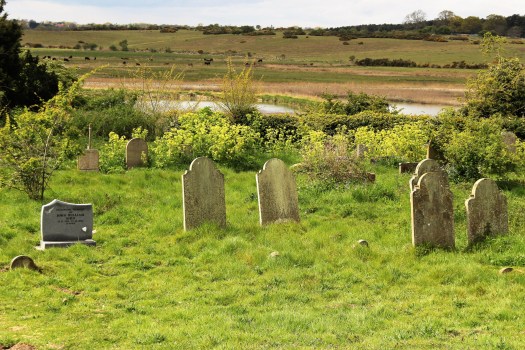
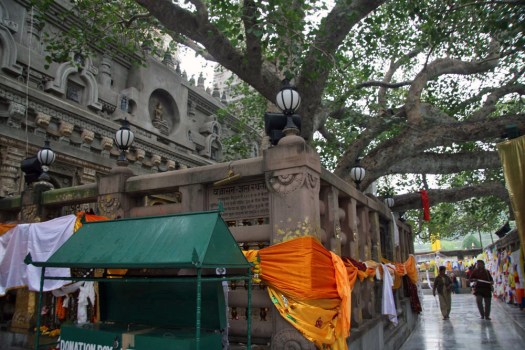


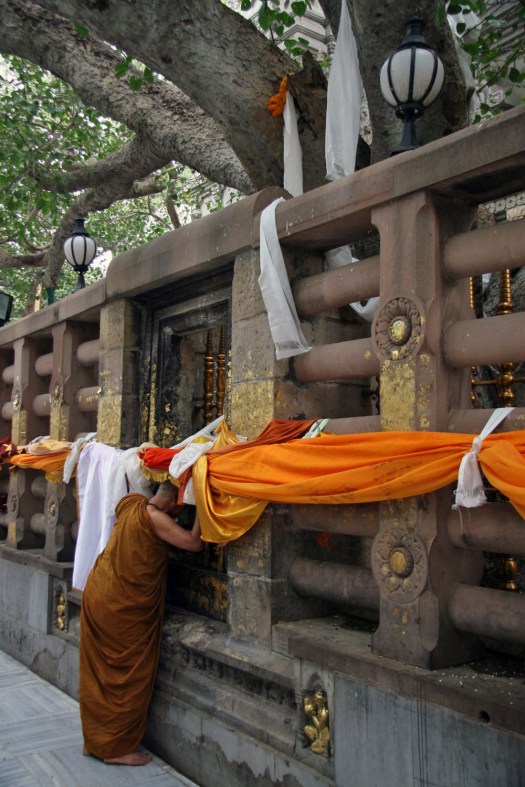


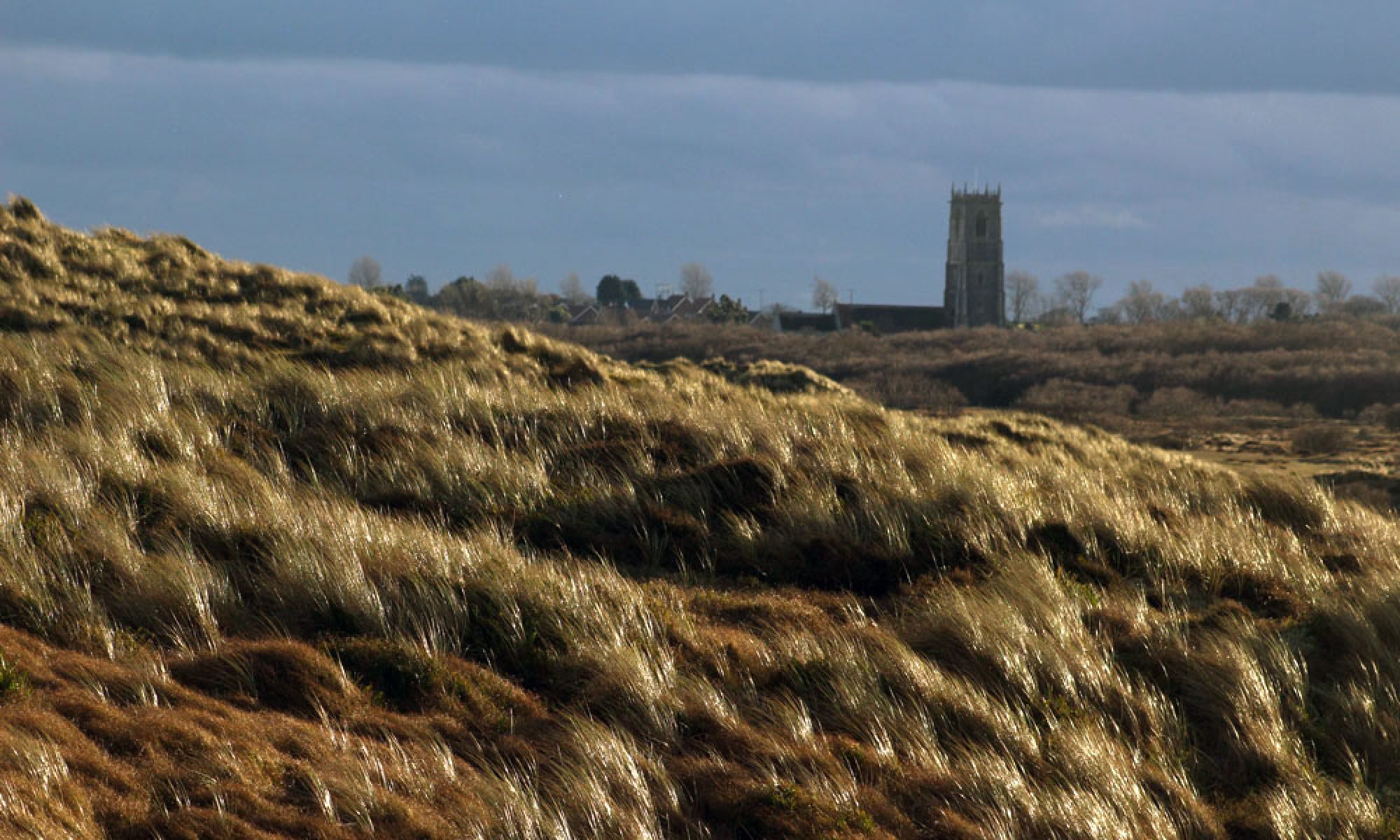
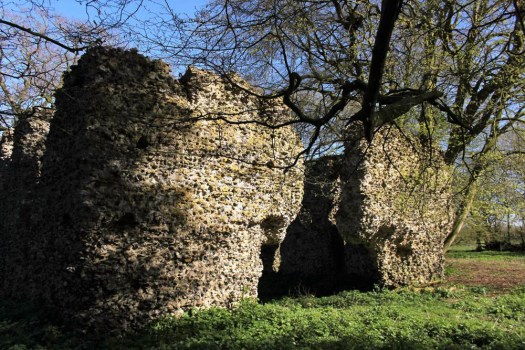 The Saints is a small, loosely defined area of northeast Suffolk just south of the River Waveney and the Norfolk border. Effectively it is a fairly unremarkable patch of arable countryside that contains within it a baker’s dozen of small villages with names that begin or end with the name of the parish saint: St Peter South Elmham, St Michael South Elmham, St Nicholas South Elmham, St James South Elmham, St Margaret South Elmham, St Mary South Elmham, St Cross South Elmham, All Saints South Elmham, Ilketshall St Andrew, Ilketshall St Lawrence, Ilketshall St Margaret, Ilketshall St John and All Saints Mettingham. The area is bisected in its eastern fringe by the Bungay—Halesworth road that follows the course of Stone Street, a die-straight Roman construction, one of several that can still be traced on any road map of East Anglia. On the whole though the roads around here are anything but Roman in character: narrow, twisting, often bewilderingly changing direction, and marked with confusing signs (too many saints!), it is a good place to visit should you wish to humiliate your Sat Nav. John Seymour in The Companion Guide to East Anglia (1968) describes The Saints as ‘a hillbilly land into which nobody penetrates unless he has good business,’ which is perhaps hyperbolic but there is undoubtedly a feel of liminality to the area that persists to this day.
 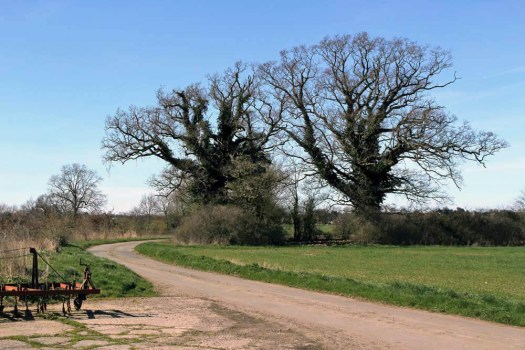 The village names conjure a medieval world where saint-obsessed religion loomed large. Such a tight cluster of settlements suggests a concentration of population where parishes might eventually combine to form a town or city – with 13 villages and the same number of churches (eleven of which are extant), there were more churches here than in all of Cambridge. But The Saints never coalesced to become a medieval city – none of the villages had a port, defensive structure or even significant market to its credit and consequently the area would slowly slip into obscurity as the medieval era played out and other East Anglia towns and cities – Cambridge, Bury St Edmunds, Ipswich and, of course, Norwich – took the baton of influence and power.
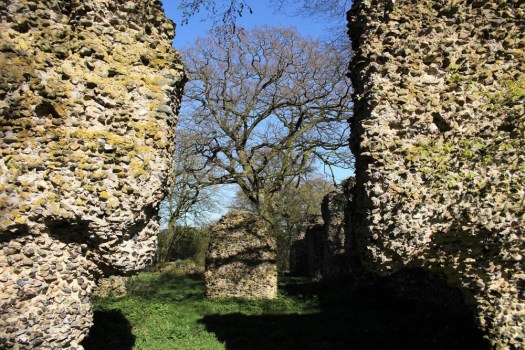
  It was not always so: one of the villages in particular held great significance in its day. The land covered by the South Elmham parishes was once owned by Almar, Bishop of East Anglia and the late Saxon Bishops of Norwich had a summer palace here at St Cross, now South Elmham Hall. The most intriguing of the churches lies within the same parish. It is not in any way complete but a ruin framed by woodland a good half mile from the nearest road. South Elmham Minster, although probably never a minster proper, is veiled in mystery regarding its origins but its appeal owes as much to its half-hidden location as it does to its obscure history. South Elmham may have once been the seat of the second East Anglian bishopric (the first was in Dunwich, the sea-ravaged village on the Suffolk coast), although North Elmham in Norfolk seems a more likely contender. Whatever the ruin’s original function – a private chapel for Herbert de Losinga, Norwich’s first bishop, is another possibility, or it may even be that a second bishopric was founded here – the church in the wood just south of South Elmham Hall dates back at least to the 11th century. It is probably older in origin – a ninth-century gravestone has been unearthed in its foundations. The site itself is undoubtedly of greater antiquity: a continuation of an earlier Anglo-Saxon presence that occupied the same moated site, which, earlier still, was home to a Roman temple and perhaps, even earlier, a pagan holy place.
 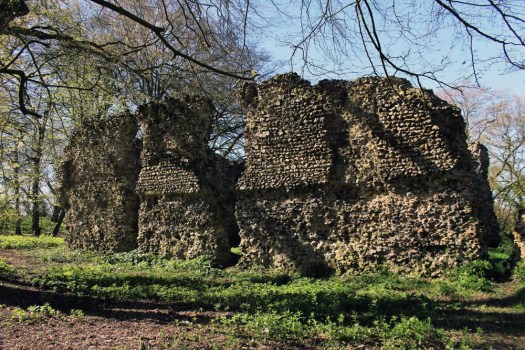 We leave the car in a muddy parking area alongside another vehicle and a dumped piece of agricultural machinery. Nearby stands a weather-beaten trestle table that suggests that this once might have served as a designated picnic spot. Now half-submerged in grass and thistles, the table did not look as if any sandwich boxes had been opened on it for some time. Things have changed here a little in recent years: the permissive footpaths that once threaded through the South Elmham estate are no longer available for the public, and the hall itself has been re-purposed for use as a wedding and conference venue. At least the minster was still accessible by means of a green lane and a public footpath across fields.
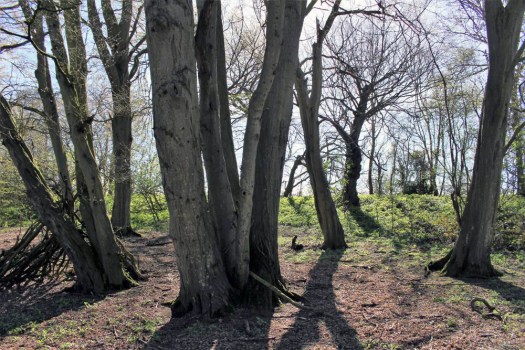
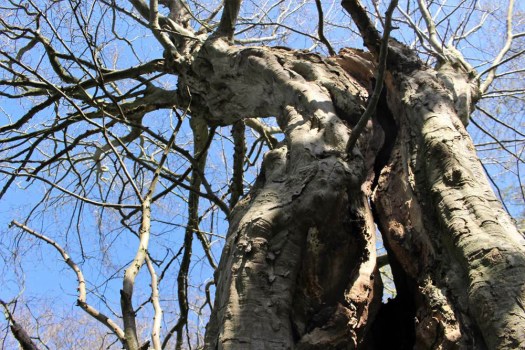
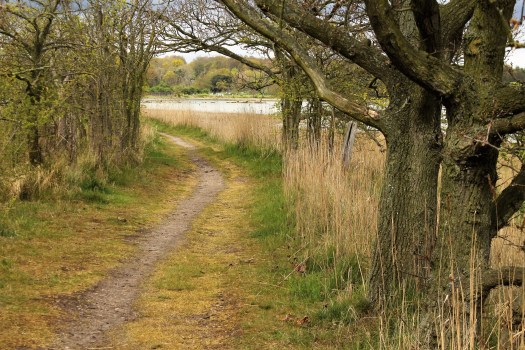
 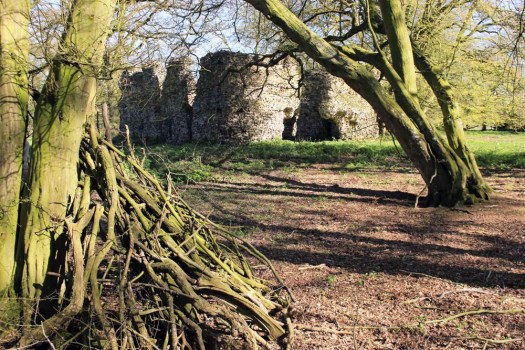 The green lane is flanked by mature hedges frothed white with blackthorn blossom. Reaching its bottom end we turn left to follow a footpath alongside a stream, a minor tributary of the River Waveney; strange hollowed-out hornbeams measure out its bank. Soon we come to the copse that contains the ruin, a rusty gate gives admission across a partial moat and raised bank into what can only be described as a woodland glade. The ancient flint walls of the church stand central, striated by the shadow of hornbeams still leafless in late March. There is no sign of a roof but the weathered walls of the nave are clear in outline, as is the single entrance to the west. On the ground, last year’s fallen leaves provide a soft bronze carpet that is mostly devoid of ground plants.
  Church or not, there is a timelessness to this place in the woods. And a strong sense of genius loci, the sort of thing that put the wind up the Romans with their straight lines and four-square militaristic outlook. I wander off to explore the bank to the west and discover the opening of a badger sett that looks to be newly excavated. Without much expectation, I rummage though the spoil musing that there might just be the remotest of chances that, burrowing deep beneath the mound, the animals have thrown up some treasure long buried in the soil below: an Anglo-Saxon torc, a Roman coin perhaps? I would even settle for a rusty button, but nothing. No matter, the mystery of the place is enough for now. We leave the bosky comfort of the site and retrace our steps along the beck and green lane back to the car. The other car has gone – we never did see its occupants.