Patience (After Sebald) – Walking The Rings of Saturn

About a year ago I wrote a post about an Aldeburgh Music weekend at Suffolk’s Snape Maltings that celebrated the life and works of the writer W G Sebald. A new film by Grant Gee, Patience (After Sebald), was also previewed on that occasion but it has taken a full year for it to have been finally been put out on general release in the UK. After such a long wait, ‘Patience’ might seem a wholly appropriate choice for a title but I finally got the chance to see the film last Sunday at a sell-out screening at Cinema City, Norwich.

The film is based on what is probably Sebald’s best known work, The Rings of Saturn, which  describes a long meditative walk in the Suffolk coastal region. In German translation the book is subtitled ‘Eine Englische Wollfahrt – an English pilgrimage’, but this is misleading as The Rings of Saturn is not really about pilgrimage at all, nor is it a work that concerns itself that much with landscape, although the shingle and wide skies of coastal Suffolk do make a cameo appearance.

Although genres such as travel, history and memoir are appropriate up to a point, The Rings of Saturn is a work that boldly defies categorisation and which cannot easily be placed into any single literary pigeonhole. Sebald’s Suffolk odyssey is really as much an internal journey through one man’s mind as anything else. Far from the normal notion of travelogue, The Rings of Saturn is more a psychogeographic exploration of one corner of East Anglia. Certainly, the physical geography here is spectral, a melancholic landscape of ghosts, personal reflection and dark cultural memory. The term ‘Proustian’ might be used to define Sebald’s style to some extent but a better word would be Sebaldian: W G Sebald is one of those rare writers, like Dickens, Kafka and Ballard, whose name can be confidentally used as an adjective thanks to a distinctive mournful style and typically digressive, fragmentary narrative.

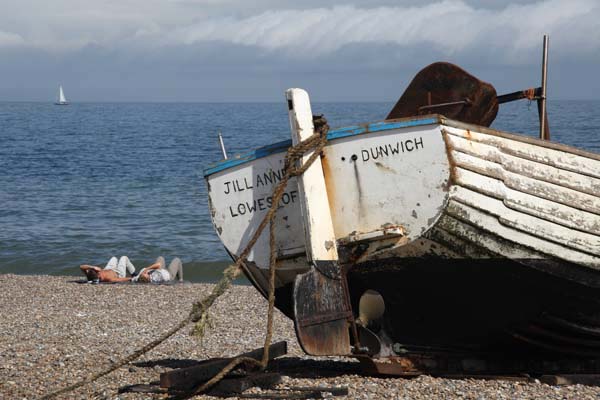
Part of the Sebaldian trope is to include images – black and white photos and line drawings – as part of the narrative flow; images, sometimes unsettling, that are tangential to the geography of the walk yet central to the narrative’s solipsistic digressions. Many of the book’s already familiar images are replicated in Patience (After Sebald), serving as a backdrop for talking heads like Robert Macfarlane, Iain Sinclair and Andrew Motion who have been recruited among others to give their personal take on Sebald’s oevre. Other images on display in the film are immediately resonant to those who have read The Rings of Saturn even though they do not appear as photographs within the pages of the book itself. A brief glimpse of a naked couple lying on a beach clearly represents the lovers that Sebald stumbled upon at Covehithe and, panicking, described as ‘like some giant mollusc washed ashore… a many-limbed, two-headed monster’. A shot of a distressed-looking plate of food undoubtedly refers to the joyless pub meal taken by the author in Lowestoft, which contained a fish that had ‘doubtless lain entombed in the deep-freeze for years’ along with tartare sauce ‘turned grey by sooty breadcrumbs’. Apart from an occasional colour inset frame showing a walker’s boots on the tarmac (the film-maker himself perhaps?), the images used are monochrome throughout, as grey as Sebaldian tartare sauce.

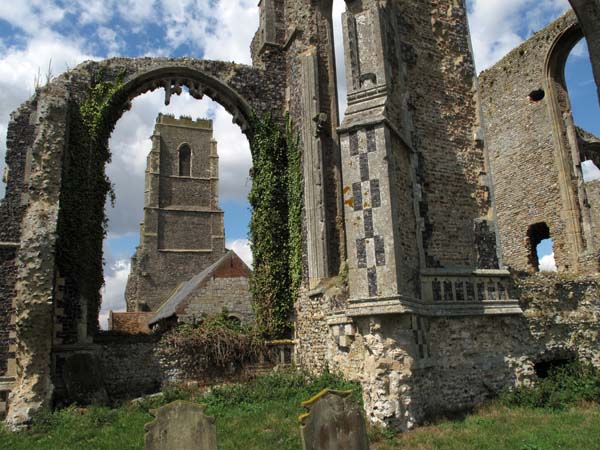
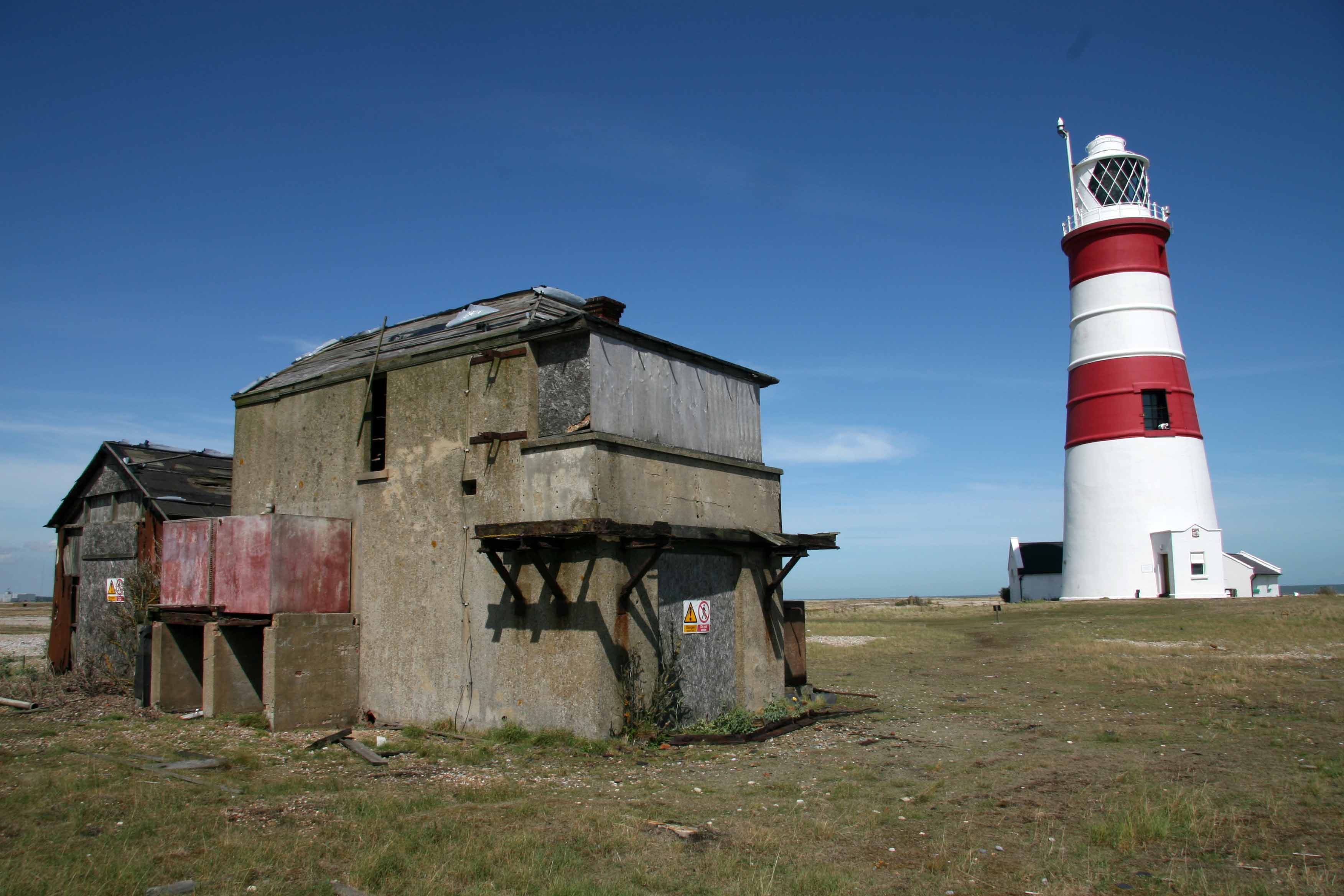
Also permeating the film are grainy 8mm-like shots of some of the locations that Sebald passed through on his long walk – places that get scant mention in The Rings of Saturn but which clearly inform its telling; places familiar to anyone who knows the Suffolk coast reasonably well – Southwold’s Sailors’ Reading Room, Boulge church, Yoxford, the ruins of Dunwich and the formerly top secret research pagodas of Orford Ness. If anywhere could be described as an archetypal Sebaldian landscape it would surely be Orford Ness.

Patience (After Sebald) complements Sebald’s book admirably. It encourages those unfamilar with his work to read The Rings of Saturn for the first time, while those already smitten can find nourishment in the distinctly Sebaldian imagery of the film and the generous personal accounts of the man himself. To be nitpicking, there are a couple of small details that some Sebaldophiles might find slightly incongruous – Andrew Motion reading his poem about the merman of Orford, perhaps, and a scene near the end that involves a puff of smoke at the roadside where Sebald died in a car accident. The latter I found quite thrilling although some might consider it borderline tacky – I can say no more.

Sometimes writers can seem to influence the reader’s view of landscape to such an extent that it is hard to come to it with innocent eyes. Once The Rings of Saturn has been read and absorbed, coastal Suffolk – in the right conditions – can easily transform into a Sebaldian landscape for those passing through it. Yet, as Robert Macfarlane recounts in Gee’s film, it is imposible to replicate Sebald’s journey exactly. Macfarlane’s own well-intentioned attempt to retrace Sebald’s steps was thwarted by sunny, distinctly non-Sebaldian weather and by simply having too much fun swimming at Lowestoft.

Even with fine weather and a light heart, it seems impossible for anyone who has read The Rings of Saturn and walked the Suffolk coast to not have some sort of Sebaldian connection. Whether we like it or not, his prose and dark historic musings have encouraged us to see the coastal landscape in a thousand shades of (tartare) grey whatever our proclivities. But we cannot replicate Sebald – and why should we? Even following those exact same footsteps, we all do our own walk, make our own pilgrimage. The psychogeographical dimension of any walk through any landscape is as dependent on the mindset of the walker as it is on the territory itself.

On a personal note, the book’s geography resonates more than I might ever have imagined: the site of the old Norfolk and Norwich Hospital where Sebald opens the text (finding himself there with a back problem a year after the completion of his Suffolk walk) is located immediately across the road from where I live.
Suffolk Coast Walks 2

Just to update the previous post – Nick Marsh, countryside officer at Suffolk Coast and Heaths AONB, went on BBC Radio Suffolk a couple of days ago to talk about my new Cicerone guide and the walking potential that the Suffolk coastal region offers. You can listen again here (fast-forward to around 2:37). It is available online until March 5.

Suffolk Coast Walks

If I might be allowed a little shameless self-publicity, my new book Suffolk Coast and Heaths Walks: Three Long-distance Routes in the AONB is published today by Cicerone. A bit of a  mouthful, I know – let’s just call it ‘Suffolk Coast Walks’ for the sake of brevity.

The book gives a detailed account of all three long-distance trails within the Suffolk Coast and Heaths AONB (Area of Outstanding Natural Beauty). All three routes make for excellent walking, either in their entirety or as selected day stages.

OS map extracts for the various stages are included and the book also has considerable background information outlining the history, geography and wildlife of this attractive region.

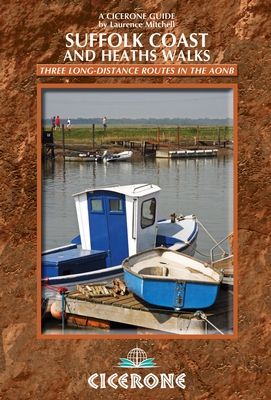
It is lavishly illustrated too, with photographs taken by yours truly (the cover shows the River Blyth at Southwold).

For a look inside the book, a sample chapter and downloadable PDF file you can visit the Cicerone website here. It is also on Amazon.co.uk here.

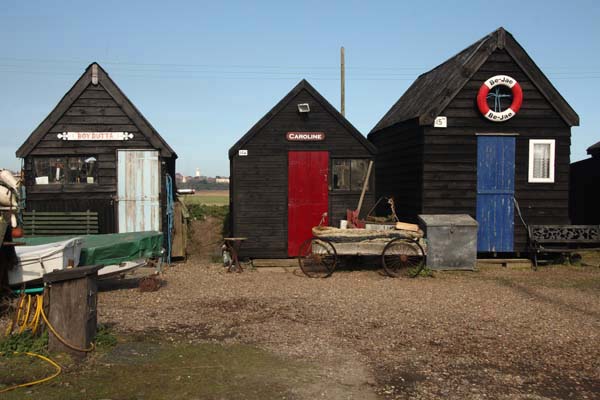
Here’s a brief sample from the introduction and a few images from the book.

Introduction

The sky seems enormous here, especially on a bright early summer’s day, and the sea beyond the shingle almost endless. Apart from the gleeful cries of children playing on the beach, the aural landscape is one of soughing waves and the gentle scrape of stones, a few mewing gulls and the piping of oystercatchers. Less than a mile inland, both scenery and soundscape are markedly different – vast expanses of heather, warbling blackcaps in the bushes, and a skylark clattering on high; the warm air is redolent with the almond scent of yellow gorse that seems to be everywhere. This is the Suffolk coast, and it seems hard to imagine that somewhere quite so tranquil is just a couple of hours’ drive away from London.

The big skies, clean air and wide open scenery of the Suffolk coast has long attracted visitors – holiday makers certainly, but also writers, artists and musicians. The Suffolk coast’s association with the creative arts is longstanding, and its attraction is immediately obvious – close enough to the urban centres of southern England for a relatively easy commute, yet with sufficient unspoiled backwater charm for creativity to flourish.

It is not hard to see the appeal – east of the A12, the trunk road that more or less carves off this section of the East Anglian coast, there is a distinct impression that many of the excesses of modern life have passed the region by. The small towns and villages that punctuate the coastline and immediate hinterland are by and large quiet, unspoiled places that, while developed as low-key resorts in recent years, still reflect the maritime heritage for which this coast was famous before coastal erosion took its toll.

The county of Suffolk lies at the heart of East Anglia, in eastern England, sandwiched between the counties of Norfolk to the north, Essex to the south and Cambridgeshire to the west. The county town is Ipswich, by far the biggest urban centre in the county, while other important centres include Bury St Edmunds to the west and Lowestoft to the north. Much of the county is dominated by agriculture, especially arable farming, but the coastal region featured in this book has a wider diversity of scenery – with reedbeds, heath, saltmarsh, shingle beaches, estuaries and even cliffs all contributing to the variety. There is also woodland, both remnants of ancient deciduous forests and large modern plantations. Such a variety of landscapes means a wealth of wildlife habitat, and so it is little wonder that the area is home to many scarce species of bird, plant and insect.

This region can be broadly divided into three types of landscape – coast, estuary and heathland, or Sandlings as they are locally known – and the three long-distance walks described in this guide are each focused on one of these landscape types.  All three have plenty to offer visitors in terms of scenery, wildlife and historic interest, and the footpaths, bridleways and quiet lanes found here make for excellent walking.

Almost all of the walks featured here fall within the boundaries of the Suffolk Coast and Heaths Area of Outstanding Natural Beauty (AONB), which stretches south from Kessingland in the north of the county to the Stour estuary in the south. The whole area – both coast and heaths – is now one of 47 Areas of Outstanding Natural Beauty in England, Wales and Northern Ireland, having received AONB status in 1970, a designation that recognises, and protects, the area’s unique landscape.

Lost Highway

Enough westering. Let’s return back across the Atlantic for this post: to Northumberland north of Hadrian’s Wall, the once lawless Reivers country where northern England meets Scotland. Not exactly east of Elveden but certainly east of Eden, the river that flows southeast from Carlisle on the Solway Firth and bisects the upland areas of the Lake District to the west and the north Pennines that lie to the east. Immediately north of here are the Cheviots, the ancient rounded hills of the Scottish Borders.

Kielder Water, a large reservoir created in the 1970s to provide a water supply for industry, has all sorts of superlatives associated with it. The reservoir itself is the largest artificial lake in the United Kingdom, while the forest that surrounds it is said to be the largest man-made area of woodland in Europe. The village that gives the reservoir its name is considered to be one of the most isolated villages in England and the area is also deemed have the clearest night skies in the UK. There is so little settlement in the vicinity that the area is relatively unsullied by light polution and, as testament to this, an astromony observatory has been constructed close to the reservoir’s northern end.

Artificial perhaps, Kileder Water is still a glorious place of long vistas and a distinct sense of isolation in winter. Alongside huge stands of Norwegian and Sitka Spruce and other would-be Christmas trees are raised banks of mature beeches and lofty stands of Scots Pines surrounding the reservoir’s cold waters. Red squirrels frolic elusively in the tops of the pines while crossbills wrench the seed from cones with their strange twisted beaks. Lying beneath the water are a scattering of buildings that once belonged to the farmland that was sacrificed to a sub-aqua future when the dam was completed. There is no sign of these now; no obvious architectural ghosts other than patterns in the water whipped up by the wind that seem to imply a regular linear structures beneath the surface – old farm walls perhaps?

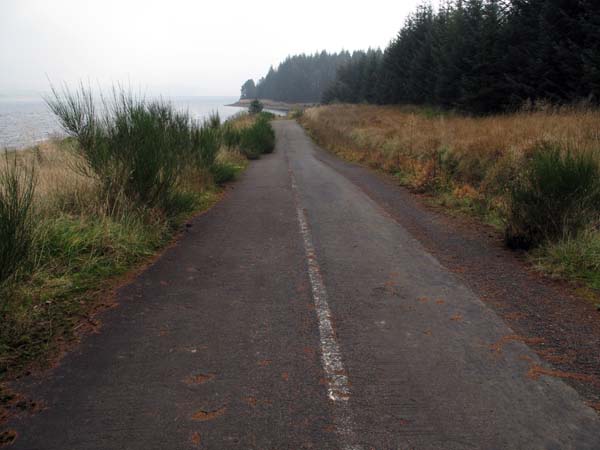
What can be seen here and there though are fragments of the main road that used to run along the North Tyne Valley in the days before ‘the flood’. A modest tarmac road with a dividing white line (no cats’ eyes), this surfaces for a short stretch along part of the shore of the Bull Crag penisula at the southern end of Kielder Water. Once upon a time, this lonely road would have carried traffic north from Bellingham to Kielder village, from where it would climb higher into the Cheviots and over the Scottish border. These days, the road sees no through traffic – just a handful of walkers and mountain bikers enjoying the facilities of the forest park. The fragment that remains begins and ends in water. This palimpsest of an earlier human landscape is now, quite literally, a road to nowhere.

High Line

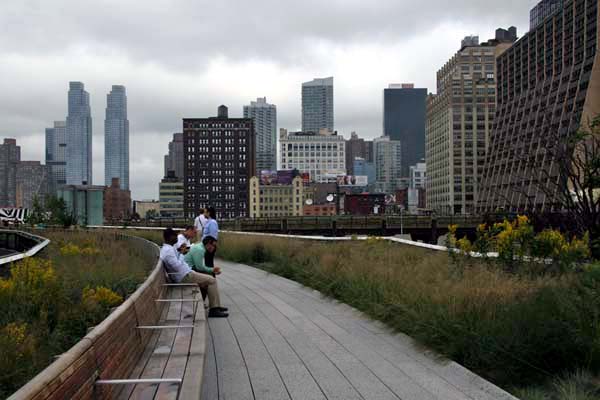
New York City isn’t the sort of place that immediately springs to mind when one thinks of walking but the city is a treasurehouse for urban exploration. Walking – with a little bit of assistance from the city’s comprehensive bus and subway system – is by far the best way to get under the skin of the ‘Big Apple’ and, to squeeze the life out of this hackneyed metaphor, who knows what you might find – pips, juicy flesh,  maybe even a worm or two?Unlike many American cities, where the assumption is that people prefer to move around in noisy mobile metal boxes, New York is a relatively pedestrian-friendly place. For a wholesome, petrochemical-free experience, there’s always Central Park, but for the past year or so there has been another traffic-free route through Manhattan’s West Side that has transformed a pre-exisiting industrial conduit to a green pedestrian byway.

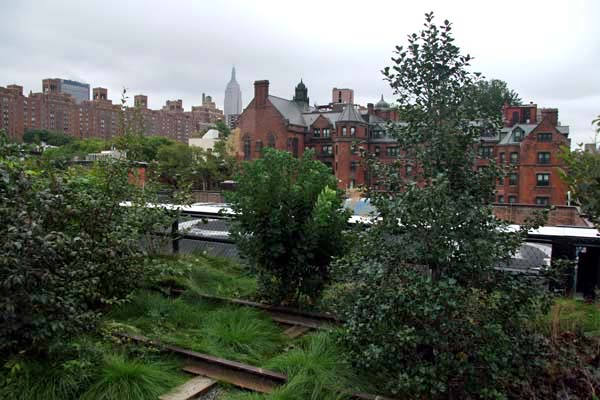
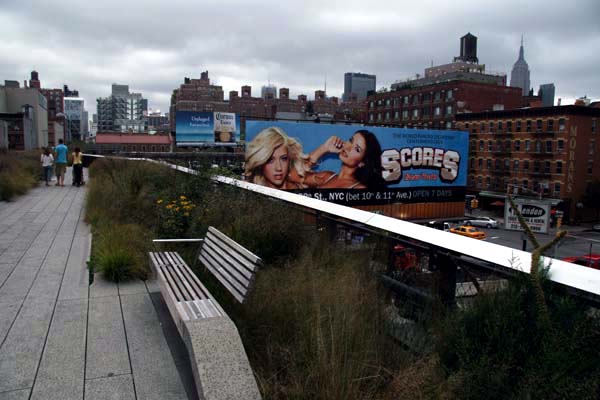
New York’s High Line, a mile and a half of raised walkway above the working class neighbourhoods of the West Side, was once part of an elevated railway that was built in the 1930s to shift goods to and from the slaughterhouses and packing plants of the Meatpacking District around Gansevoort Street. Defunct by the mid 1980s, the rail line has since been lovingly transformed into a fine green artery that links that same meaty neighbourhood with West 34th Street in Hell’s Kitchen to the north. In place of sleepers and railtracks a landscaped walkway now threads along its length, which is lined on both sides by plentiful benches and seating areas, and long leafy borders filled with grasses, perennials and shrubs. To add a bit of glamour, the Empire State Building peeks above the surrounding city roofline at regular intervals as a reminder that Midtown’s architectural bling is really not so far away.

The real beauty of the High Line is that it does not really have any specific sight to see at either end – the Meatpacking District was never a big tourist draw, although the neighbourhood is currently on the up and being gentrified faster than you can say ‘sushi bar’. Sometime in the future there will be a new American art museum built at Gansevoort Street but, for the time being, rather than any particular goal, the attraction is the High Line itself – the walking of it. What better way to take in the city than to stroll above the streets and buildings where New Yorkers actually work and play out their lives?

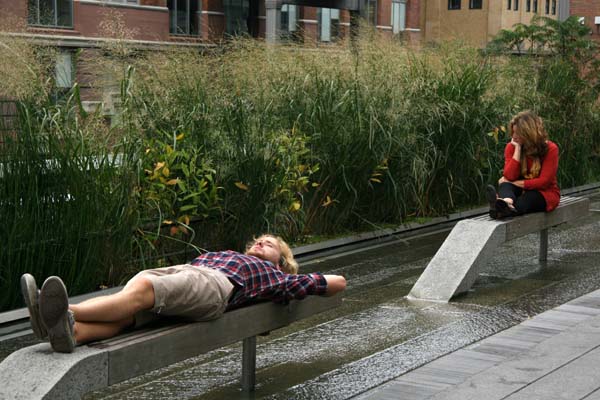
Technically speaking, the High Line is an urban park rather than a mere thoroughfare. Its not just for tourists but a place filled with office workers eating sandwiches and  friends taking a stroll together – native New Yorkers looking down on the streets they have known all their lives and seeing them from a fresh perspective. It is also quite remarkably crime-free.

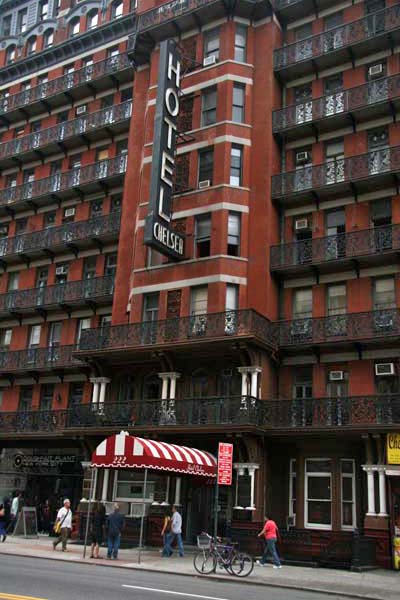
Halfway along, just south of Hell’s Kitchen, the route runs through the West Chelsea district and anyone wishing to pay homage to Sid Vicious or Dylan Thomas (who both died here), or Jack Kerouac, Bob Dylan or Joni Mitchell (who all embraced its muse), could do worse than make a short pilgrimage to visit the famous Chelsea Hotel at West 23rd Street. Sadly, the hotel has recently been bought up by a developer and is no longer open to ‘receive new guests’, so artists, writers and rock stars in search of a creative Bohemian atmosphere or a suitable venue for high-spirited shenannigans are now obliged to look elsewhere.

Crossing the Bridge

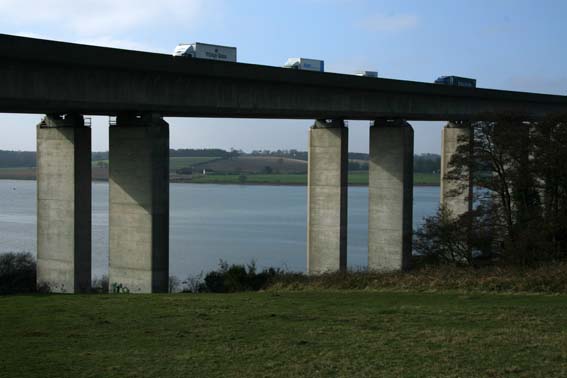
A little south of Ipswich, the vast concrete span of the Orwell Bridge stretches across the eponymous river like a conveyor belt to Hades. Well not Hades exactly, but the Port of Felixstowe. A constant rattling procession of lorries shunt to and fro the port, their drivers barely aware of the river they are crossing or the county town they are skirting by. The ciphers that identify their payloads have become household names — Maersk, China Shipping, Cosco – those magic metal boxes that contain the necessities of 21st-century life. Well-travelled, and more often than not coming from the Far East, the containers are the camels of the latter day Silk Road: a trade route, which, as any historian will tell you, was about a lot more than just silk.

The bridge might appear to be no place for pedestrians, but they are tolerated, and walkers intent on completing the Stour & Orwell Walk between Languard Point and Cattawade, and wishing to avoid the extra six or so miles of the alternative ‘Ipswich Loop’, are obliged to cross it on using the walkway on its southern side. The approach on foot from Orwell Country Park is intimidating – the noise, speed and volume of traffic all contributing to the inevitable feeling that this is an unnatural place for hikers to be setting foot. The 30-metre drop to the Black Ooze (yes, it really is called that) of the River Orwell below is held at bay by just a concrete ledge a little more than a metre high. This is certainly not comfortable strolling territory, nor a place to suddenly become aware of a hitherto undiscovered acrophobia.

Steps lead up sharply to the bridge walkway, past a Samaritans sign that bears a short but kind message and a phone number. Like steps to the gallows, the certainty that you are shadowing the last steps taken by some desperately unhappy souls is chilling. At the top is a free phone, proof that someone cares, although the lorries flying by seem wholly indifferent. The views along the Orwell estuary are pleasing – green fields, houses snuggled in woodland, little boats bobbing in silver water – but the constant thrum of the traffic, and a tangible sense of alienation, do not encourage lingering. The walk across takes around 15 minutes.

Bridges are powerful metaphors for the journeys of life, for transformation. The novelist Ian Banks wrote an entire novel – The Bridge, no less — using an enormous industrial super-complex of a bridge as the dream environment of his comatose crash victim protagonist. Religion and mythology make good use of the bridge as metaphor too and the crossing of a body of water — the River Jordan, River Styx — is ascribed a spiritual meaning. Most of the time though, our concerns are more mundane: if crossing the Orwell Bridge on foot is disturbing then it is because of its height and heavy traffic as much as its psycho-geographic imprint.

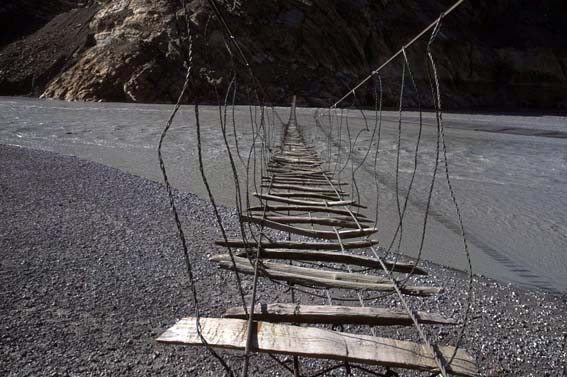
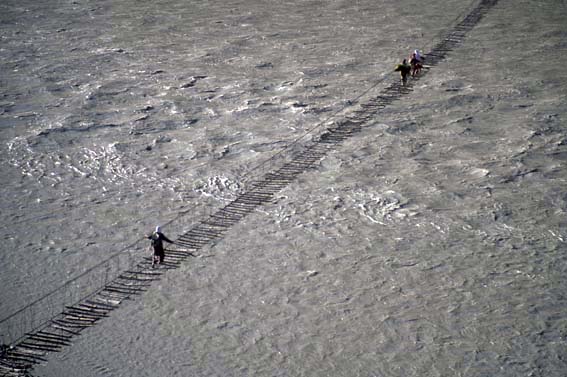
Elsewhere in the world, where health and safety concerns are not held as sacred as they are here in the West, dodgy-looking footbridges have been used daily for generations without much fuss. The one illustrated here is over the Hunza River in the far north of Pakistan. To be honest, it is a little nerve-wracking to traverse, especially when local villagers join you and the bridge sways nauseatingly above the rapid rock-filled glacial river beneath. More alarming still is to cross halfway only to discover a missing slat and the necessity of making a jump to the next complete one.

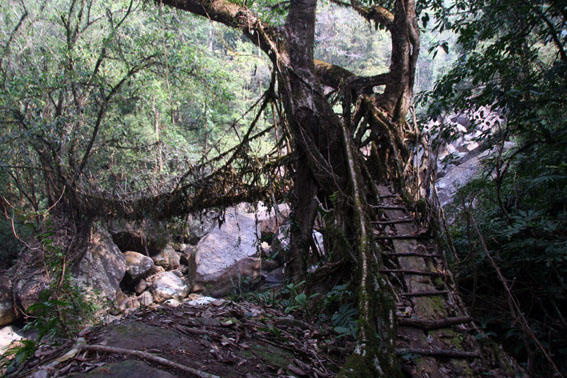
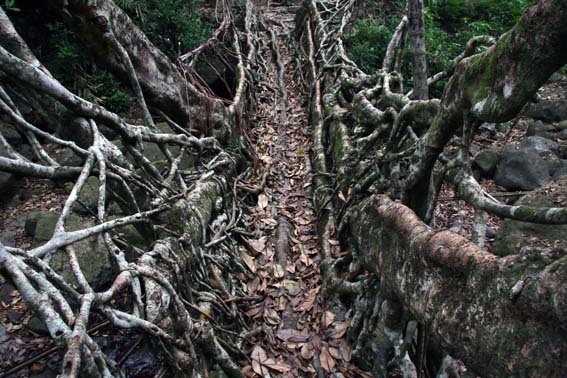
In contrast, this footbridge feels much safer; nurturing even. Perhaps it is its solid organic nature that reassures, and also the surprising realisation that it hardly sways at all? This remarkable feat of bio-engineering, which resembles something that Frodo might have encountered in The Lord of The Rings,  is one of many living root bridges found in the deep, rain-washed valleys of Meghalaya, northeast India. Fashioned from the living roots of fig (Ficus elastica) trees that grow alongside the region’s turbulent monsoon streams they take decades to build but last for centuries. You can read my article on them in Geographical magazine here.

Returning closer to home, to the Waveney Valley in fact, here is a short extract from Slow Norfolk & Suffolk that describes an encounter on the bridge across the Waveney at Mendham on the Suffolk/Norfolk border. Perhaps bridges do affect us psychologically more than we might credit?

This is classic Waveney Valley scenery — the sort of thing Munnings might have painted if he had not concentrated on horse fairs or attacking modernism quite so much. It’s the kind of landscape that brings reverie. The iron bridge crossing the Waveney seems like a giant staple attaching Norfolk to the Suffolk mainland. Brown cows wandering the meadows contentedly graze and flick flies away, keeping their eyes on a pair of locals fishing beneath the trees and catching nothing. As poplars rustle in the breeze, the very English sound of an accordion drifts down from the Munnings pub. It could almost be the 18th century, if it wasn’t from the fishermen’s car parked by the road. As I am taking all this in, a man who is clearly the worse for drink ambles down the road towards the bridge. He stumbles exactly halfway across, pauses for a moment, then goes back the way he has come. It is as if he is fearful to place his feet on Norfolk soil, or there is some sort of invisible barrier. Two minutes later, a sleek Jaguar arrives from the north to pick the man up. Then it turns around and ferries him back across the bridge… into Norfolk.

Walking the Edge

The latest issue of Geographical magazine has a feature by Alastair Humphreys on walking around London following a route as close to the M25 orbital as possible. The focus here – other than the testing of outdoor clothing and equipment – seems to be that of ‘micro-adventures’ in one’s local area: a worthy notion in this information-bloated age where, if truth be told, there are few exotic places left to explore. The adventurers of yore usually had an ulterior motive anyway – empire carving, resource procurement, trade – and so latter-day explorers, unsponsored by king and country (and usually publishers) and wishing to find something new, have to look instead at the finer detail, examine the way countries have changed, focus on the small print of ‘place’.

The writer Iain Sinclair has already written about the M25 at length in his book London Orbital where, instead of sleeping in a bivvy bag in green belt fields (and tweeting about it) as Humphreys has done, the author completed the circuit by way of day-long excursions from his Hackney home in the company of a handful of friends. Sinclair’s clockwise plod reveals a twilight zone where megalopolis begins to morph into leafy shires. Most revealingly, he identifies a ring of vanished mental hospitals and institutions that trace the course of the future motorway with uncanny accuracy. Like plague pits located beyond medieval city walls, it appears as if it was decided in Victorian times that illness – especially the mental kind – had to be kept at arm’s length and well beyond the city’s grasp lest it infect the metropolitan populace. The distance necessary for this physical and spiritual separation seems to coincide almost exactly with that of London’s orbital racetrack.

Turning to a more rural setting, here in East Anglia both Norfolk and Suffolk may be circumambulated (more or less – let us not quibble about precise boundaries) by following a series of long-distance footpaths. In Norfolk, begin with the Angles Way in Great Yarmouth, follow it along the Waveney Valley almost as far as Thetford in Breckland and then take the  Iceni Way along the River Great Ouse and across the Fens north to Hunstanton where the Norfolk Coast Path can be picked up to continue east. At Cromer, the meandering Weaver’s Way can then be followed through the Broads to arrive back at Yarmouth. In Suffolk, the Suffolk Coast Path can be walked from Lowestoft to Felixstowe before continuing around the Suffolk estuaries by means of the Stour and Orwell Walk to Cattawade. Here, the county boundary may be traced west to by means of the Stour Valley Path, straying occasionally into Essex and Cambridgeshire, as far as Sudbury before continuing to Bury St Edmunds along the St Edmund Way and Icknield Way path to Breckland  from where the Angle’s Way completes the circuit back to the Suffolk Coast.

Last year I had a notion that it might be interesting to split the Norfolk boundary circuit into four seasonal portions, four lengths of the county rectangle that would be walked around each of the year’s cardinal points: the Angle’s Way in mid winter; the Iceni Way in spring and so on, completing the circuit to arrive back at Great Yarmouth around the autumnal equinox. Starting out with good intentions, I walked the length of the Angles Way in late December 2009 and early January 2010. Plans for setting out on the next section, the Iceni Way, were abandoned however – or, rather, put on hold – when a commission to write a guide for Cicerone Press on the three long-distance walks within the Suffolk Coast & Heaths AONB turned my attention to trails a little further southeast. My forthcoming guide Suffolk Coast and Heaths Walks: Three Long-distance Routes in the AONB will be published in November this year.

W.G.Sebald, In Memoriam

The UEA-based German writer, W. G. (‘Max’) Sebald, died just over nine years ago in a car accident close to his home south of Norwich. One of his most famous books, and certainly the one most closely connected with the East Anglia region, is The Rings of Saturn, published in 1999. Superficially a post-illness walking tour of east Suffolk, this labyrinthine unclassifiable work delves tangentially into deep history to discuss episodes as wide ranging as the import of silkworm cultivation into Europe, the writings of 17th-century Norwich polymath Thomas Browne, Nazi concentration camps in Croatia and the scurrilous private life of the Suffolk-based translator of Omar Khayyam.

Focusing unhealthily on the dark, isolated and horrific, Sebald’s writing is hardly what one might describe as ‘feel-good’; indeed, it is often gloomy to the point of verging on the morose. His literate, hang-dog style can almost seem self-parodying on occasion, especially when it circles down to earth to confront the quotidian as in the case of an hilarious description of a disappointing dinner in Lowestoft – only Sebald could disparagingly describe the ‘breadcrumb armour-plating of the fish’ and sachet tartare sauce ‘turned grey by sooty breadcrumbs’. Although he veered towards the hyper-melancholic, his writing was always elegant and elegiac, not to mention meditative, lapidary, dream-like and solipsistic. Interweaving memory, fiction and observation along the course of his walk, there is a Proustian quality to his writing that questions the transience of life and suffering.

Clearly, The Rings of Saturn has sufficient devotees for others to want to walk in Sebald’s footsteps, seeking out the Suffolk landscape that inspired such beautiful gloom along the eastern reaches of the Waveney Valley and the Suffolk coast between Lowestoft and Dunwich – a landscape that seems oddly devoid of people in Sebald’s book. Aldeburgh Music at Snape Maltings recently held a weekend devoted to a celebration of Sebaldia that involved the American rock chanteuse Patti Smith no less. It remains to be seen whether the film Patience (After Sebald) by Grant Gee that was also screened during the weekend will be available to general view in the near future.

Here’s a short film and a piece in the Guardian.

Cromer New Year, 2011

Many of us feel a need to mark the turning of the year in some way other than simply customary overindulgence on the eve of the old year – an outing to some favoured spot on New Year’s Day perhaps? For those of us who live in Norwich, the North Norfolk coast usually fits the bill. It is not just a matter of blowing cobwebs away or walking off the previous night’s hangover, although certainly that may be an element of it, but more a way of welcoming the New Year and bidding farewell to the cultural interregnum that is the week after Christmas. The last week in December may not strictly be a month of Sundays but it can sometimes feel like it.

Christmas and New Year have long been syncretised with ancient rituals that used to mark the winter solstice, the turning point of the year that heralds the long-awaited lengthening of days. The trouble is these days, as with any public holiday, the Christmas break (should that be ©hristmas?) is largely seen as just another retail opportunity to sell you stuff you really don’t need. New Year’s Day seems different though – especially now that the ‘January sales’ tend to begin on Boxing Day – and has the feel of a day with a tad more community spirit than most. It may be cold January but, venturing outdoors, you get the impression that families are more likely to go out for a walk together on this day than any other in the year. Naturally enough, this phenomenon may also have some connection with New Year resolutions that involve fitness, family togetherness and fresh resolve to avoid couch potato blight. Personal New Year favourites tend to be a walk along the shingle bank at Cley-next-the-Sea, a five-mile circuit centred on Horsey that takes in Horsey Mere and a seal-friendly stretch of the northeast Norfolk coast, or the cliff walk between Overstrand and Cromer. This year, we chose the latter: a seaside amble along the beach from Cromer to Overstrand then a return to Cromer by way of the cliff path.

On a dull winter’s day the north Norfolk seascape can appear almost monochromatic. It is necessary to make adjustments in order to fully appreciate its understated, charcoal-sketch beauty. Scandinavians, fully at home with cold northern light, are good at this; Brits, however, our eyes forever enviously half-cocked on the promise of Mediterranean sun, are not so adept. Whatever the time of year, the north Norfolk coast is a liminal landscape: just sea, sky and sand. Head due north from here and there’s nothing but cold dark water until you reach the Arctic pack ice – nothing but notional maritime territories: Humber, Dogger, Forties, Viking. Horizontal layers of grey stratify the landscape: murky water; shining banks of cloud that weigh heavy on the horizon; sand and pebbles in the foreground. Look behind you and the cliffs behind are crumbling: too soft to win the fight in any sea versus land standoff. The aural landscape is hardly brighter: just the usual coastal din of argumentative gulls and overexcited dogs, the swash of waves and the grate of pebbles.

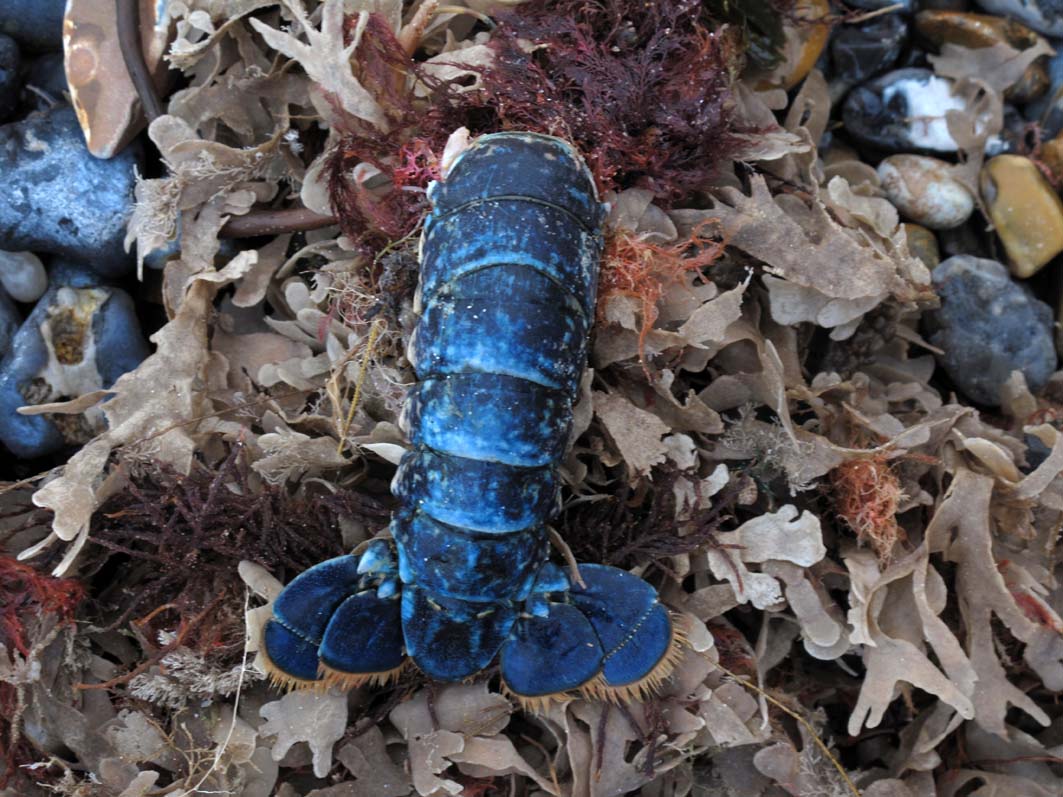
Crunching east along the pebbles, keeping a casual eyen open for the ochre glint of amber (never found), a steely blue jewel  nestled in seaweed reveals itself. The object, a detached lobster tail – or, rather, thorax – is so intensely blue that it seems to suck in light like a tiny dead star fallen to earth. The cerulean richness seems unworldly in this colour-bleached landscape. Separated from carapace and succulent flesh, its isolation renders it all the more precious. Precision-engineered to allow the most delicate of movements, it is a tail designed for swimming, dancing and mating displays, a tail for lobster love.

Returning along the cliffs next to the golf course the path is lined with thickets of sea buckthorn. In other years these have been so weighed down with squishy orange fruit that they dazzle the eye but this winter the berries, following a savagely cold December, are little more than a withered memory, with few to be seen on the bushes, thinned by frost action and hungry birds. Archaeological evidence suggests that sea buckthorn berries once played an important role in man’s diet but the truth is that, while they may be nutritious, they are also unbelievably astringent eaten raw, like bitter acid on the tongue. Freezing and cooking are supposed to reduce their unpalatable quality so we must conclude that Norfolk’s early settlers made some sort of jam out of the fruit.

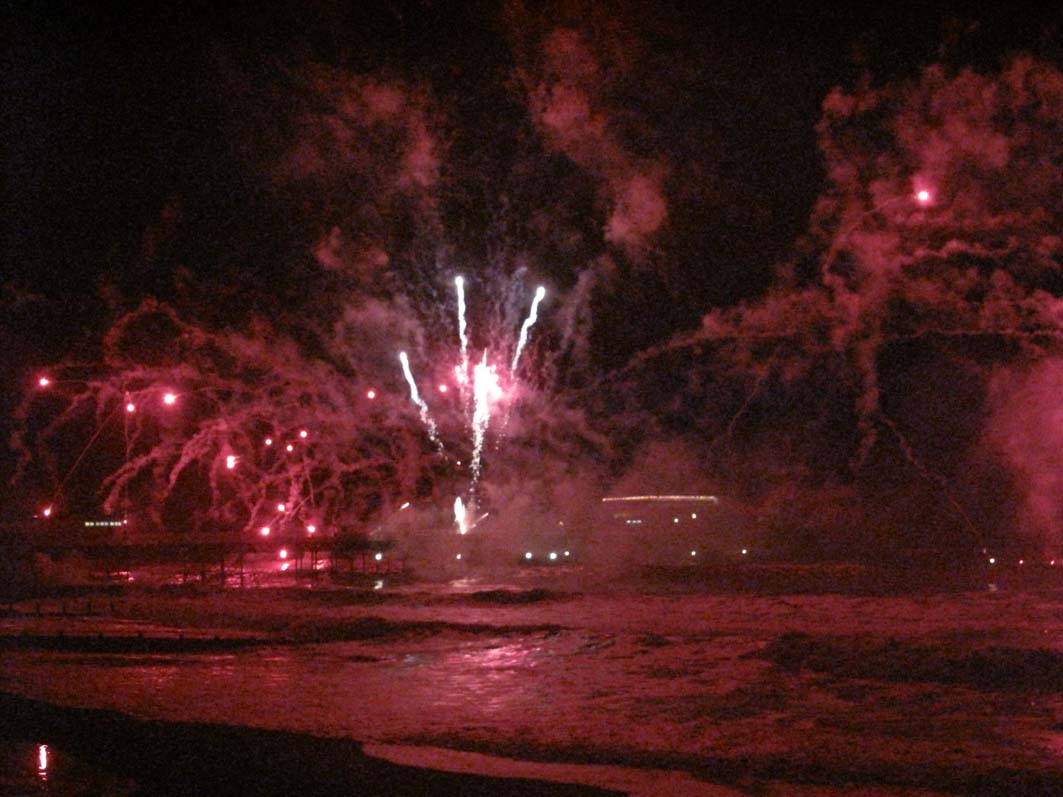
Since the millennial year, Cromer has staged a New Year firework display that is said to attract at least half the town’s population and the same again from the county beyond. This year, we stayed to watch. By well before the time that darkness fell, it was impossible to find a seat in the Rocket Cafe above the Lifeboat Museum – the perfect viewpoint for the event. Instead, we stood among the crowd by the seawall facing the pier, while others positioned themselves up the steps that lead up to the main promenade. The display, when it finally began after what seemed like a long, cold late-afternoon wait, was a wonderfully explosive affair – a lengthy and varied display that made the annual Lord Mayor’s Procession event in Norwich look like a damp squib in comparison. As the last cracks of pyrotechnic thunder echoed against the sea wall, and the final salvo of rockets stabbed at the sky, I wondered what Cromer’s offshore crabs made of all this unexplained cacophony. Were they all scurrying northwards along the seafloor heading for the relative peace of Dogger Bank?