Dacha

Reading a recent article on the excellent Earthlines blog about Gerry Loose, and then finding out more about the Scottish hutting movement and specifically the Carbeth hutters community in Stirlingshire, I have come to the conclusion that I am probably something of a closet hutter at heart. The best that I can ever probably hope for though is to have my own shed one day.

It is a common enough passion – indeed, books have been written about British (predominantly male) shed culture. But, with no rear garden and a backyard too small to comfortably squeeze a shed into, the closest I currently get to fulfilling my fantasy is my city allotment where I have inherited a tumbledown structure without door or window glass that is filled with garden tools and grumpy secretive spiders. Too small and decrepit to serve as a comfortable retreat, this shed is clearly no place to linger but at least I have a plastic chair en plein air for whenever I need a rest from wrenching couch grass out of the ground. 
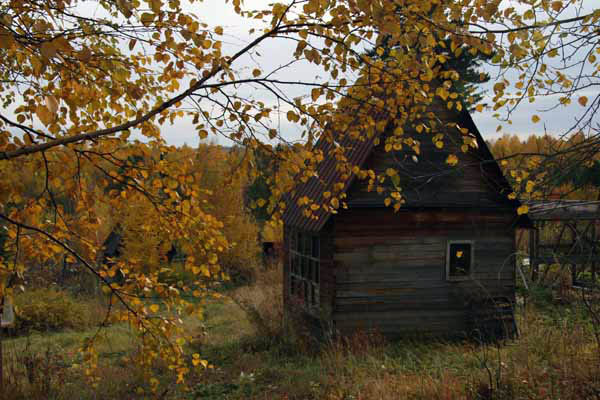
In northern Europe, and especially in Scandinavia and Russia where even the middle classes live in apartment blocks,  the situation is quite different. Here, many city dwellers have a wooden hut and a patch of ground to call their own – a simple rural haven where they can enjoy a little R&R and temporary respite from urban life. No nation embraces this tradition more than Russia, where a country dacha is seen not only as a place to grow vegetables but something akin to a holiday home: a base for collecting berries and mushrooms in autumn, for fishing, for sunbathing; a place for friends and family to gather around food, to drink vodka, play games and sing. A dacha is a place to spend summer weekends al fresco, a place where city children can learn about nature. In Russian society, a dacha serves a function that is a combination of allotment garden, beach hut and social club. To have a dacha is not a Walden-like solitary pursuit but, rather, something that proudly shouts out ‘community!’
I was lucky enough to visit a dacha a couple of years ago on a long, late-summer Russian journey from Pskov, close to the Estonian border, to Irkutsk near Lake Baikal in eastern Siberia. At Krasnoyarsk, 18 hours west of Irkutsk on the the Trans-Siberian railway, I had arranged to stay in the family apartment of a local tour guide and political science lecturer called Anatoliy. After picking me up at the station and meticulously showing me all the permutations of the city bus route to and from his identikit Khrushchevki apartment block (the very last stop, thankfully) he took me out to show me his country dacha that, coincidentally, was close to the railway tracks that I had just travelled along. 

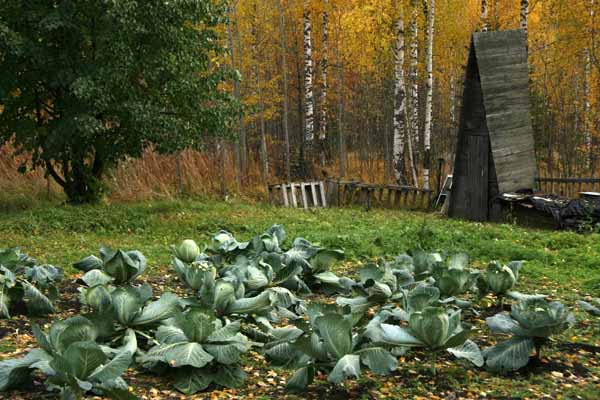
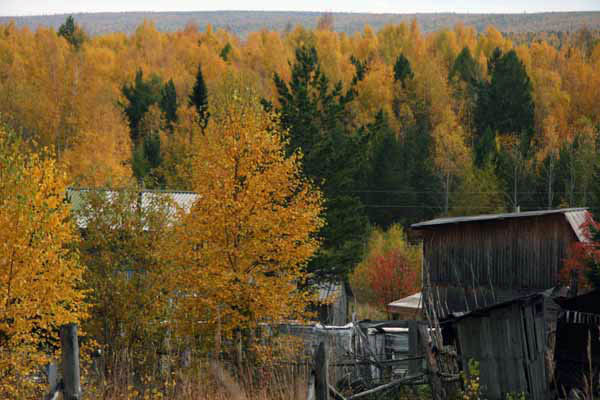
There is more to Siberia than gulags and permafrost but life is hard nonetheless. In the few months of the year when the ground is not snow-covered there are plenty of other things to contend with, notably predatory mosquitoes and nasty infective ticks everywhere in the grass. Given such limitations, I was hugely impressed by the size and vigour of Anatoliy’s cabbages and also by the efforts he took to tend them given that we had driven for more than an hour to reach the dacha. Even more  impressive was the air of autumnal tranquility that seemed to hang over the place like a healing balm. In Siberia, autumn may be just a brief golden precursor to a long dark winter but  September is the most glorious of months.
Elveden – Gateway to the Land of Nod

So why Elveden? And why east of it? Obviously there’s the name itself – E(lve)den, close enough to Eden for a cheesy pun – and let us remember that in Biblical terms the territory that lies ‘on the east’ of Eden is the Land of Nod, where Cain was exiled after murdering his brother. Of course, as well as a place of banishment for betraying siblings the Land of Nod also has connotations as a mythical place of sleep. Given Elveden’s real life position at the western end of the Suffolk-Norfolk border perhaps one of the Snorings (Little Snoring or Great Snoring – take your pick) forty miles or so to the north in West Norfolk could substitute for the aforementioned slumberland? (A real-life Land of Nod actually does exist in the East Riding of Yorkshire – it’s a tiny hamlet apparently).

Elveden itself is not without interest. The Suffolk village straddles the A11 just south of Thetford. There are traffic lights there these days and it has subsequently become quite a well known spot for traffic delays. In the bad old days, though – before the traffic lights and imposed speed limit – the stretch of single carriageway here was an infamous accident black spot. Norfolk-knockers like that nice Jeremy Clarkson have always been quick to point out that Norfolk is one of the few counties in the country that does not have a motorway leading to it and for many years there has been a strong campaign to get the whole of the A11 dual-carriagewayed right up to Norwich. As things currently stand, the A11 between Mildenhall and Thetford is one of the few remaining stretches of single carriageway. However, now that the powers that be have finally agreed to allow road widening to go ahead around Elveden, it looks as if a continuous dual carriageway will become a reality in the near future. No doubt the five minutes that will be knocked off the current London to Norfolk journey time will quickly elevate Norwich’s currently modest economy to Shanghai-like heights.

Those whizzing past the village in the future might want to consider a little of Elveden’s, frankly strange, history as it flashes past in an automotive blur. Here’s a brief extract from my Slow Norfolk and Suffolk book:

Elveden

Situated astride a busy road just beyond the Little Ouse in Suffolk, to most people this is little more a sign on the A11 and an inconvenient bottleneck for traffic. It used to be an accident black spot too before traffic-calming measures were introduced. Some will tell you that there have been more people killed on the A11 since World War II than there are names on the obelisk-like war memorial south of the village. Elveden is a small estate village centred upon Elveden Hall, a somewhat bizarre private residence. The estate, which has the largest arable farm in the country, is in the possession of the Earl of Iveagh but the hall itself was emptied of its contents in 1984 and stands empty.                                                   

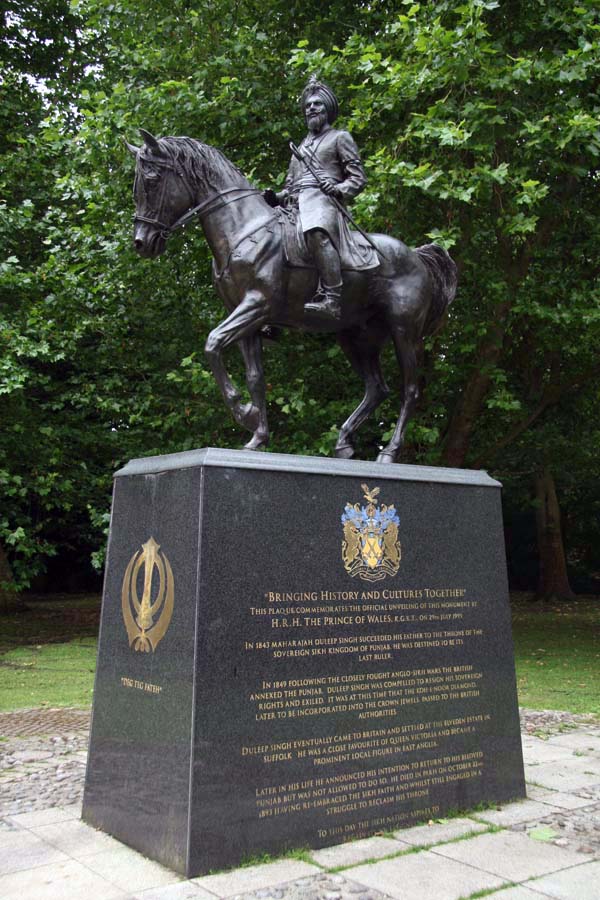
Elveden Hall is best known as the home of Maharajah Duleep Singh, a deposed Sikh prince from the Punjab who was exiled to England for his part in the Sikh Wars during Queen Victoria’s reign. The Maharajah purchased the estate in 1863 and refurbished the Georgian hall in lavish Moghul style using Italian craftsmen – a North Indian tradition apparently. He also built an aviary where he kept exotic birds and in an unselfconscious effort to outdo the English squirearchy he took up the habits of English country life with a passion, leading parties that shot thousands of pheasants on his estate on an almost daily basis. Naturally, if you have a 17,000-acre estate and a vast private fortune, you can do that sort of thing without worrying too much about the cost of it all. The Maharajah was always keen to impress the inhabitants of his adopted home and tended not to do things by halves. He was even good enough to hand over the Koh-i-Noor diamond to QueenVictoria and to cheerfully convert to the Anglican Church such was his willingness to fit in. An equestrian statue of the Maharajah stands in Thetford and, although he died in Paris in 1893, his surprisingly modest grave lies in the churchyard of Elveden’s St Andrew and St Patrick Church.

Elveden Hall passed into the hands of the Guinness family after Duleep Singh’s death and the first Earl of Iveagh went even further, building a new wing and adding a replica Taj Mahal to the complex. If the hall sounds as if it it would make a perfect film set then you are quite right as, since its interior was emptied in 1984, Elveden Hall has been used as a location for films such as Tomb Raider, the Bond movie The Living Daylights and Stanley Kubrick’s Eyes Wide Shut. The bad news is that the hall is not open to the public. You might try getting a job as a film extra here, as a friend of mine did on Eyes Wide Shut. He reports that he didn’t see much of the interior but did learn that Tom Cruise was unable to find any suitable accommodation in the area and had to be helicoptered in each day from afar for filming. You can just about get a glimpse of the hall from the rear of the village churchyard and make out its green dome.

NB: The photograph at the top of this post does not represent Elveden. It was taken east of it though – at Brockdish in the Waveney Valley. I just liked its ‘fish out of water’ feel.