Murmuration

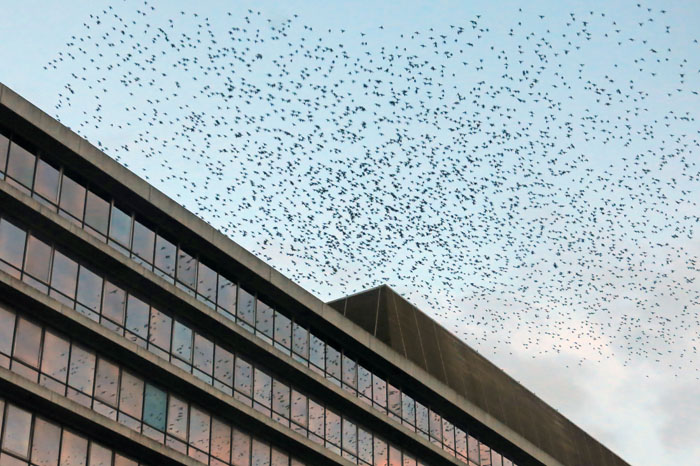
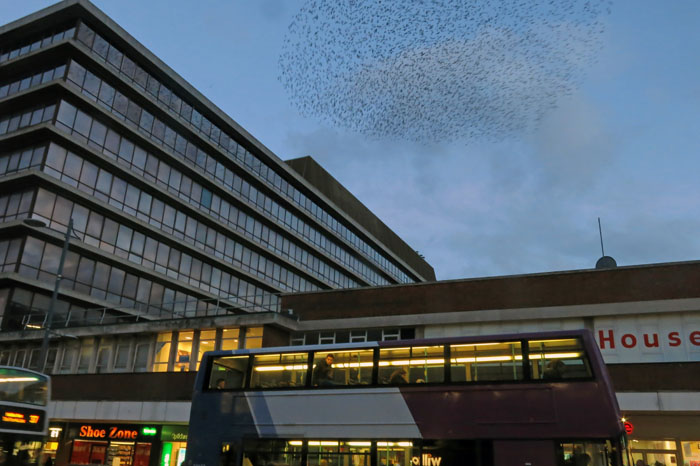
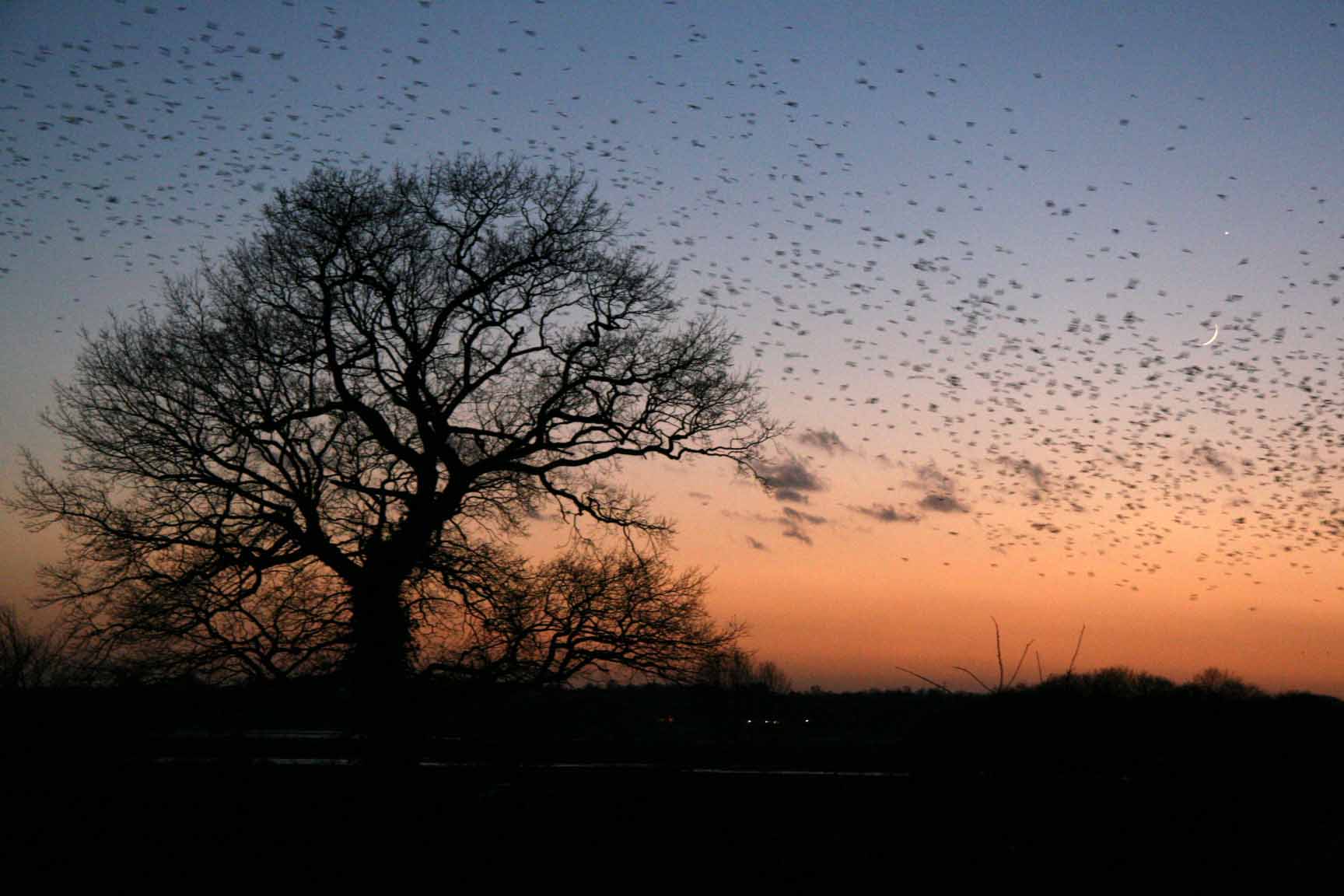
IMG_3939Norwich, mid January. At dusk over the past few weeks an avian spectacular has been witnessed taking place in the sky over St Stephen’s Street. As the daylight dwindles around the four o’clock mark a swirling murmuration of roosting starlings may often be seen in the sky above this busy city centre shopping street. There’s a pleasing degree of unpredictability to such behaviour, and some afternoons the starlings seem to be conspicuously absent, but as a rule the birds circumscribe a giddy figure eight in the sky above the old Norwich Union office block, Surrey Street bus station, the Marsh Insurance building and Queens Road.

IMG_3933For many of the shoppers and workers hurrying home on the bus this phenomena takes place virtually unnoticed. Even so, there are those who stop to look and wonder at such wild exuberance in what is to them a familiar and quotidian urban environment. While shopping is bought and buses are boarded in the street below the massed starlings dance above – a joyous ensemble piece that twists and turns like a single organism, choreographed by some sort of instinctive group consciousness. As the light fails the birds finally settle, with what seems like a collective spontaneous decision, on the roof of a disused office building where they will spend the night. Darkness falls: the spectacle is over for another day.

IMG_3980

True, this is not a particularly grand example of the murmuration phenomenon – perhaps just a thousand birds or so: it is hard to say – but beauty and wonder is relative and this modest display has a personal dimension in that it can even be glimpsed from the windows of my home. Such a spectacle within a stone’s throw of one’s own doorstep can only be seen as a gift.

Snettisham

IMG_3195

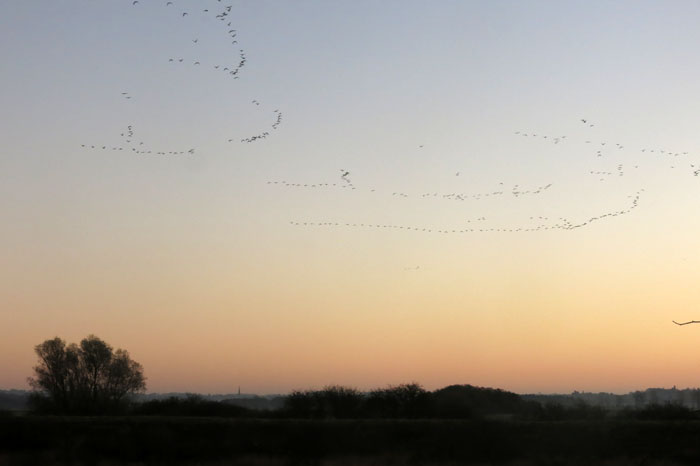
There’s a good omen as we leave Heacham before dawn: the sharp cry of a tawny owl emanating from somewhere in the woods. Fifteen minutes later, walking from Snettisham RSPB car park towards the beach at The Wash, there are already a  few skeins of geese in the sky, flying west, ready to breakIMG_3208fast on sugar beet fields.

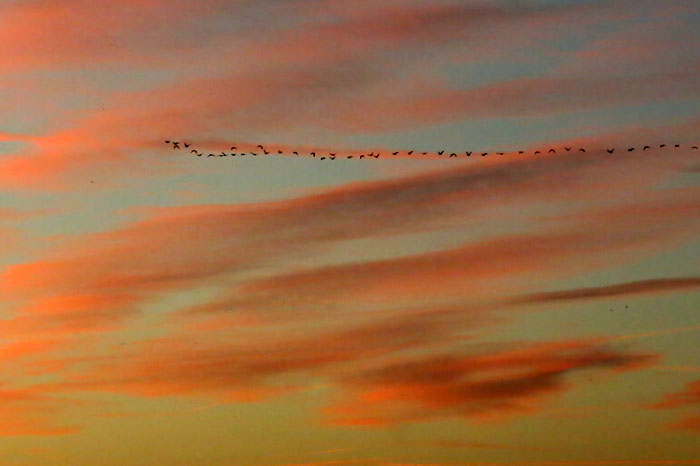
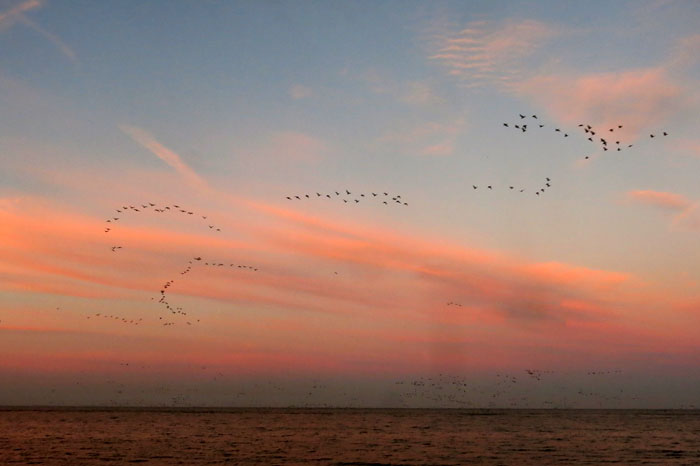
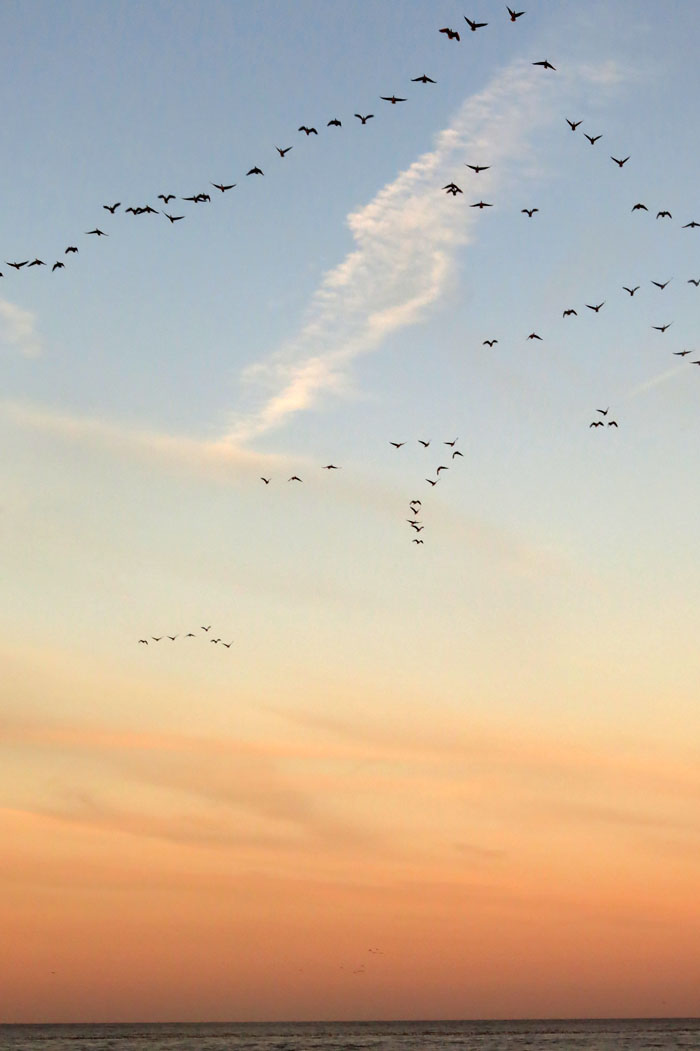
Mostly though, you hear them before you see them – a noisy gabbling racket coming from dark rafts of life out on the water. Tens of thousands of pink-footed geese overwintering from Greenland and Iceland – west Norfolk must seem like Shangri-La after all that tundra and icy water. The geese peel off in groups at regular intervals, forming fluid arrowheads as, honking excitedly, they fly west inland.

IMG_3247

There is an unwritten discipline at work, and every bird seems to know its place in the squadron. Flapping inland, the geese merge loosely with other groups before they eventually disappear from view. To our human eyes, Snettisham church rising out of the mist is the only recognisable local landmark; perhaps its steeple serves as a beacon to the geese too, as they seem to know exactly where they are going. IMG_3218

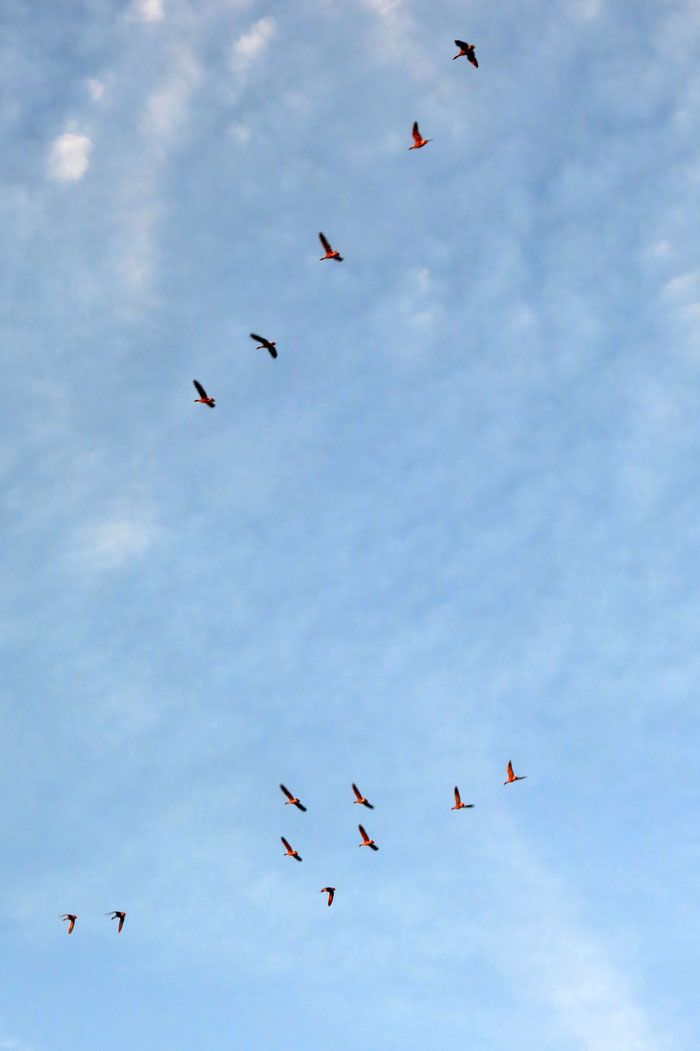
The sun rises over the land, a brilliant orange fire that lights the birds as they fly over head, turning their underbelly pink, orange, red. Momentarily they almost resemble flamingos.

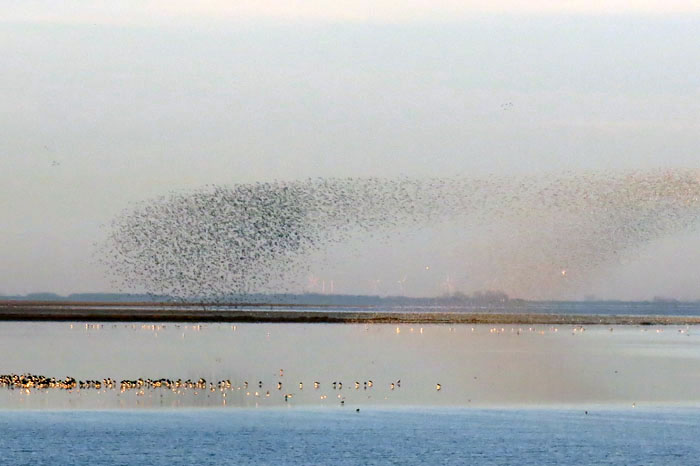
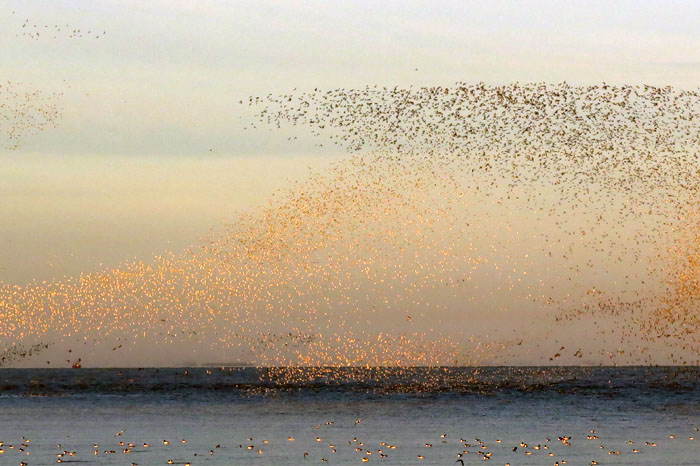
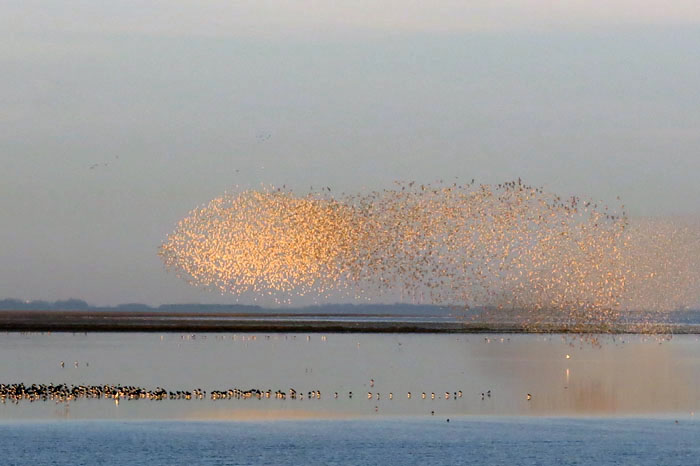
IMG_3244The tide is turning quickly and hidden sandbanks are revealed as the unseen moon sucks water from the land. As dawn-pink drains from the sky our attention is drawn to an untold number of hyperactive waders a little way to the south. Mostly dunlin, curlew and knot, it is the latter, another Arctic winter visitor, that are the most extraordinary as dense clouds of them rise sporadically into the sky, tightly grouped like starling murmurations. As they swiftly weave and turn, shifting the angle of their wings, the colour of this mass organism transforms dramatically from black to white to golden – the avian equivalent of a firework display. Such fleeting serendipity of form and colour: a photograph can hardly do this justice. As with the pink-footed geese, the Arctic’s seasonal loss is Norfolk’s gain.

IMG_3282IMG_3269IMG_3265

IMG_3267

IMG_3313 IMG_3344

Burston 1914 – 2014

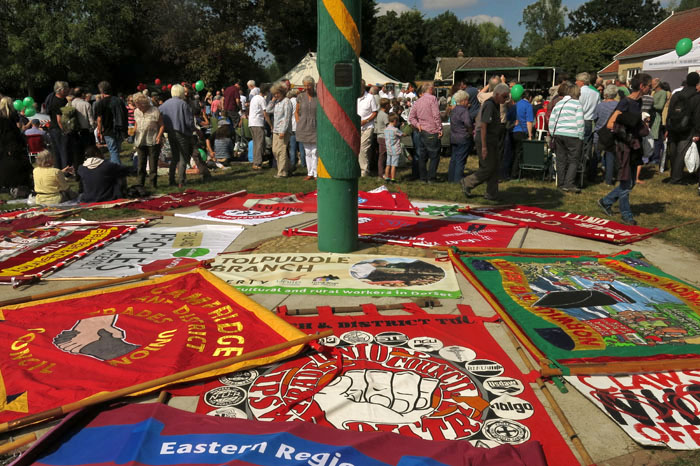
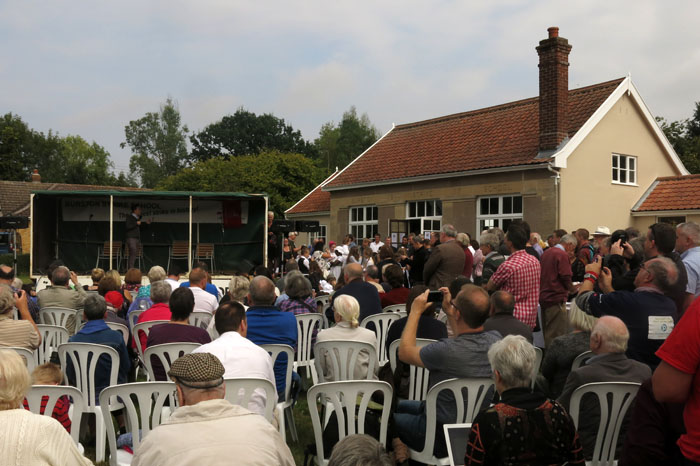
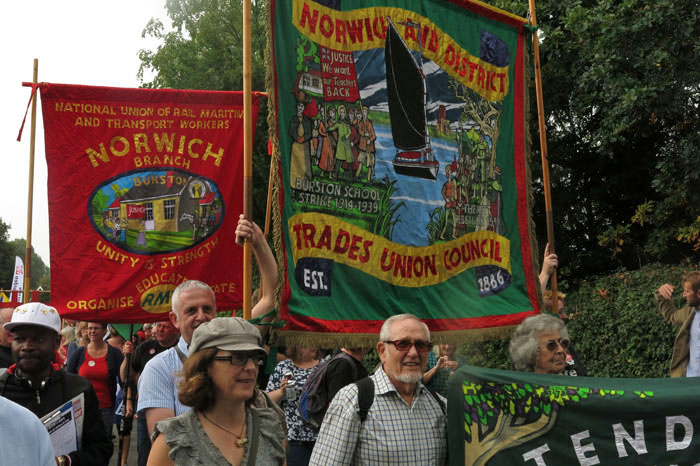
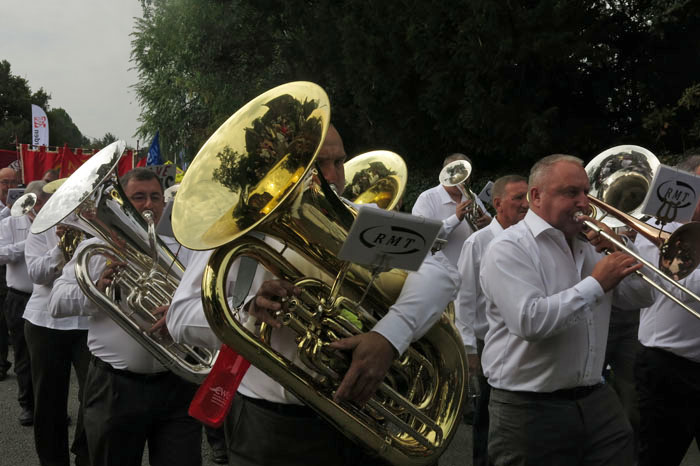
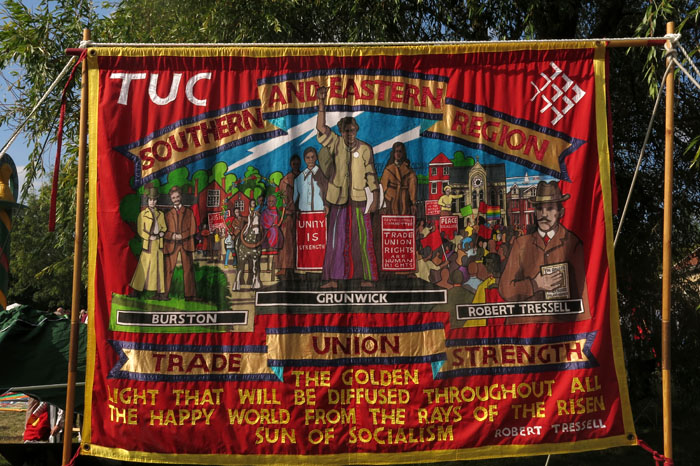
IMG_1372Earlier this year I wrote of Norfolk’s radical tradition and how this would be the centenary year of the Burston School Strike, the longest running strike in British history that lasted from 1914 to 1939.  Last Sunday the annual rally took place in this quiet south Norfolk village and folk came from far and wide to particpate and celebrate. As always, there were stalls selling political literature and T-shirts, brass bands entertaining the crowd, and musicians and speakers on the small stage. IMG_1297As usual the sun shone obligingly. Sadly this year, those old stalwarts of the Left, Tony Benn and Bob Crow, were no longer here to speak but Owen Jones (a ‘braying jackal’ according to Fox News, an honorable plaudit indeed) proved a worthy successor making a stirring speech before the procession around the village ‘candlestick’ took place. IMG_1321IMG_1327Rural south Norfolk might not seem the most obvious place to see trades unionists and brass bands marching under banners but they are used to it here at Burston – it’s been going on for 30 years. A necessary reminder for what is usually considered a true blue county that zombie neoliberalism is not the only narrative. Long may it continue.

IMG_1350IMG_1364

IMG_1377

Edgeland

IMG_4934Edgelands are everywhere, orbiting our towns and cities like unbeautiful rings of Saturn: non-places, junkspace, transitory transition zones that lie between that which is unequivocally urban or rural. Transitory because they are spaces in flux, with fluid geography that today may be brownfield site or landfill but tomorrow could be new housing, an out-of-town shopping emporium or a bypass. I hesitate to use the term ‘liminal’ here, that overused adjective beloved of psychogeographers, but … oh go on, I will. Edgelands are, if you’ll excuse the trope, zones of liminality, thresholds of the urban world. They might also be defined as those places that people pass through but do not usually stop at. They represent the view from the car  on the daily commute, that untidy marginal landscape glimpsed flashing by through the grimy window of the morning train.

IMG_4921Paul Farley and Michael Symmons Roberts in Edgelands, their definitive book on the subject, quote a long list of names associated with waste landscapes of this type in the United States, a lexicon that starts with ‘boomberg’ and ends with ‘world city’. My favourite though is ‘stimdross’, which sounds like some sort of propriety brand of exfoliant cream.

IMG_4944Like anywhere, Norwich, the city where I live, has its own edgelands. These take on a different character depending on which side of the city you look. To the north, the city sprawls for miles through ‘30s council estates, Tudorbethan suburbs and rural fringe new-build with leadlight windows and double garages. Heading in this direction from the centre, it is only after the airport is passed that the city finally gives way to the arable farmland that continues all the way to the Norfolk coast.

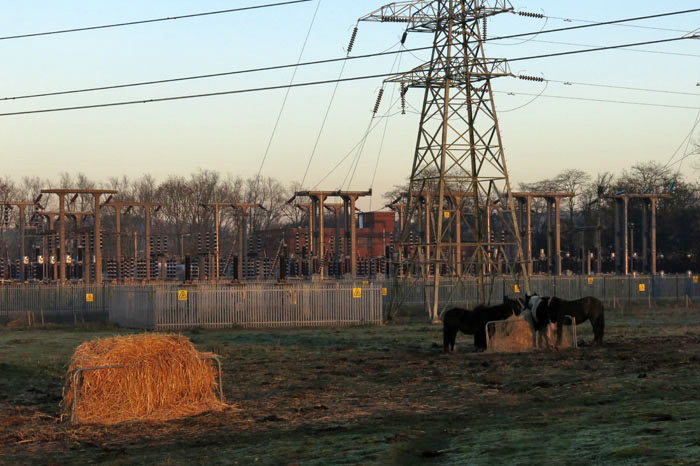
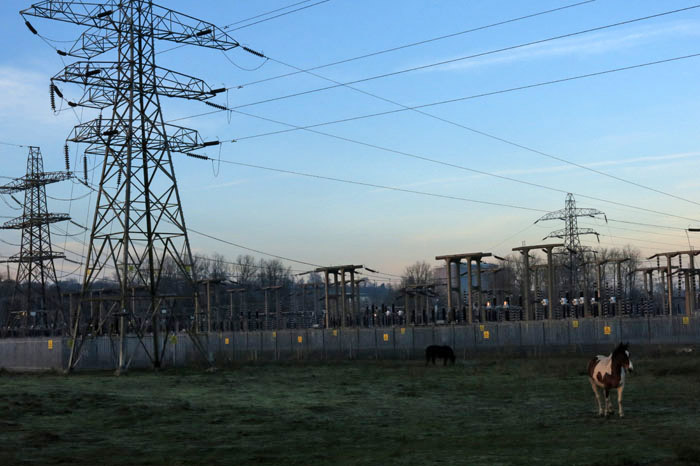
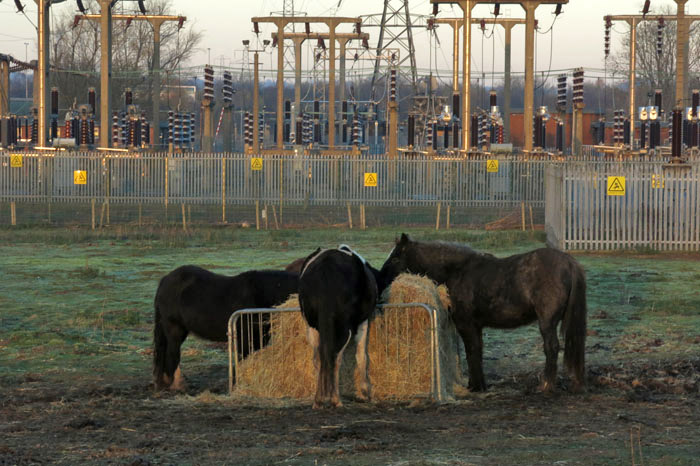
IMG_4946Heading south, the transition comes much sooner. A little way beyond the ring road the landscape changes abruptly as it crosses a railway line and the River Yare. Here, where the traffic of the southern bypass creates an ever-present thrum, is an edgeland par excellence: a territory that has elements of both urban and rural but belongs to neither camp. The rough grassland here is too poor for arable crops but supports both grazing horses and a vast imposing electricity substation. Lofty pylons march across the landscape, dwarfing the horses. The scene is a strange juxtaposition that shouts of marginalisation but the horses do not seem to mind. Who owns them? Travellers probably, or is it wrong to make such an assumption?

IMG_4926

The OS map of the territory reveals a henge in the field here, right next to where the electricity substation and horses are. The Arminghall Woodhenge, which was discovered in 1929 thanks to crop marks on an aerial photograph, was excavated in 1935 and discovered to be a Neolithic monument orientated on the mid-winter sunset. All that remains now is a vague bump and dip in the ground but once this was a place of power, a place of knowledge, ritual and observation. Now that power is reduced to a ghost of landscape, forgotten, returned to the earth – a palimpsest overlaid with electrical distribution hardware and grazing horses. Most of the motorists speeding by on the southern bypass avert their eyes from the unsightly pylons and transformers and do not give these fields a second glance. How can they ever know of the henge if they do not even notice the horses?

IMG_4951

Radical Norfolk

2013188929Norfolk doesn’t tend to be the first place that comes into mind when you think of political radicalism but, surprisingly perhaps, there is  a strong tradition here and the East Anglian countryside has not always been as true blue as some might have you think.

Thetford in the Norfolk Brecks is the birthplace of republican and revolutionary pamphleteer Thomas Paine (1737-1809), a man who had an important part to play in both French and American revolutions. Two hundred an fifty years earlier, Robert Kett, a yeoman farmer from Wymondham was another radical figure who became a thorn in the side of the ruling class. It was Kett who, along with his brother, sided with his own impoverished labourers and helped break down fences erected to enclose common land in 1549. Kett’s ragged rebel army  camped on Mousehold Heath just outside Norwich before eventually being defeated by government forces, after which Robert Kett was hanged at Norwich Castle, and his brother William at Wymondham Abbey, as an example to uppity peasants.

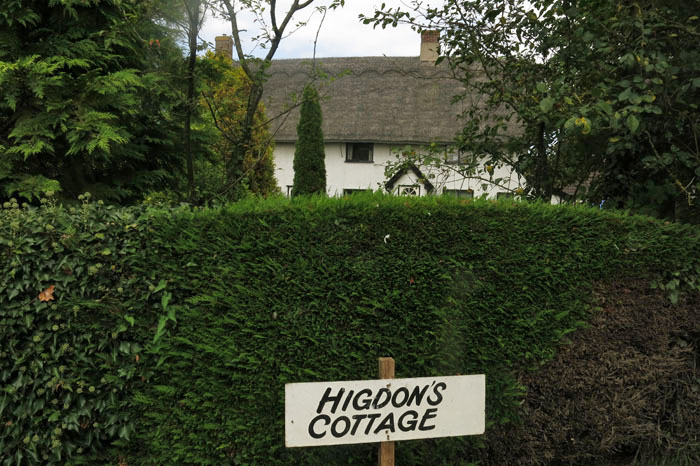
Another pair of local heroes were Tom and Kitty Higdon who in the first half of the 20th century led the longest strike in British history at their tiny school  at Burston in south Norfolk. Here  is a brief extract from Slow Travel Norfolk on the subject:

The Burston Strike School

‘The labourer must henceforth take his place industrially socially and politically with the best and foremost of the land.’

Tom Higdon, 1917

In brief, the story goes that Tom and Kitty Higdon were appointed as teachers at Burston School in 1911 after previously working for nine years at Wood Dallingin north Norfolk. The Higdons, who were Christian socialists, had complained about the poor conditions at the Dalling school and the frequent interruption of the children’s education when recruited for farm work. Many of the farmers employing the children were also school managers and tensions mounted as a result of this, particularly as the Higdons had also encouraged local farm labourers to join trade unions. When matters came to a head, the Higdons were given the simple choice of dismissal or removal to a different school.

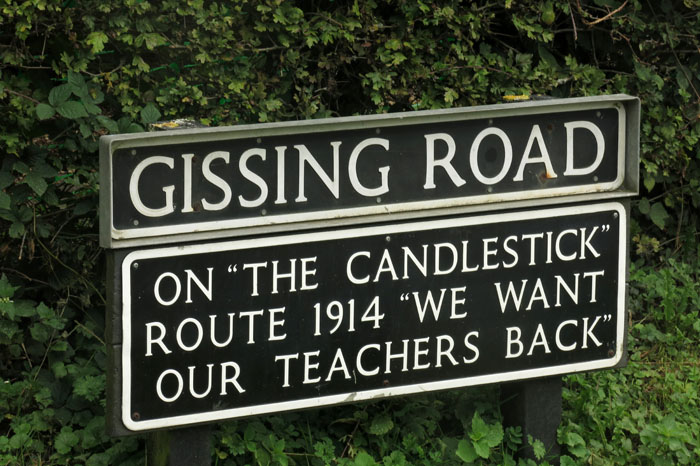
The couple were transferred to Burston, where they found conditions much the same:their complaints to the school managers, the chairman of whom was the local rector, created tensions here too. The pair were dismissed on fabricated charges of pupil abuse on April Fool’s Day 1914 and, following their dismissal, 66 of the school’s 72 pupils marched along Burston’s ‘candlestick’ (a circular route around the village) carrying placards that bore messages like ‘We Want Our Teachers Back’. Many parents refused to send their children to the official council school and, as a result, a separate ‘strike’ school was established.

The Burston Strike School, as it came to be known, began as little more than a tent on the village green but later moved to a carpenter’s shop in the village. There was considerable intimidation by local employers against the rebel parents and many workers were sacked or evicted from their tied cottages. The village rector, the Reverend Charles Tucker Eland, who firmly believed that labourers should know their place in the social order, also went as far as evicting poor families from church land. Fortunately, the labour shortage created by the onset of World War I worked to the advantage of the labourers. Money was raised by labour organisations such as the Agricultural Labourers’ Union and the Railwaymen and, by 1917, there were sufficient funds to build a new schoolhouse. Both Sylvia Pankhurst and George Lansbury attended the opening ceremony in that same year. The school ran until 1939 when Tom Higdon died and the same modest building serves today as a museum of the strike school’s history. There has been a rally organised by the TGWU held annually in the village since 1984, the 70th anniversary ofthe school’s founding.

An annual rally still takes place in the village each year on the first Sunday in September. It’s a colourful, upbeat affair and a rallying call for what might be described as ‘the old Left’, with speeches by well-known political figures and trades unionists, and music by the likes of Billy Bragg. Regular – indeed, almost annual – speakers were two men who have both sadly passed on this week: Bob Crow and Tony Benn. (The last time I saw Tony Benn here I remember that he recounted the words of Thomas Paine from Rights of Man: ‘My country is the world, my religion is to do good.’)

As 2014 is the centenary year of the strike there is additional event this year on April 1st, but now that both of these two mighty oaks of the Left have fallen it may prove to be a poignant occasion.

Slow Travel Norfolk

2029[1]

Well, it is finally out – my new book Slow Travel Norfolk.

Here is a brief extract from the book about an extraordinary rook roost that takes place at Buckenham Carrs each winter:

A  large  wooded  area  just  east  of   Buckenham  station, Buckenham Carrs is in winter home to an enormous rook and jackdaw roost mentioned in the Domesday Book. It’s thought there may be as many as 80,000 birds. The roost is the central motif of Mark Cocker’s Crow Country, which celebrates both crows and the Yare Valley where he lives. The Buckenham roost, which takes place in the winter months, roughly between late October and March, is quite a spectacle to behold, a natural phenomenon that has been taking place long before the fields were ploughed here and the church at Buckenham constructed. Ideally, you’ll want a crisp winter’s evening with a clear sky and a full moon.                                                                                                                                                    The best vantage point is to walk up the narrow road from Buckenham station until you reach a copse on the left with a small ruined brick shelter. You’ll see it all from here. The performance – if you can call it that – is a slow burn. Just after sunset, groups of rooks, and some jackdaws, fly in to gather on the large ploughed area immediately to the west; others land in the trees that surround it. Some have come quite a long way to be sociable but the crow conversation taking place sounds rather tetchy, all guttural complaining caws.                                                                                                                                       Momentum slowly builds as more and more groups of birds fly in to land in the field. As the light fades, the noise from the congregation builds louder and eerily expectant: something is clearly about to happen. Eventually, when the darkness is almost complete some sort of signal spurs the birds airborne and the sky blackens with rooks that swirl noisily east to settle in the woods of Buckenham Carrs where they will spend the night together.                                                                                                                                                It’s an astonishing, almost primal, event. One that almost laughs in the face of man’s perceived dominion over nature. No collective noun can adequately describe it: a building of rooks, a train of jackdaws. It’s less a murder of crows, more a mass execution.

IMG_0287

For an another take on Slow Norfolk, here is a lovely post about Going Slow on the north Norfolk coast on The World According to Dina, which generously mentions my book too.

Keswick All Saints

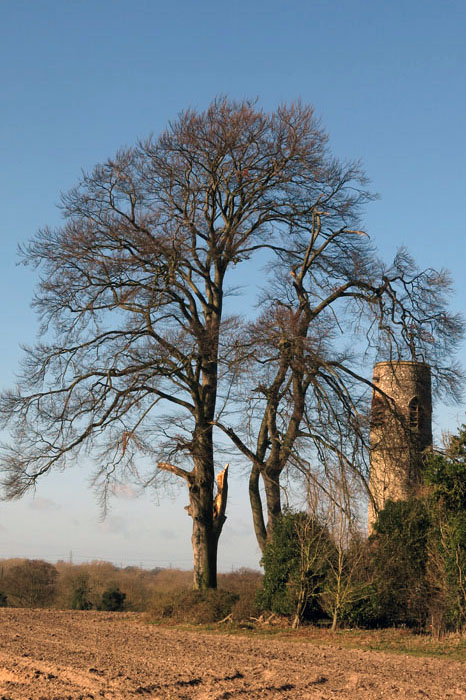
IMG_5265A little way south of Norwich, standing atop what counts for a hill in these parts, is a tiny roundtower church nestled amidst trees. All Saints Church stands above the small village of Keswick  in a crumpled corduroy landscape of wintry ploughed fields. Like most of the territory of this urban fringe, the church lies within the acoustic shadow of the city’s southern bypass and the dull thrum of traffic melds with the chatter of birds in the trees and hedgerows – mostly finches, tits and blackbirds at this time of year. Across the valley, a thread of pylons leads inexorably north towards Norwich where they will deliver electricity to power the city’s PlayStations, fridge-freezers and TiVo boxes. IMG_5289A narrow track leads from the main road up to the church but this is impassable in a car as a collapsable central barrier has been installed. With nowhere to park, we sneak into a bus lay-by on the main road in the knowledge that, this being Sunday, there won’t be one along for at least an hour or so. Arriving on foot at the gate, the church noticeboard informs us that services are held once a month on the last Sunday of the month, an impressive boast for such a small church in this day and age. In fact, a quick look at Simon Knott’s highly commendable Norfolk Churches website tells us that this is probably the smallest working church in all the county. And, as Norfolk has the lion’s share of Europe’s roundtower churches (124 of 185 in the whole of the UK), Keswick All Saints is probably the smallest functional roundtower church in Britain, if not in Europe. Not today, though – today, the church door remains firmly locked.

IMG_5277  IMG_5320  IMG_5282Keswick Hall just across the valley was once the home of the Gurney family, a local dynasty with farming and banking interests. The mossy tombs of several family members look down from the vantage point of the graveyard towards the hall that was once their earthly domain. The original church fell into disuse in the 16th century and was later partly demolished to repare the church at nearby Intwood (also All Saints) when the two parishes were united. Nearly four hundred years later in 1893, it was the Gurney family who came to the rescue, restoring the ruin and adding a short nave to create a mortuary chapel, which eventually became a church once more when services were authorised in 1934. IMG_5311If the earlier church was small, the Gurney restoration is tiny, just half the size of the original. But we could not get inside this ecclesiastic doll’s house to see the stained glass window or roof angels. No matter – on a sunny and unseasonably mild February day that already bore the promise of spring it was enough to enjoy the snowdrops in the copse and watch a pair of buzzards circle overhead on the thermals that rose from the sun-warmed fields.IMG_5322

The Turning of the Year

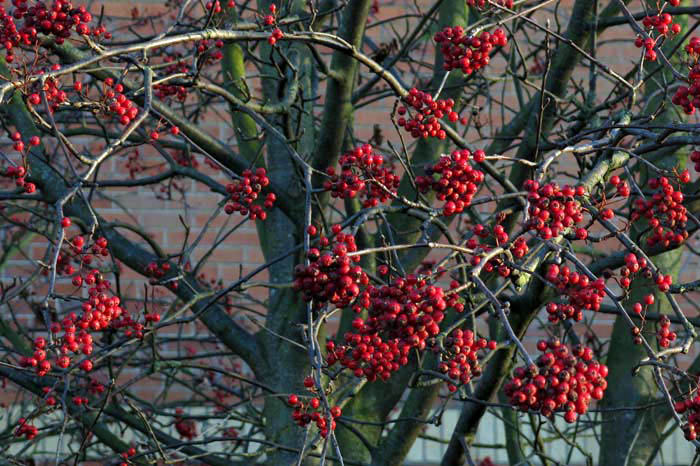
IMG_4891(This winter’s berries)

The turning of the year. These past few days mark the interregnum that sits uncomfortably between Christmas and New Year – a week of virtual Sundays and a period when some of us – those who are self-employed at least – do not know whether they should be at work or not, whether they should carry on regardless or surrender to the seasonal zeitgeist of calorific leftovers, television repeats and relentless retail opportunity. This is a living limbo marked by the dull ache of too much alcohol and rich food, and too little sunlight: rural Scandinavia in a parallel universe on a bad day, where Disneyesque fibre-optic conifers and tattered tinsel replaces the glittering white rime of pines, chain store neon glare subs for the aurora borealis and the petrochemical chug of cars queuing for city centre parking space drowns the imagined crooning of fur-clad carollers, the glassy tinkle of falling icicles and the satisfying crunch of snow beneath sensible Nordic footwear. We are now so far removed from the traditional Christmas tropes that any sense of irony has long been lost, and the multiple identities – spiritual and otherwise – of the winter soltice are now commonly, if erroneously, perceived as having been replaced by Winterval, a quasi-mythical simulacrum close to the hearts of apoplectic ‘PC-gone-mad’ bashers.

IMG_4958 (2)

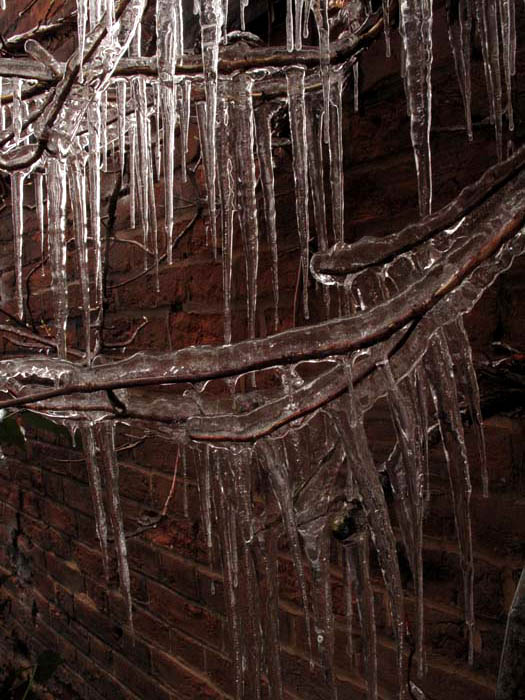
(Last winter’s icicles)

The weather doesn’t help, of course – too mild, too wet, too windy this year. At least some sort of status quo continues in the back yard where non-denominational  (or possibly JW) goldfinches arrive in pairs to feast on niger seeds as they do every day, a suitably attired mirror-image illusion of avian dandies on opposite sides of the bird feeder. Meanwhile, out in the dun damp arable fields that surround the city beyond the new-build green belt, fieldfares flock – newly arrived winter visitors from Scandinavia, the real place that is, not the parallel universe version. Elsewhere, the TV flickers like a well-behaved heart monitor as a nation prepares for the ritual liver damage and rictus-grinned high spirits that signify New Year’s Eve. Or, rather, the younger ones do: most older folk ensure they are safely tucked up in bed by the witching hour when a nation stumbles forward, arse over tip, across the calendar date line. The circle is, as they say, unbroken. Happy New Year.

Walking in Norfolk

51Ym0tIQenL__SY445_

My new Cicerone walking guide, Walking in Norfolk is going to be published in a week or two’s time and so here is a small taster of what to expect. The book contains 40 circular walks in all, and covers all parts of the county from northeast Norfolk to the Waveney Valley to the Fens.

Here’s a bit from the Introduction:

‘Very flat, Norfolk’, asserts Amanda in Noël Coward’s Private Lives, reflecting pretty much the commonly held view of the county: a place, with attitude perhaps (think of its heroes – Horatio Nelson, Thomas Paine, Delia Smith, Stephen Fry…Alan Partridge), but certainly not with altitude. The stereotyped view, although misleading, is understandable enough, as most people have some sort of image of Norfolk even if they have never visited the county. Many will have seen the vast sandy expanse of North Norfolk’s Holkham Beach in films like Shakespeare in Love or TV programmes like Stephen Fry’s Kingdom. Many more will think of boating holidays on the Norfolk Broads, or make associations with the low-lying Fenland region of the far west of the county: aspects of Norfolk, certainly, but not the full picture by any means.

…and here’s a snippet from Walk 10: Burgh St Peter and ‘The Triangle’:

039‘The Triangle’ is a local name that was sometimes used to refer to the parishes of Aldeby, Wheatacre and Burgh St Peter in southeast Norfolk. Bound on two sides by a bend of the River Waveney and on the other by the now-dismantled Beccles to Great Yarmouth railway, the triangle of land so defined has something of the feel of an island to it. There is no through road here, just a quiet single-track lane that links the farmsteads on the marshland edge. To the north, east and south a large flat area of marshes lies between the relatively high land of ‘The Triangle’ and the river itself.

041Burgh St Peter’s Church of St Mary the Virgin is one of Norfolk’s oddest churches as its tower is in the form of a five-section ziggurat (or, as some have fancied, a collapsible square telescope). The body of the church dates from the 13th century but the tower is an 18th-century addition, supposedly inspired by the Italian travels of William Boycott, the rector’s son. A dynasty of Boycotts served the church for a continuous period of 135 years and Charles Cunningham Boycott, the son of the second Boycott rector, gave the term ‘boycott’ to the English language when he behaved badly over absentee rents in Ireland and was socially ostracised as a result.

Mappa Mundi – but whither Norwich?

Hereford_mappa_mundi_14th_cent_repro_IMG_3895[1]

This summer I visited Hereford for the first time in decades. I have long wanted to see the famous Mappa Mundi at the cathedral there and so this was an opportunity. The ancient map, along with the almost as well-known chained library, is on display in a special exhibition area beside the cloisters. With an entrance fee to pay, the map is clearly a nice little earner for Hereford Cathedral, as is the gift shop where visitors can purchase souvenir posters, books, and fridge magnets – ‘mappa money’ perhaps? It is all the more surprising then to learn that not so very long ago Hereford Cathedral was considering selling its precious artefact to raise cash and the map was saved at the eleventh hour by generous donations from the National Heritage Memorial Fund and long-time Anglophile John Paul Getty Jr.

The Mappa Mundi was made by a man called Richard de Haldingham e de Lafford from Lincolnshire, whose real name was Richard de Bello, a prebendery (senior member of clergy) of Lafford (Sleaford) in the diocese of Lincoln Cathedral. Richard was promoted to a stall in Hereford Cathedral around the end of the 13th century. The map is thought to have been drawn sometime between 1276 and 1290.

The map is certainly a wondrous thing – a single piece of vellum measuring 1.58 x 1.33 metres and tapering towards the top like an upside down shield. It depicts the world that was known in the late 13th century, a world of fact and fiction, of the familiar and fantastical, of uncanny accuracy and cartographic howlers. More than anything it is a map that superimposes the oceans and landmasses of the known world with the fantasmagorical topography of the dark medieval psyche. At the centre, of course, is Jerusalem surrounded by the continents of the Old World. Asia, the orient, lies at the top, Europe at bottom left hand corner and Africa to the right of this. Superimposed on this are drawings of famous cities and towns, Biblical events and personalities like Noah and his family at sea in the Ark, and figures from mythology like the Golden Fleece and the Cretan labyrinth. There are images of peoples of the world as well as plants, animals and disturbing weird creatures that belong to ‘Here be Dragons’ territory like Gangines, Grifones and the Sciapod, who shelters himself from the sun by the shade of a single enormous foot.

The British Isles lie at the extreme lower left hand edge of the map. England and Scotland are pinched at their join to be depicted almost as separate islands. Some of the rivers – Severn, Thames, Humber – have taken on an Amazon-like width. London and Oxford are pretty well where they should be, although Durham is clearly in the wrong place, located here south of Carlisle and west of York. There’s clearly a degree of local bias at play in the drawing of the map. Lincoln, thought to be the home town of the map’s creator, is depicted as an elaborate castle that nearly equals the Tower of London in status, while the representations of Winchester and Oxford are both rather puny in terms of their relative importance at the time. Hereford is shown as you might expect, and even nearby Clee Hill (Môr Clee) looking something like a cartoon jelly, a humble bit of topography but perhaps included as a local detail in a nod to the map’s Hereford home.

Studying the map (there’s a much clearer English equivalent on the wall opposite to facilitate this) we did what I am sure most visitors do; we looked for our own city of residence, in our case Norwich. There is no sign of it. Indeed, even the bulge of East Anglia is unrepresented as if cartographically redacted like a revisionist face on a Stalin-era photograph. The map maker, a native of Lincolnshire, would surely have known of the existence of Norwich. The city was, after all, the second largest city in England at the time. With a magnificent cathedral, a Norman castle and a large city population, the city was then a far more significant urban centre than it is today. Far more important than Hereford, Gloucestershire or even York, all of which are represented on the map.

This deliberate omission seemed a mystery until I reflected on the date of the map and what was taking place around that time. In the late 13th century several violent confrontations took place between the aggrieved citizens of Norwich and the clergy incumbent at the city’s Cathedral. As a result, Norwich has the distinction of being the only English city ever to be excommunicated following a particularly bloody riot between citizens and monks in 1274. The Etheldreda Gate to the Cathedral, which still stands today, was constructed as penance by Norwich citizens. Was it this excommunication that led Richard de Bello to ignore the city and omit it from his map? After all, the map was drawn to show the creation of God not the world of Man. Norwich, excommunicated at the time, may simply have been considered insufficiently God-fearing to be included as part of His world.

This God-less tradition may have continued to some extent. The 2011 census revealed that Norwich had the highest proportion of respondents in England and Wales saying they were of ‘no religion’ – 42.5% of the population against an average of 25.1%. There again, the city, which historically is strongly non-conformist, claims to have an above average churchgoing rate, and of the 56,268 who proclaimed no religion in the census nearly 800 were Jedi Knights.