Bunhill Fields

IMG_0156Three weeks ago I happened to be in London. As things turned out, on that very same day  the city was somewhat preoccupied with a very high-profile event at London’s most iconic church. Given the circumstances, I felt the need to escape the gravity of St Pauls and mark my all-too-rare visit in a more personal way. So on the morning of April 17 I headed to Bunhill Fields in the Borough of Islington. Here, at a quiet Nonconformist graveyard tucked away from the thrum of city traffic, are buried some of England’s less showy heroes.

IMG_0145Here you’ll find John Bunyan, radical preacher of Pilgrim’s Progress fame, whose stone form lies prone atop a hefty tomb. Nearby stands an obelisk that commemorates Daniel Defoe, a man who in addition to writing Robinson Crusoe was also a great traveller and author of an opinionated account of the  nation in the early years of the 18th century. Next to the Defoe obelisk, and far more humble, is a plain stone that marks the life of another great Londoner– William Blake. So unpretentious is this tomb marker that it does not even stand on the exact spot where Blake are buried – the actual grave is unmarked and the poet’s bones lie elsewhere nearby, although the exact spot is uncertain.

It was a cold grey day, and workmen were working industriously clearing the ground in another part of the graveyard. Otherwise, there were no other visitors to Blake’s – or anyone else’s – grave on that particular morning. Meanwhile, just a mile or so to the south, the traffic had been stopped and bells silenced – no ding-donging permitted on this day. Assorted armed forces lined the street in a gung-ho revival of Falklands fever as a sorry procession of politicians, prison novelists, low-rent celebrities, arms dealers, blubbing chancellors and sundry Spitting Image characters entered the cathedral to take their seats beneath the lofty Wren dome.

As history was rewritten for the umpteenth time in a matter of days, Blake’s bones lay sleeping unperturbed in Bunhill Fields – definitely not for turning. A bone fide Londoner who wrote of higher places, William Blake was a man whose words could reach out to everyman – to Londoners of every stripe certainly, but also to those in Scotland, County Durham, Liverpool…South Wales…South Yorkshire…

Do what you will, this world’s a fiction and is made up of contradiction

Orford Ness

Walking, whether rambling or hiking in the countryside, or the unplanned urban exploration of a would-be flâneur’s dérive – call it what you will – seems to be the hippest new literary genre. Often found cosily in tandem with what can only be described as ‘the new nature writing’, the genre undoubtedly has its stars. High in that firmament is Robert Macfarlane.

Almost everywhere you look in the literate media these days, Macfarlane’s name seems to crop up. As well it might, as his new book The Old Ways has instantly and deservedly become a best seller. Having already been lauded in features in the Guardian and suchlike, The Big Issue has this week also seized the opportunity to echo the zeitgeist and published a feature on Macfarlane taking a walk in the company of fellow writer and bipedalism enthusiast, the sardonic (and sesquipedalian) pavement-plodder Will Self.  The desired result: an interesting combination of styles and focii in which rural meets urban, wild nature confronts man-tamed landscape, and literary topography melds with psychogeography.  Given such a brief, it seems almost odd that the Psychogeographer General, Iain Sinclair, landscape ombudsman extraordinaire, wasn’t invited along for the stroll. There again, three is a crowd, and Sinclair was no doubt already busy enough with the Sisyphean task of hurling word-bombs of withering allusive prose at the perimeter fence of the Stratford 2012 Olympics site.

The Big Issue walk – delightfully, if almost predictably – took place along the crumbling Suffolk coast, the mysterious region between Bawdsey and Orford Ness, a coastline rich with legend and secret histories: a luminous landscape of shingle, rare birds and nuclear power stations where the mud itself murmurs of UFO sightings, secret weapons testing, silted estuaries, lost ports and sea-claimed monasteries – the most distinctly ‘Here be Dragons’ patch on the East Anglian map. Pleasingly, the Will and Rob walk also took in some of the territory I have described in my own humble walking guide to the Suffolk coast: Suffolk Coast and Heaths: Three Long-distance Walks in the AONB, available from all good book shops and even a few bad ones.

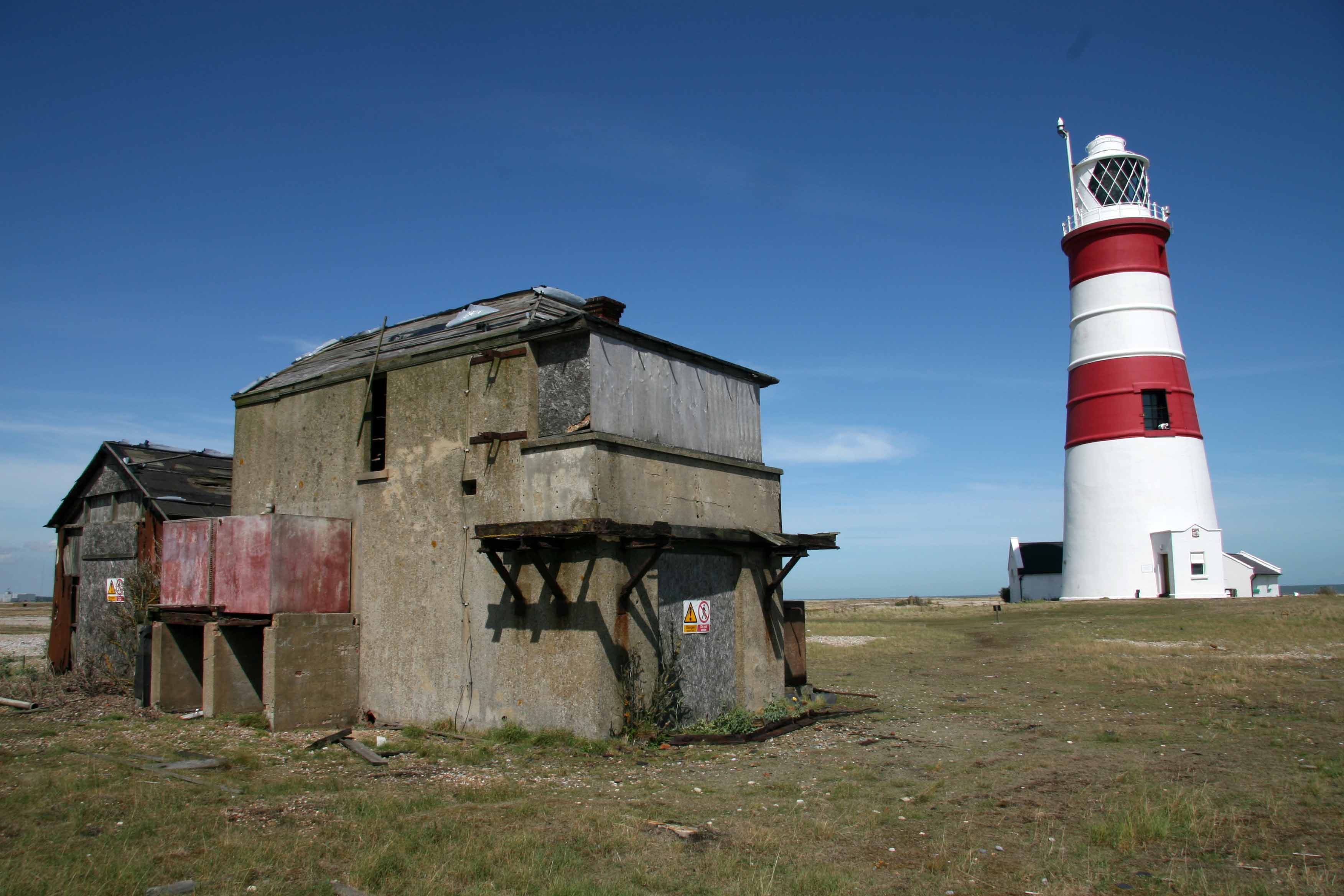
The Macfarlane-Self walk concluded at the lighthouse on Orford Ness, the mysterious island-like shingle spit that stretches south from Aldeburgh. Orford Ness is bypassed by the Suffolk Coast Path but it does feature in Slow Norfolk and Suffolk, another book of mine that hurrahs the Suffolk coastline. Here’s a brief extract:

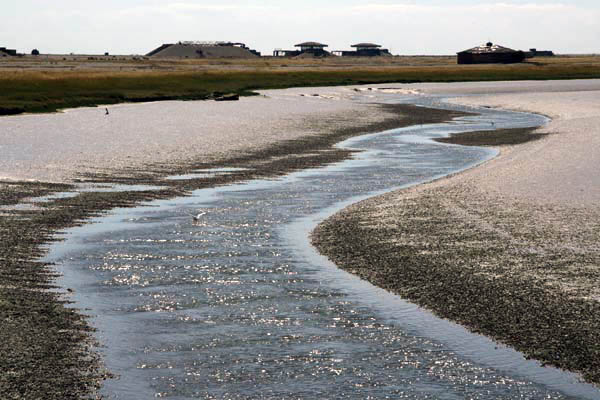
If you are not at Orford Quay for sailing, your eyes will no doubt be drawn across the water to Orford Ness, which exudes an air of mystery typical of places associated with forbidden territory. From 1913 to the mid 1980s, the spit was firmly closed to the public, a top secret, no-go area dedicated to military testing and radar research. The links with its secret past are part of its appeal; otherwise, it’s undeniable that Orford Ness is quite a remarkable bit of geography.

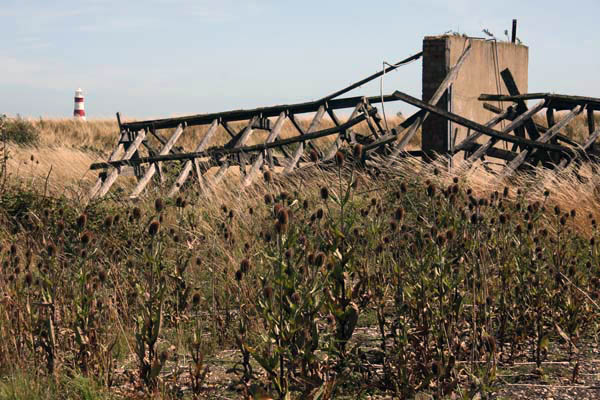
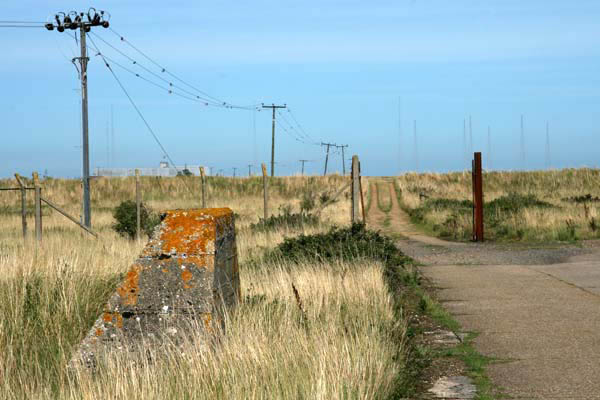
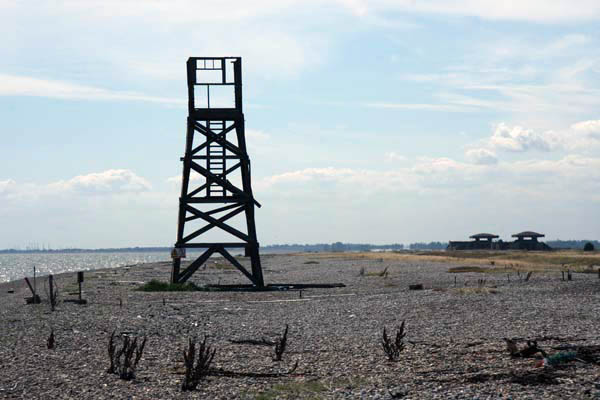
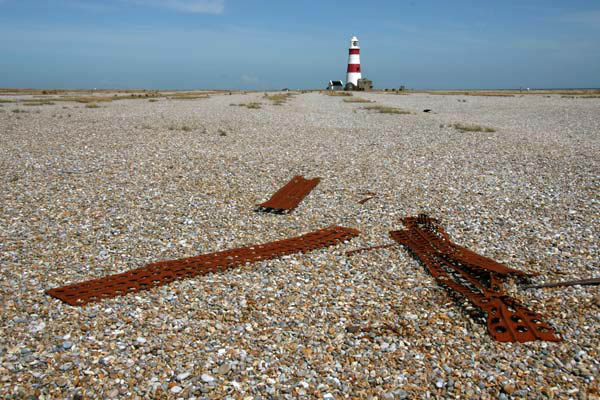
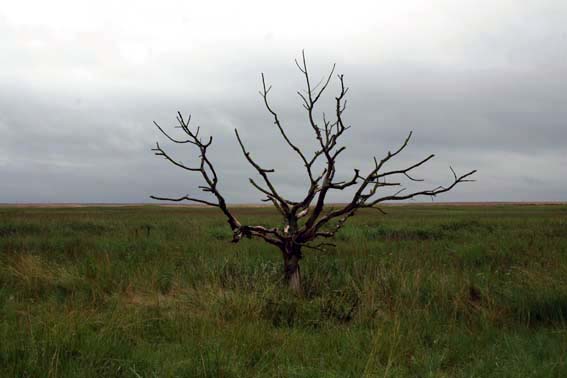
Though hardly pretty, this long shingle spit is undoubtedly evocative. Signs warn about unexploded ordinance, and everywhere you’ll see tangles of tortured metal and wire netting among the teasels in the shingle. Overall, it’s a rather melancholy landscape and you might begin to wonder if Orford Ness should actually be ‘orfordness’, a state of mind, rather than the name of a wayward landform.

Seen from Orford Quay, Orford Ness has the appearance of being an island, and the ferry trip across the River Ore simply adds to this impression, but it’s not – it’s actually a long sand spit that begins just south of Aldeburgh and gradually widens as it follows the coast south. It is the largest shingle spit in England (nearly ten miles long) and it is only when you disembark at the jetty that you can really appreciate the scale of the place. The National Trust has a number of recommended way-marked routes to follow but the reality is that you won’t see much unless you are prepared to walk some distance. Concrete roads lead around the spit and you have to trudge along these some way before you get to see anything of much interest. Bicycles are not permitted.


And yes, that is the Orford lighthouse on the East of Elveden gravatar

Patience (After Sebald) – Walking The Rings of Saturn

About a year ago I wrote a post about an Aldeburgh Music weekend at Suffolk’s Snape Maltings that celebrated the life and works of the writer W G Sebald. A new film by Grant Gee, Patience (After Sebald), was also previewed on that occasion but it has taken a full year for it to have been finally been put out on general release in the UK. After such a long wait, ‘Patience’ might seem a wholly appropriate choice for a title but I finally got the chance to see the film last Sunday at a sell-out screening at Cinema City, Norwich.

The film is based on what is probably Sebald’s best known work, The Rings of Saturn, which  describes a long meditative walk in the Suffolk coastal region. In German translation the book is subtitled ‘Eine Englische Wollfahrt – an English pilgrimage’, but this is misleading as The Rings of Saturn is not really about pilgrimage at all, nor is it a work that concerns itself that much with landscape, although the shingle and wide skies of coastal Suffolk do make a cameo appearance.

Although genres such as travel, history and memoir are appropriate up to a point, The Rings of Saturn is a work that boldly defies categorisation and which cannot easily be placed into any single literary pigeonhole. Sebald’s Suffolk odyssey is really as much an internal journey through one man’s mind as anything else. Far from the normal notion of travelogue, The Rings of Saturn is more a psychogeographic exploration of one corner of East Anglia. Certainly, the physical geography here is spectral, a melancholic landscape of ghosts, personal reflection and dark cultural memory. The term ‘Proustian’ might be used to define Sebald’s style to some extent but a better word would be Sebaldian: W G Sebald is one of those rare writers, like Dickens, Kafka and Ballard, whose name can be confidentally used as an adjective thanks to a distinctive mournful style and typically digressive, fragmentary narrative.

Part of the Sebaldian trope is to include images – black and white photos and line drawings – as part of the narrative flow; images, sometimes unsettling, that are tangential to the geography of the walk yet central to the narrative’s solipsistic digressions. Many of the book’s already familiar images are replicated in Patience (After Sebald), serving as a backdrop for talking heads like Robert Macfarlane, Iain Sinclair and Andrew Motion who have been recruited among others to give their personal take on Sebald’s oevre. Other images on display in the film are immediately resonant to those who have read The Rings of Saturn even though they do not appear as photographs within the pages of the book itselfA brief glimpse of a naked couple lying on a beach clearly represents the lovers that Sebald stumbled upon at Covehithe and, panicking, described as ‘like some giant mollusc washed ashore… a many-limbed, two-headed monster’. A shot of a distressed-looking plate of food undoubtedly refers to the joyless pub meal taken by the author in Lowestoft, which contained a fish that had ‘doubtless lain entombed in the deep-freeze for years’ along with tartare sauce ‘turned grey by sooty breadcrumbs’. Apart from an occasional colour inset frame showing a walker’s boots on the tarmac (the film-maker himself perhaps?), the images used are monochrome throughout, as grey as Sebaldian tartare sauce.

Also permeating the film are grainy 8mm-like shots of some of the locations that Sebald passed through on his long walk – places that get scant mention in The Rings of Saturn but which clearly inform its telling; places familiar to anyone who knows the Suffolk coast reasonably well – Southwold’s Sailors’ Reading Room, Boulge church, Yoxford, the ruins of Dunwich and the formerly top secret research pagodas of Orford Ness. If anywhere could be described as an archetypal Sebaldian landscape it would surely be Orford Ness.

Patience (After Sebald) complements Sebald’s book admirably. It encourages those unfamilar with his work to read The Rings of Saturn for the first time, while those already smitten can find nourishment in the distinctly Sebaldian imagery of the film and the generous personal accounts of the man himself. To be nitpicking, there are a couple of small details that some Sebaldophiles might find slightly incongruous – Andrew Motion reading his poem about the merman of Orford, perhaps, and a scene near the end that involves a puff of smoke at the roadside where Sebald died in a car accident. The latter I found quite thrilling although some might consider it borderline tacky – I can say no more.

Sometimes writers can seem to influence the reader’s view of landscape to such an extent that it is hard to come to it with innocent eyes. Once The Rings of Saturn has been read and absorbed, coastal Suffolk – in the right conditions – can easily transform into a Sebaldian landscape for those passing through it. Yet, as Robert Macfarlane recounts in Gee’s film, it is imposible to replicate Sebald’s journey exactly. Macfarlane’s own well-intentioned attempt to retrace Sebald’s steps was thwarted by sunny, distinctly non-Sebaldian weather and by simply having too much fun swimming at Lowestoft.

Even with fine weather and a light heart, it seems impossible for anyone who has read The Rings of Saturn and walked the Suffolk coast to not have some sort of Sebaldian connection. Whether we like it or not, his prose and dark historic musings have encouraged us to see the coastal landscape in a thousand shades of (tartare) grey whatever our proclivities. But we cannot replicate Sebald – and why should we? Even following those exact same footsteps, we all do our own walk, make our own pilgrimage. The psychogeographical dimension of any walk through any landscape is as dependent on the mindset of the walker as it is on the territory itself.

On a personal note, the book’s geography resonates more than I might ever have imagined: the site of the old Norfolk and Norwich Hospital where Sebald opens the text (finding himself there with a back problem a year after the completion of his Suffolk walk) is located immediately across the road from where I live.

Gloomy Sunday

It is Sunday in Edinburgh and the city streets are filled with Frenchmen in blue shirts and black berets all come for the Six Nations rugby match against Scotland at Murrayfield stadium. Preferring the game that favours a more spherical ball it seems like a good opportunity to take the train to Glasgow for the day.

The previous day, on our mentioning Scotland’s largest city, Colin, our bed and breakfast host, remarked, “Well, I’m Edinburgh man so I’m biased but I think Glasgow makes the most of what it’s got to be fair.” It is no secret – Edinburgh and Glasgow may be less than 50 miles apart – one hour on the train – but there is a cultural gulf between the two cities. Or so they would have you believe: rough, working class Glasgow versus genteel, middle-class Edinburgh; Billy Connolly versus Miss Jean Brodie; deep-fried pizza versus herb-infused foccacio. This is, of course, a misleading generalisation but it cannot be denied that the two cities do have a markedly different feel. Edinburgh is no longer ‘Auld Reekie’ but a stylish European capital with a beautiful skyline. Glasgow, on the other hand, remains a Victorian city par excellence – famously, the second city of the British Empire. While Edinburgh seems to thrive on its glorious past and embody the spirit of the Georgian Enlightenment, Glasgow, like Manchester and Sheffield over the border in England, is a place in post-industrial transition, a city trying to find its rightful place in the 21st century. Despite its City of Culture makeover a decade or so ago, Glasgow still manages to look a bit threadbare around the edges in a way that central Edinburgh does not. This is only part of the picture though – take a bus out to one of the outlying ‘schemes’ in either metropolis and peripheral Edinburgh looks every bit as unattractive and dysfunctional as the wastelands of outer Glasgow.

In Glasgow, the Willow Tearooms still operates in the city centre, a working shrine to the distinctive secessionist style of Charles Rennie Mackintosh, one of the city’s most famous sons. The Glasgow School of Art designed by Mackintosh when he worked as an architect in the city lies just around the corner. The ‘Room de Luxe’ at the top of the stairs is a delight – elegant high-backed chairs, roses in vases and a view through stained glass windows down onto Sauchiehall Street below.  The window glass (original we are told) distorts a little, affording a slightly twisted view of a boarded-up Pound-Mart store opposite, humdrum 1960s and peeling paint. A solitary busker, clearly audible from the tearoom, plays the trumpet to passers-by, belting out jazz standards like Summertime in fast rotation. But summertime it is not – the day is dreich and chilly, the sky the colour of cold porridge – Gloomy Sunday might be a more apposite choice.

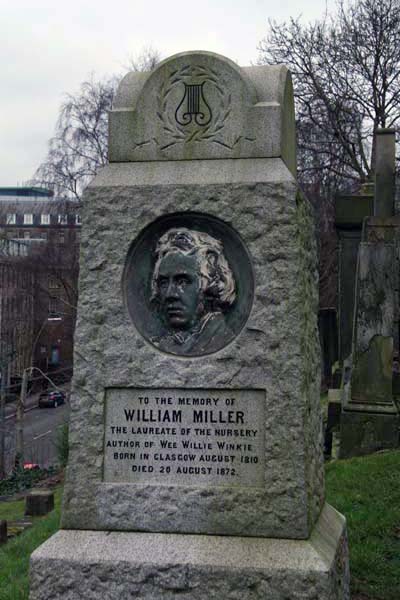
A mile or so to the east, beyond Queen Street Station and George Square with its Modern Art Gallery, St Mungo’s Cathedral sits next door to the Royal Infirmary, a proximity that is surely no mere coincidence. Beyond the dark glowering sandstone of the cathedral and across a footbridge (‘the Bridge of Sighs’ utilised by funeral processions) lies the Necropolis – Glasgow’s city of the dead. The most obvious monument, looming high on a Doric column at the top of the hill is a memorial to John Knox, the Protestant reformer but the first that we pass on the winding road uphill is a monument to William Miller, ‘The Laureate of the Nursery’ responsible for the children’s nursery rhyme Wee Willie Winkie, which was originally written in Scots:

Wee Willie Winkie rins through the toon,
Upstairs and doonstairs, in his nichtgoon,
Tirlin’ at the window, cryin’ at the lock,
“Are the weans in their bed? For it’s now ten o’clock.”

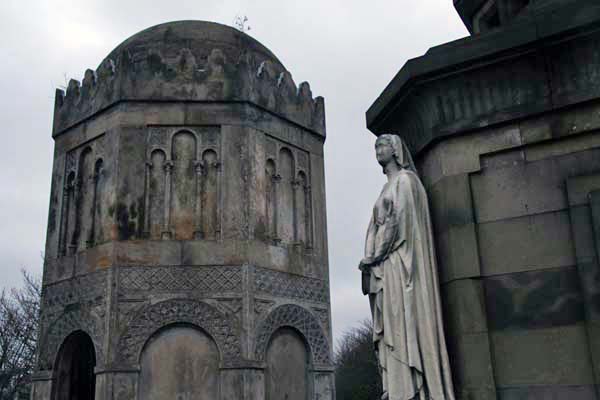
We climb the path to the top. Low cloud has drained all colour from the view apart from that of the glowing rust brown of the neo-Norman Monteath mausoleum, which brings to mind an Armenian church but was apparently modelled on the Knights Templar Church of the Holy Sepulchre in Jerusalem. Further up, the William Rae Wilson mausoleum is decidedly Moorish, a fitting monument to someone who travelled and wrote about the Middle East. Next to this, the entrance of the Graeco-Egyptian mausoleum of John Houldsworth is flanked by stern white angels, Hope and Charity, while Faith lies within glowing almost praternaturally in the gloom.

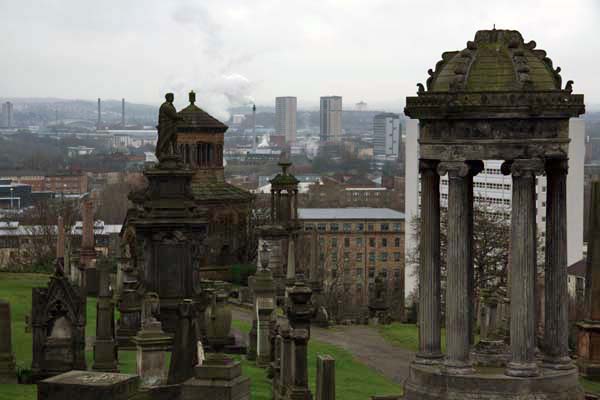
The view is the thing here. From the vantage point of the Necropolis it is easier to grasp the scale of Scotland’s largest city, even on a dull day such as this. The concrete, brick and stone of the city centre sprawls to the west beyond St Mungo’s spire and buttresses. Elsewhere, the land dips and rises gently to trace the valleys of Glasgow’s rivers, the Clyde and Kelvin. High-rise housing schemes dot the horizon east and north, an architectural echo of the serried ranks of tombs that line the Necropolis thoroughfares – a world of folk that once belonged to Glasgow’s inner city but now find themselves detached and isolated. If you believe the clichéd image, a realm of ne’er do wells – bampots, malkies, and chiv-wielding neds – but also pensioners, terminally unemployed steel workers, young single mothers and beleaguered immigrants. Whatever the reality, it is a long way from the fancy designs of Charles Rennie Mackintosh and certainly no place for Wee Willie to wander alone at night.

Heading back to Edinburgh our train squeezes past another returning to Glasgow at Croy station. Not quite as crowded as those we saw heading for Edinburgh on the way there, its carriages are full of middle-aged men in kilts and Scotland rugby shirts. They look somewhat subdued – clearly Scotland has lost the rugby.

The Writing on the Wall

Just up the road from where I live there is a large black-painted gable wall that bears the legend ‘PINK FLOYD’ in large bold white letters. Clearly, it was a gesture made using good quality paint as it has been there as long as I remember. For all I know it may even date back to the time of the original Pink Floyd line-up with Syd Barrett, although somehow
I doubt it – I rather think it is the work of a fan from the Floyd’s high-profile years of Dark Side of the Moon and after. Since that original graffito was daubed another paintbrush-wielding wag has come along to add a couple more brushstrokes and change the ‘I’ in ‘PINK’ to a slender ‘U’ thus rendering it ‘PUNK’, but this anarchic amendment  is not wholly successful, the paint being of insufficient quality to resist natural weathering. One might assume that this addition was made sometime around 1977 but here in Norwich there were individuals sporting orange Mohicans and tartan bondage trouser outfits well into the 1990s. Either way, the gable text seems to be of sufficient permanency that you can almost imagine archaeologists of the future puzzling over the meaning of its ‘Pi(u)nk Floyd’ cipher. Being archaeologists, they will probably attribute it as being of ‘possible
ritualistic significance’.

A little further up the road is a T-junction where the back of a one-way sign has been neatly and inquisitively stencilled: ‘WHY DO YOU DO THIS EACH DAY?’ Years ago, I used to turn left here every morning on my daily drive to work in North Norfolk. The graffito wasn’t there in those days but, had it been, I don’t think I could really have ignored it. It did, after all, pose the very question that was perpetually at the back of my mind and now it seems so significantly placed that I could almost believe that somehow I unconsciously put it there myself – I didn’t.

Putting to one side the familiar and shoddy tagging that seems the imperative of young men wishing to mark their territory like cock-legged dogs, graffiti seems to be at its most potent when a degree of passion is involved. Often it is the unintended permanency of a fleeting emotional state that renders it so evocative. One local piece of graffiti that immediately springs to mind, although I have long forgotten exactly where I saw it, was the legend ‘S. HEWETT IS A HOUR’ (sic), probably the work of a jilted teenage boy
who needs to work on his spelling. Inadvertently, by means of dyslexic subtext, this wounded individual has stated that ‘S. Hewett’, whoever she is, represents a fragment of time – perhaps she really was a waste of time as far as he was concerned. Although this declaration is undoubtedly passionate it seems odd that its author addresses the target of his fury by what seems to be a school register name rather than something more familiar. Maybe he is unknown and unrequited, rather than jilted, and just trying to spread rumours? These days, of course, he would do this by TXT. In contrast to this angry but passionate exclamation, another lovers’ tiff-style message I once saw scrawled on a wall in a neat feminine hand simply stated, ‘CHARLES I DESPISE YOU’. Such withering dispassion would be hard for anyone called Charles to ignore.

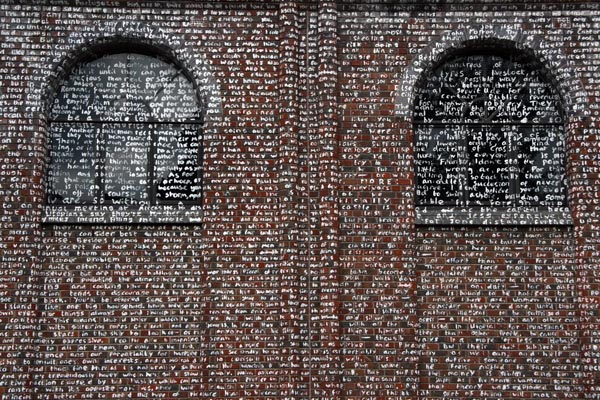
There is a fine line between urban wall scrawling and what might be considered ‘art’ but if you make the text 40,000 words long and legitimise it with an Arts Council grant then it may well become officially sanctioned. This is what the artist Rory Macbeth did in 2006, inscribing the entire text of Sir Thomas More’s 1516 work Utopia on the walls of a derelict building in central Norwich that was due for demolition. As Macbeth rightly states, ‘Most graffiti is utopian’. It should be remembered though that, in Greek, utopia actually means ‘no place’, and not ‘paradise’ as is often supposed.

Tomsk Waits

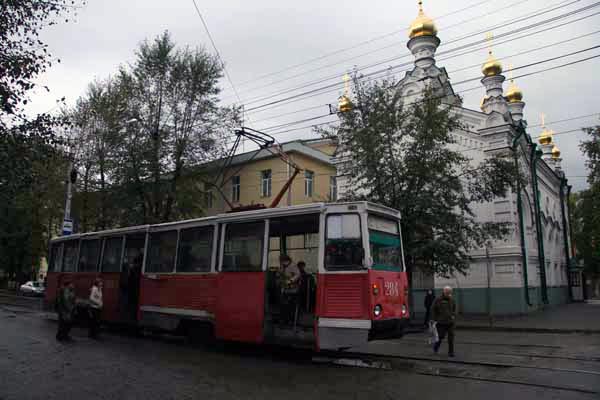
In contrast to the northwest Scotland of previous posts, the central Siberian city of Tomsk is indisputably East of Elveden – both figuratively and geographically. It is, after all, almost one quarter of the way around the world heading east from where I write. I spent a few grey rainy days here last autumn as a side trip to a long Trans-Siberian rail journey.

Tomsk lies just north of the main Trans-Siberian line, a sizeable city of about half a million sitting on the right bank of the Ob, a river that snakes its way north from here to the Gulf of Ob and the Arctic Ocean. Tomsk isn’t Arctic though – it lies at about the same latitude as Moscow and Glasgow, although it does drop to less than −20 °C in winter. Back in the 19th century, Tomsk was populated mostly by Cossacks, Tatars and political exiles but the city was side-stepped during the building of the Trans-Siberian railway line, when the new city of Novosibirsk (‘New Siberia’) was favoured as a stop instead.

These days Tomsk is a youthful, student-filled city; a relatively attractive place by Siberian standards, with a clutch of trendy brightly lit cafes around Ploschad Lenin, its central square. Trendy coffee bars are all the rage in the new Russia – even in backwoodsy Siberian cities like Tomsk. Here you’ll find ‘Travellers Coffee’, where you can get a pricey ‘bolshoi’ cappuccino, and another place called ‘Food Master’ – in a land where the Cyrillic alphabet reigns supreme, Latin script and English names are considered a guarantee of Western sophistication… or cheerless fast food. Food Master dishes up Mexican food with a pronounced Siberian accent – fajitas with beetroot, refried beans with dill and so on. There’s also an awkwardly translated English menu that temptingly offers ‘Languages with mushroom sauce’ and ‘Fat lard’ – fusion cuisine perhaps, but with a ‘con-’ prefix. Even here, in an establishment that is unapologetically ‘New Russia’, a Soviet-era fixation persists that has each component priced according to weight and itemised on the final bill – bread (the precise number of slices), sauce, garnish, meat (again precise, eg: ‘pig meat, 100g’) – as it would be the humblest factory workers’ stolovaya canteen. Actually, stolovayas are the places that I generally try and seek out – redolent of boiled cabbage, they promise cheap wholesome stodge served up by plump headscarfed women – just point and smile (or scowl if you want to blend in). It’s a genuine retro experience: school dinners, Soviet style. There is one of these tucked away in a basement a little further along Prospekt Lenin.

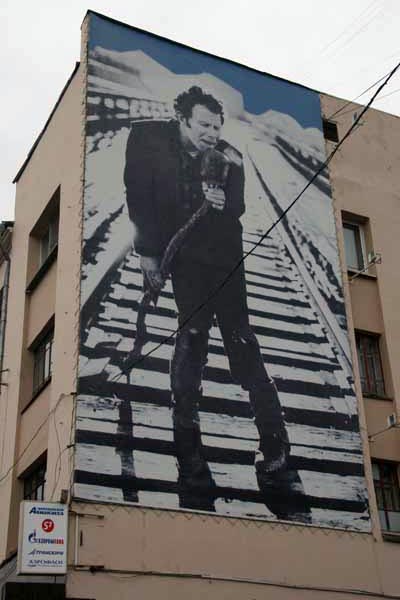
Stylish cafes are not the only concession to Western culture. Halfway along the high street a gable is covered with an enormous poster of gravel-voiced American troubadour Tom Waits standing astride a railway line and bellowing into a microphone windscreen mounted on a crooked stick – very much Tom the iconic hobo poet. The club in the basement beneath is called ‘Underground’ (a song from Swordfishtrombones) and, of course it is a lovely pun – Tom(sk) Waits – geddit. It seems unlikely that Tom Waits’ management is aware of this brazen Siberian deployment but equally doubtful that Californian copyright law stretches quite this far.  Waits is well known as an enthusiastic litigator of those who besmirch his image but this one seems to fit the brand perfectly.

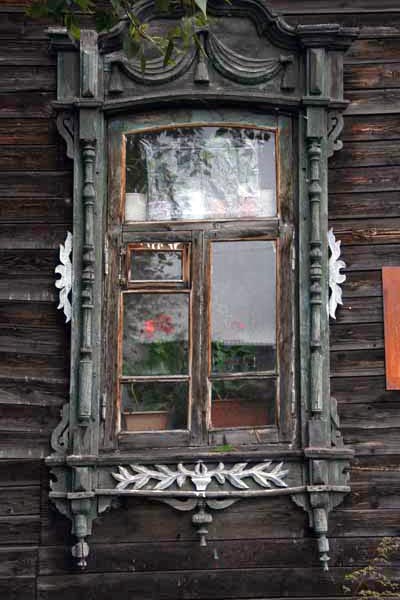
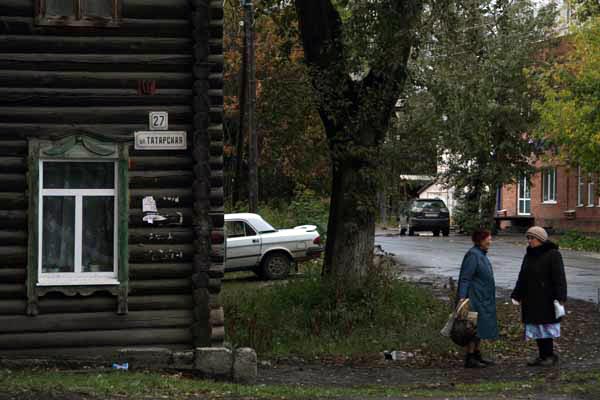
Drop down a street or two to the west, away from the clubs and cafes of Prospekt Lenin, and you immediately find yourself in Old Siberia. A leafy street called Tatarskaya (this was once the city’s Tatar quarter) has old wooden houses with elaborately carved window surrounds and friezes. Poor, a little tumbledown but undeniably picturesque, this is the sort of thing that tourists  come to see, although most tend not to wander this far off the direct Trans-Siberian route between Yekaterinberg and Irkutsk.

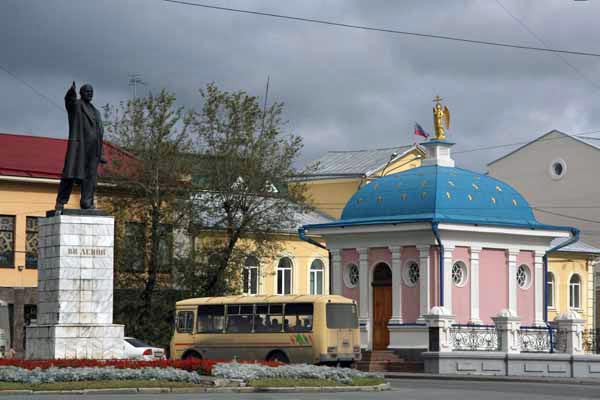
Heading further north along Prospekt Lenin you soon reach a part of town that seems to have far more resonance with the old Soviet Union. Naturally enough, there is a Lenin statue here – this one in ‘hailing a taxi’ pose – as well as some brutalist Stalin-era civic buildings, Krushchevski apartment blocks and rusting boats at the river quay. This really could be a scene from almost anywhere in the former USSR pre-1991 but it is not – it is simply a matter of post-Soviet redevelopment not quite reaching this far uptown yet.

Tomsk may have once been lauded as the ‘Siberian Athens’ thanks to its univeristies and large number of students but Anton Chekhov did not like it one bit, although surely it must have been an improvement on the penal colony at Sakhalin Island that he had visited prior to passing through the town.

He wrote to his sister: ‘Tomsk is a very dull town. To judge from the drunkards whose acquaintance I have made, and from the intellectual people who have come to the hotel to pay their respects to me, the inhabitants are very dull, too.’

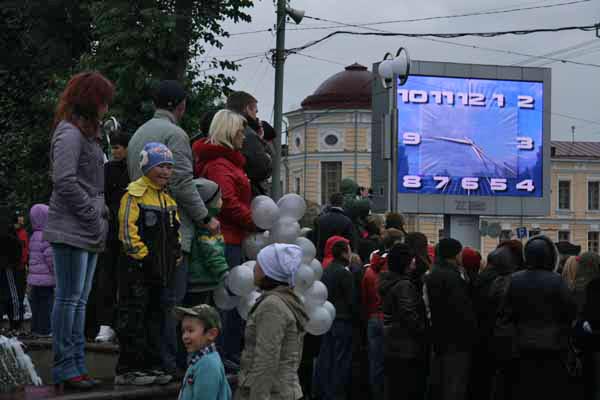
Quite understandably, Tomsk citizens have never quite forgiven this scathing dismissal of their city and in response have erected a mocking statue of Chekhov close to the university. Perhaps wounded by the accusation of  dullness, the authorities seem keen these days to instil some European-style civic fun into the Tomsk city calendar. They have inaugurated a carnival, and the one I witnessed last year was the fifth according to the posters. Roads were closed and a stage set up in the main square where a variety of acts came on to dance and mime to Russian turbo-pop. There was even a group of African djembe drummers hired for the task who grinned amiably as they performed to a bemused crowd that did not really know quite what to do. Young families and groups of friends watched the action on the stage and took pictures of each other with their mobile phones before sloping off for an ice-cream. No doubt it will take a while for imported carnival culture to catch on here – just two decades ago, rather than drumming Africans or disco-dancing teenagers, the citizens of Tomsk were watching processions of tanks and soldiers with supersized hats march by.

While Tomsk may struggle with the concept of carnival it is doing well in the world of football. In recent years the city’s home side FC Tom Tomsk (their logo in Cyrillic spells TOMb) has risen like an eagle up the divisions to reach the dizzy heights of the Russian Premier League. It remains there, respectably mid-table, to this day. The Hotel Sputnik where I stayed is located right next door to the team’s stadium but sadly I had to move on to Irkutsk the day before their fixture with Lokomotiv Moscow.

For a look at another quirky Russian city, Kazan, take a look at my feature in the latest edition of hidden europe magazine here.

Crossing the Bridge

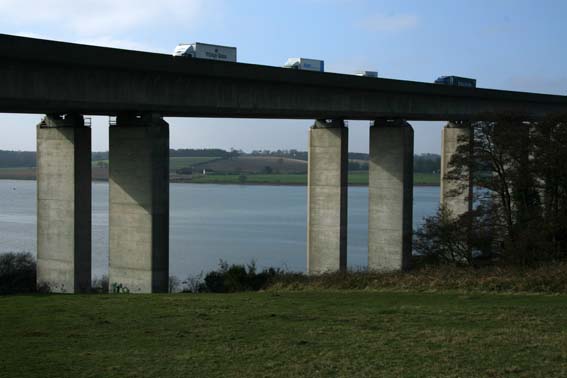
A little south of Ipswich, the vast concrete span of the Orwell Bridge stretches across the eponymous river like a conveyor belt to Hades. Well not Hades exactly, but the Port of Felixstowe. A constant rattling procession of lorries shunt to and fro the port, their drivers barely aware of the river they are crossing or the county town they are skirting by. The ciphers that identify their payloads have become household names — Maersk, China Shipping, Cosco – those magic metal boxes that contain the necessities of 21st-century life. Well-travelled, and more often than not coming from the Far East, the containers are the camels of the latter day Silk Road: a trade route, which, as any historian will tell you, was about a lot more than just silk.

The bridge might appear to be no place for pedestrians, but they are tolerated, and walkers intent on completing the Stour & Orwell Walk between Languard Point and Cattawade, and wishing to avoid the extra six or so miles of the alternative ‘Ipswich Loop’, are obliged to cross it on using the walkway on its southern side. The approach on foot from Orwell Country Park is intimidating – the noise, speed and volume of traffic all contributing to the inevitable feeling that this is an unnatural place for hikers to be setting foot. The 30-metre drop to the Black Ooze (yes, it really is called that) of the River Orwell below is held at bay by just a concrete ledge a little more than a metre high. This is certainly not comfortable strolling territory, nor a place to suddenly become aware of a hitherto undiscovered acrophobia.

Steps lead up sharply to the bridge walkway, past a Samaritans sign that bears a short but kind message and a phone number. Like steps to the gallows, the certainty that you are shadowing the last steps taken by some desperately unhappy souls is chilling. At the top is a free phone, proof that someone cares, although the lorries flying by seem wholly indifferent. The views along the Orwell estuary are pleasing – green fields, houses snuggled in woodland, little boats bobbing in silver water – but the constant thrum of the traffic, and a tangible sense of alienation, do not encourage lingering. The walk across takes around 15 minutes.

Bridges are powerful metaphors for the journeys of life, for transformation. The novelist Ian Banks wrote an entire novel – The Bridge, no less — using an enormous industrial super-complex of a bridge as the dream environment of his comatose crash victim protagonist. Religion and mythology make good use of the bridge as metaphor too and the crossing of a body of water — the River Jordan, River Styx — is ascribed a spiritual meaning. Most of the time though, our concerns are more mundane: if crossing the Orwell Bridge on foot is disturbing then it is because of its height and heavy traffic as much as its psycho-geographic imprint.

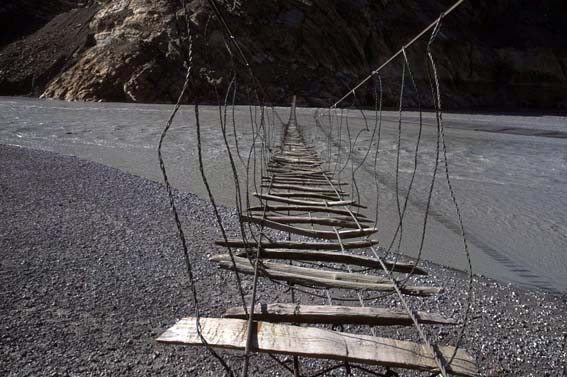
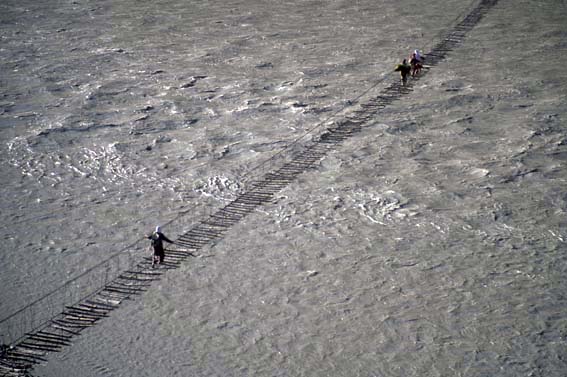
Elsewhere in the world, where health and safety concerns are not held as sacred as they are here in the West, dodgy-looking footbridges have been used daily for generations without much fuss. The one illustrated here is over the Hunza River in the far north of Pakistan. To be honest, it is a little nerve-wracking to traverse, especially when local villagers join you and the bridge sways nauseatingly above the rapid rock-filled glacial river beneath. More alarming still is to cross halfway only to discover a missing slat and the necessity of making a jump to the next complete one.

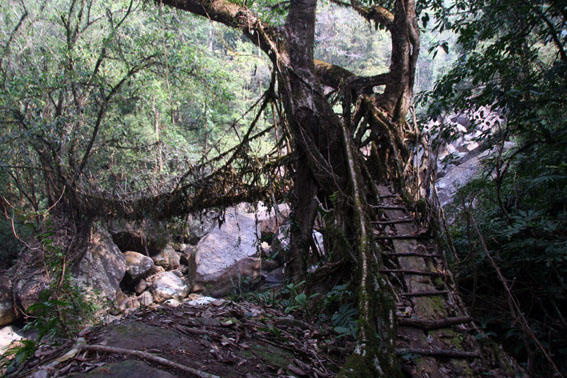
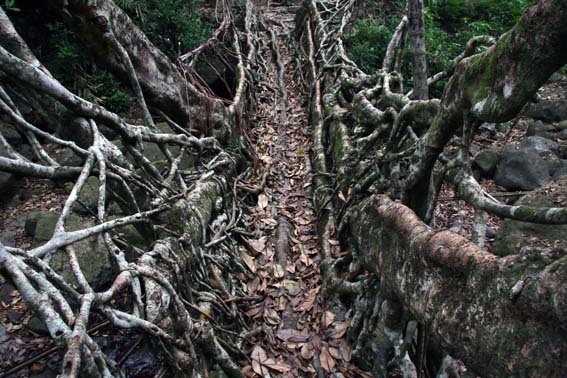
In contrast, this footbridge feels much safer; nurturing even. Perhaps it is its solid organic nature that reassures, and also the surprising realisation that it hardly sways at all? This remarkable feat of bio-engineering, which resembles something that Frodo might have encountered in The Lord of The Rings,  is one of many living root bridges found in the deep, rain-washed valleys of Meghalaya, northeast India. Fashioned from the living roots of fig (Ficus elastica) trees that grow alongside the region’s turbulent monsoon streams they take decades to build but last for centuries. You can read my article on them in Geographical magazine here.

Returning closer to home, to the Waveney Valley in fact, here is a short extract from Slow Norfolk & Suffolk that describes an encounter on the bridge across the Waveney at Mendham on the Suffolk/Norfolk border. Perhaps bridges do affect us psychologically more than we might credit?

This is classic Waveney Valley scenery — the sort of thing Munnings might have painted if he had not concentrated on horse fairs or attacking modernism quite so much. It’s the kind of landscape that brings reverie. The iron bridge crossing the Waveney seems like a giant staple attaching Norfolk to the Suffolk mainland. Brown cows wandering the meadows contentedly graze and flick flies away, keeping their eyes on a pair of locals fishing beneath the trees and catching nothing. As poplars rustle in the breeze, the very English sound of an accordion drifts down from the Munnings pub. It could almost be the 18th century, if it wasn’t from the fishermen’s car parked by the road. As I am taking all this in, a man who is clearly the worse for drink ambles down the road towards the bridge. He stumbles exactly halfway across, pauses for a moment, then goes back the way he has come. It is as if he is fearful to place his feet on Norfolk soil, or there is some sort of invisible barrier. Two minutes later, a sleek Jaguar arrives from the north to pick the man up. Then it turns around and ferries him back across the bridge… into Norfolk.

Walking the Edge

The latest issue of Geographical magazine has a feature by Alastair Humphreys on walking around London following a route as close to the M25 orbital as possible. The focus here – other than the testing of outdoor clothing and equipment – seems to be that of ‘micro-adventures’ in one’s local area: a worthy notion in this information-bloated age where, if truth be told, there are few exotic places left to explore. The adventurers of yore usually had an ulterior motive anyway – empire carving, resource procurement, trade – and so latter-day explorers, unsponsored by king and country (and usually publishers) and wishing to find something new, have to look instead at the finer detail, examine the way countries have changed, focus on the small print of ‘place’.

The writer Iain Sinclair has already written about the M25 at length in his book London Orbital where, instead of sleeping in a bivvy bag in green belt fields (and tweeting about it) as Humphreys has done, the author completed the circuit by way of day-long excursions from his Hackney home in the company of a handful of friends. Sinclair’s clockwise plod reveals a twilight zone where megalopolis begins to morph into leafy shires. Most revealingly, he identifies a ring of vanished mental hospitals and institutions that trace the course of the future motorway with uncanny accuracy. Like plague pits located beyond medieval city walls, it appears as if it was decided in Victorian times that illness – especially the mental kind – had to be kept at arm’s length and well beyond the city’s grasp lest it infect the metropolitan populace. The distance necessary for this physical and spiritual separation seems to coincide almost exactly with that of London’s orbital racetrack.

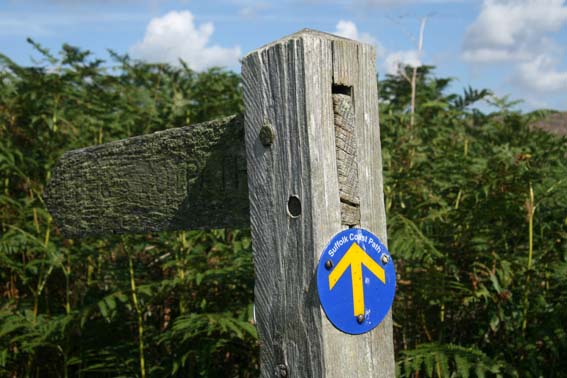
Turning to a more rural setting, here in East Anglia both Norfolk and Suffolk may be circumambulated (more or less – let us not quibble about precise boundaries) by following a series of long-distance footpaths. In Norfolk, begin with the Angles Way in Great Yarmouth, follow it along the Waveney Valley almost as far as Thetford in Breckland and then take the  Iceni Way along the River Great Ouse and across the Fens north to Hunstanton where the Norfolk Coast Path can be picked up to continue east. At Cromer, the meandering Weaver’s Way can then be followed through the Broads to arrive back at Yarmouth. In Suffolk, the Suffolk Coast Path can be walked from Lowestoft to Felixstowe before continuing around the Suffolk estuaries by means of the Stour and Orwell Walk to Cattawade. Here, the county boundary may be traced west to by means of the Stour Valley Path, straying occasionally into Essex and Cambridgeshire, as far as Sudbury before continuing to Bury St Edmunds along the St Edmund Way and Icknield Way path to Breckland  from where the Angle’s Way completes the circuit back to the Suffolk Coast.

Last year I had a notion that it might be interesting to split the Norfolk boundary circuit into four seasonal portions, four lengths of the county rectangle that would be walked around each of the year’s cardinal points: the Angle’s Way in mid winter; the Iceni Way in spring and so on, completing the circuit to arrive back at Great Yarmouth around the autumnal equinox. Starting out with good intentions, I walked the length of the Angles Way in late December 2009 and early January 2010. Plans for setting out on the next section, the Iceni Way, were abandoned however – or, rather, put on hold – when a commission to write a guide for Cicerone Press on the three long-distance walks within the Suffolk Coast & Heaths AONB turned my attention to trails a little further southeast. My forthcoming guide Suffolk Coast and Heaths Walks: Three Long-distance Routes in the AONB will be published in November this year.

W.G.Sebald, In Memoriam

The UEA-based German writer, W. G. (‘Max’) Sebald, died just over nine years ago in a car accident close to his home south of Norwich. One of his most famous books, and certainly the one most closely connected with the East Anglia region, is The Rings of Saturn, published in 1999. Superficially a post-illness walking tour of east Suffolk, this labyrinthine unclassifiable work delves tangentially into deep history to discuss episodes as wide ranging as the import of silkworm cultivation into Europe, the writings of 17th-century Norwich polymath Thomas Browne, Nazi concentration camps in Croatia and the scurrilous private life of the Suffolk-based translator of Omar Khayyam.

Focusing unhealthily on the dark, isolated and horrific, Sebald’s writing is hardly what one might describe as ‘feel-good’; indeed, it is often gloomy to the point of verging on the morose. His literate, hang-dog style can almost seem self-parodying on occasion, especially when it circles down to earth to confront the quotidian as in the case of an hilarious description of a disappointing dinner in Lowestoft – only Sebald could disparagingly describe the ‘breadcrumb armour-plating of the fish’ and sachet tartare sauce ‘turned grey by sooty breadcrumbs’. Although he veered towards the hyper-melancholic, his writing was always elegant and elegiac, not to mention meditative, lapidary, dream-like and solipsistic. Interweaving memory, fiction and observation along the course of his walk, there is a Proustian quality to his writing that questions the transience of life and suffering.

Clearly, The Rings of Saturn has sufficient devotees for others to want to walk in Sebald’s footsteps, seeking out the Suffolk landscape that inspired such beautiful gloom along the eastern reaches of the Waveney Valley and the Suffolk coast between Lowestoft and Dunwich – a landscape that seems oddly devoid of people in Sebald’s book. Aldeburgh Music at Snape Maltings recently held a weekend devoted to a celebration of Sebaldia that involved the American rock chanteuse Patti Smith no less. It remains to be seen whether the film Patience (After Sebald) by Grant Gee that was also screened during the weekend will be available to general view in the near future.

Here’s a short film and a piece in the Guardian.