Jezero to Jajce

Incompetence can have its benefits, it can even sometimes lead to adventure – that is my experience. A simple small error or misunderstanding can lead the way to the unexpected: an experience that perhaps you did not plan for but which you are grateful for in hindsight. This is how I came to walk from Jezero to Jajce in central Bosnia, from the Republika Srpska  (RS) to the Bosnian Federation.
In Jajce I had enquired at the bus station about transport to the nearby Pliva Lakes. I used the Serbian/Bosnian/Croat word for lake, ‘jezero’, and was sold a ticket for a bus that was leaving almost straight away. Getting on the bus, I also checked with the driver – I wanted to go to ‘Jezero’. Sure, no problem.

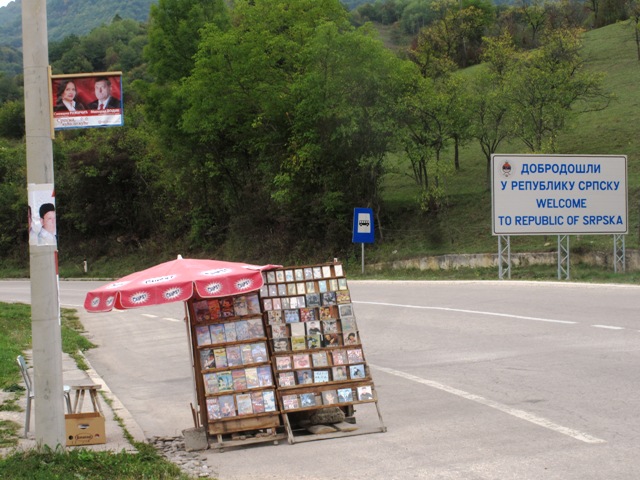
We set off out of town and very soon a large body of water became visible through the trees beneath the road. After a while the lake petered out and we followed a river along a narrow gorge. By this stage it was clear that we had already travelled considerably further than the five kilometres I had been told it would be. I mentioned this to the driver but he just motioned that ‘Jezero’ lay a little further on. A few minutes later, a large sign at the roadside announced in English and Serbian Cyrillic, WELCOME TO THE REPUBLIC OF SRPSKA and then, shortly after, a town sign that simply said JEZERO. Then it dawned on me what had happened – in these parts ‘Jezero’ was not just some generic geographical feature but the name of a small town, although calling a town ‘lake’ when it is not actually next to one seemed odd to me.
Stepping down from the bus, a road sign pointing back the way we had just come announced that Jajce was 12 kilometres distant. There was nothing else to but to start walking.

Passing a busy café-bar full of men drinking Jelen beer and a Bosnian Serb policeman who eyed me suspiciously I retraced my steps eastwards along the road. At least the road was quiet, with only an occasional lorry or speeding car to break the silence every few minutes or so. Back at the sign that announced the RS border were a handful of roadside stalls selling cut-price CDs and DVDs, and even tape cassettes with unreadable sun-bleached covers. Why the stalls had set up here was a mystery. Was it some sort of legal loophole, free-trading in the no man’s land that lay between the RS and the Federation, or does some sort of psychogeographical phenomena exist in which motorists entering the Republika Srpska develop a sudden unexplained hankering for Ceca ’Live in Concert’ and Turbo-folk CDs?
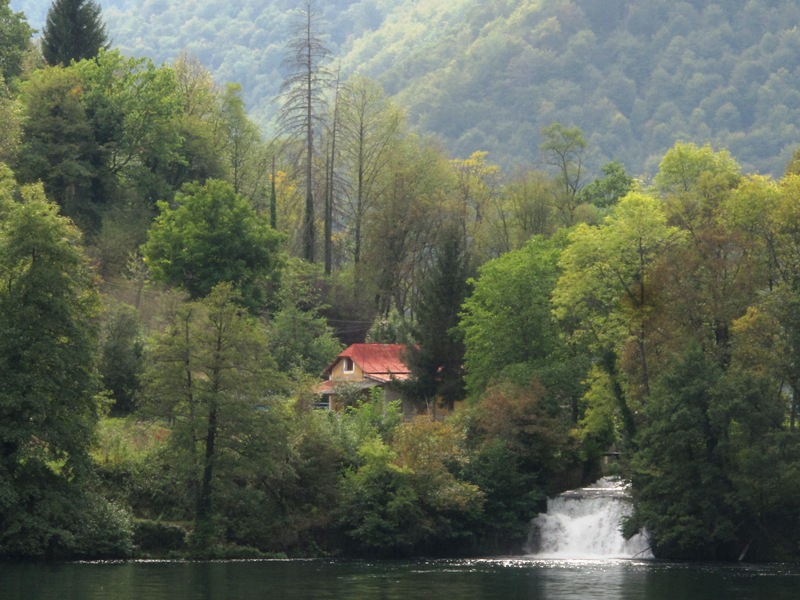
The road back to Jajce followed the river closely, steep wooded slopes rising to a high ridge on the opposite bank. Like much of central Bosnia, it was a landscape of prodigious beauty – lush, green and bursting with bucolic bountifulness – a countryside so gorgeous that the notion of any sort of violent conflict ever taking place against such an exquisite backdrop seemed unlikely, almost impossible. But appearances can be deceptive –this was not only Bosnia but a region that straddled one of the country’s fragile ethno-political fault-lines.

An hour’s brisk walk brought me to the edge of the lake close to where a large abandoned glass building rose above trees at the roadside – once a fancy restaurant with a panoramic view perhaps? Now it was unloved with shattered windows and rampant weeds colonising its stairway. From here a track lead away from the road to follow the lake shore and then a series of weirs until the separate channels eventually converged to revert back into a river once more. It was along this stretch that a picture-perfect cluster of small wooden water mills stood, lovingly preserved as quaint rustic heritage.

Venturing a little further east, the main road became visible once more high above the river. The track soon passed directly underneath it and little by little the steep-pitched roofs of Jajce started to reveal themselves on the hillside ahead, although, as yet, there was no sign of the town’s fortress or its famous waterfall.

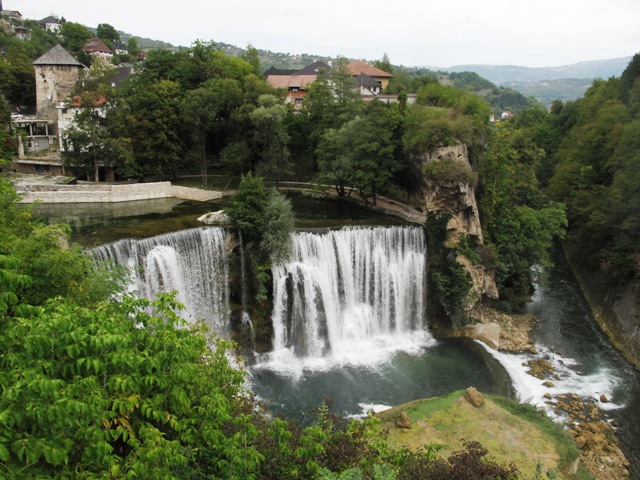
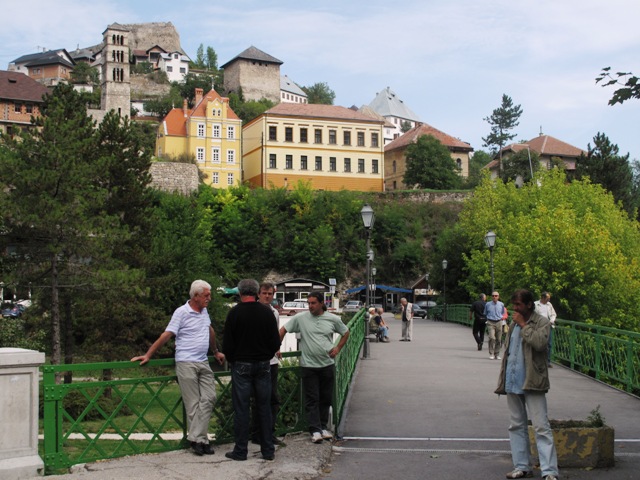
Jajce always was Bosnia’s poster girl. Quite literally: the town’s famous waterfall appears on numerous tourist posters and did so even in the days of package-holiday Yugoslavia back in the 1970s. But this western approach to the town revealed a side of Jajce’s history that does not appear in conventional tourist literature. Walking through the town’s outskirts I passed the ruined shells of houses and long-abandoned orchards, while bullet-scarred walls provied further evidence of recent conflict if ever there was any doubt. This, I suspected, was the part of town where Jajce’s Serb population probably used to reside. These days some of them no doubt live just up the road, across the RS border in Jezero. This is just inference on my part but the reality is what was once a town with a mixed population of Serbs, Muslims and Croats is now overwhelmingly Croat and Muslim. Nearly every town in Bosnia has a similar tale to tell, although the demographic changes vary depending on whoever had the upper hand in a three-sided ‘ethnic cleansing’ war of attrition. Often this was the Serbs but not always.
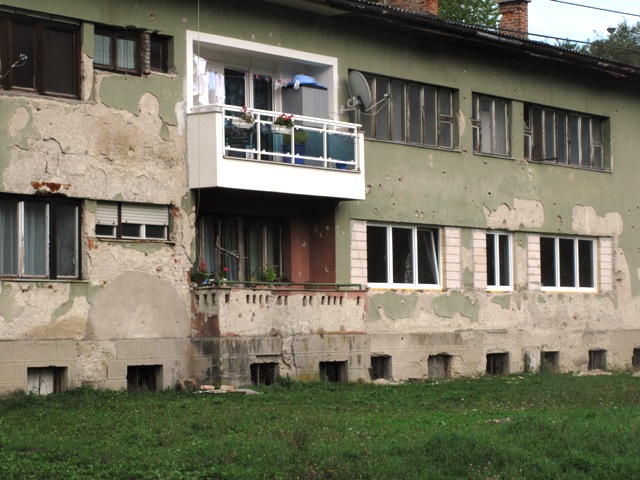
A positive note though: in one battle-scarred apartment block on Jajce’s outskirts someone had clearly recently moved back in, as a brightly painted new balcony complete with satellite dish now stands out defiantly from the bullet-wracked front wall. Bosnia needs its optimists.
Baconsthorpe

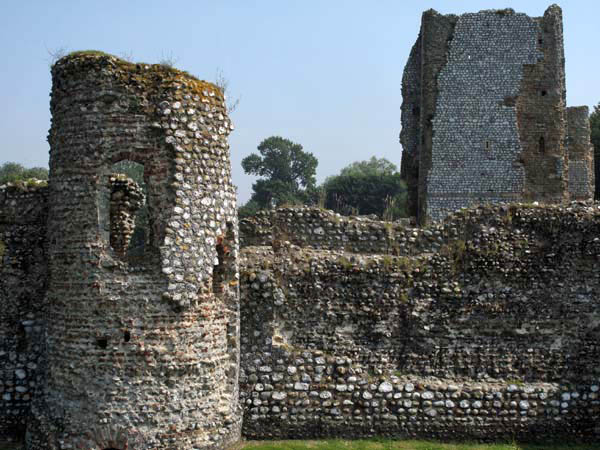
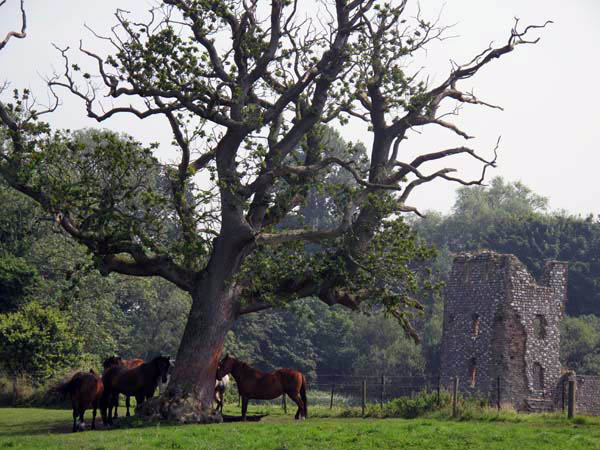
The ruined castle at Baconsthorpe in north Norfolk can hardly be described as ‘hidden’ but it does lie nicely tucked away from the limelight, located at the end of a dusty farm track at some distance from the main road. Strictly speaking, it is not really a castle, more a fortified manor house, but with a large moat, thick flint walls and a no-nonsense gatehouse, unlawful entry by unwelcome visitors would certainly not have been easy.

To reach Baconsthorpe Castle  you can drive right up to the door from the village of the same name.  The site is managed by English Heritage and there is no charge for car park or entry. Better still, you could walk from Bodham, the village to the north that straddles the busy Holt to Cromer road. Certainly, to follow the footpath up and down the shallow valley before skirting Baconsthorpe Wood, makes arrival here a little more special. With luck, as the castle comes into view after leaving the wood you will be greeted by some of the sleek chestnut horses that graze in the meadow beside it.

 Next door to the gatehouse stands a group of old farm buildings that have seen better days — no doubt a bustling, energetic place before the middle of the last century, now their only role appears to be that of the storage of farm machinery. Within the gate there’s a compound and a bridge across to the inner court.  Here, to the east, the moat widens to become a large pond –  known as a ‘mere’ in these parts – which provides luxury accommodation for the ducks that thrive on the sandwich crumbs left by picnicking visitors. Swallows swoop low and fast over the water to grab unsuspecting flies but there’s little sound other than a summery rustle of leaves, the narcotic coo of pigeons and, during school holidays, the gleeful cries of children here with their parents.

What is of particular interest here is not so much what remains of the castle but what has happened to those parts that are absent. Certainly, it is not just the effect of the elements. Built as a 15th-century manor house by the locally powerful Heydon family, the inner gatehouse and fortified house were added at the time of the Wars of the Roses. Some of the buildings were converted into a textile factory at the height of Norfolk’s  profitable wool trade in the Tudor years. The outer gateway came in the Elizabethan period.

The English Civil War brought an economic downturn to the Heydon family fortune (Sir John Heydon commanded Charles I’s artillery, which did not endear him to the  Parliamentarians). The castle was seized by Roundheads and occupied for a while before eventually being sold back to the Heydon family. Encumbered by accumulated debt, Sir John Heydon was obliged to demolish many of the buildings to sell as architectural salvage. Many of the stones reportedly found new purpose in the walls of nearby Felbrigg Hall. The stained glass with the Heydon family crests were removed and installed in Baconsthorpe’s St Mary’s Church.

The voices of wealthy landowners, shepherds, textile workers and Roundhead soldiers would all once have echoed here within the castle’s sturdy walls. Now, apart from the subdued utterances of occasional visitors, they stand silent: mute witnesses to history; flint and brick repositories of the past.

Tofiq Bahramov, the ‘Russian linesman’

Last weekend England beat Norway 0 – 1 in a friendly football match at Oslo. Great Britain beat Norway at Eurovision too, although this was hardly cause for celebration as coming 25th, just a few points above 26th-placed Norway at the very bottom, is really nothing to be proud of. Many admire ‘null point’ Norway’s steely determination to achieve dependably low scores in this annual cheesy telefest, but those behind the Great Britain entry probably expected far more. But what what can you expect from a septuagenarian crooner named after an obscure German opera composer?

As we all now know, this year’s Eurovision was held in Baku, the Azerbaijan capital. The jury is still out as to whether this ex-Soviet country in the Caucasus geographically belongs to Europe or not but, for the purposes of this competition, Azerbaijan is as much a part of Europe as Norway or France…or even Israel.

I travelled to Baku back in 2000 and returned once more for a brief stay in 2010. In 2000, Baku had seemed quite a threadbare sort of place but by the time of my second visit the Azeri capital had visibly enlarged upwards and outwards to resemble a high-rise building site, with lofty buildings mushrooming near the port like blue glass monoliths. Now there was ferocious traffic too, but I braved this to seek out the Tofiq Bahramov football stadium in the north of the city. The national stadium, which had originally been a contender for the Eurovison 2012 venue, was not easy to reach on foot and necessitated the hazardous crossing of lanes of teeming city traffic. It would seem as if one of the consequences of rapid urban development is to make travel through the city on foot difficult, undesirable and even unwise. Planners seem to assume that, given shopping malls, high-rise offices and a blanket spread of MacDonalds outlets, the hapless pedestrian will happily abandon bipedalism for more appropriate means of locomotion. Clearly, those of us preferring foot power just stand in the way of progress with our unreasonable demands for footpaths, pavements and pedestrian crossings. But I digress.

The England football team’s most glorious moment back in 1966 may well owe a debt to Azerbaijan.  The sympathetic ‘Russian linesman’ at the 1966 world cup was actually an Azeri national named Tofiq Bahramov, although at the time Azerbaijan was an autonomous republic within the USSR. It was Bahramov who decided that Geoff Hurst’s extra time shot that bounced off the crossbar had actually crossed the line – a controversial decision that proved to be a vital turning point in the game in England’s favour. The final 4-2 scoreline clinched it. After the game, Bahramov, along with the referee and the other linesman,  received a golden whistle for his duties from HM the Queen. We can only presume that he would still have been given it even if England  had lost the final.

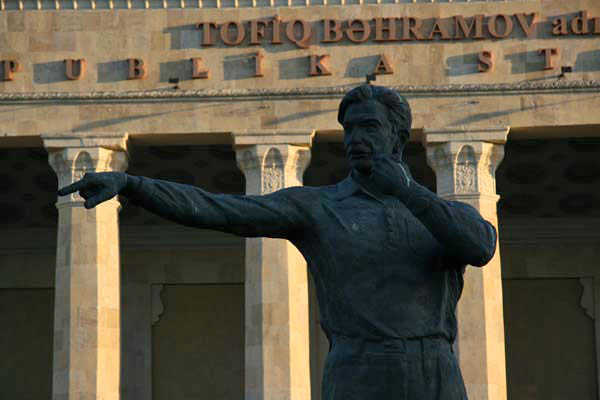
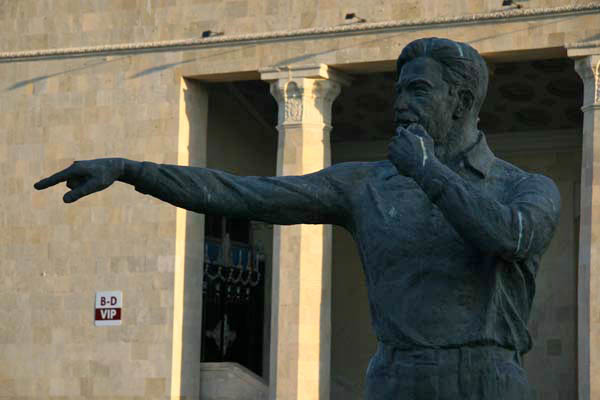
A statue of Tofiq Bahramov blowing a whistle in refereeing pose stands outside the national stadium that has borne his name since his death in 1993. The statue was unveiled in 2006 when England came to Baku to play Azerbaijan and none less than Geoff Hurst turned up to make a speech at the ceremony; FIFA president Sepp Blatter also attended. Ironically perhaps, the stadium, built in the shape of a ‘C’ to honour Stalin (C = S in the Cyrillic alphabet), was partially constructed by German prisoners during World War II. Bahramov had himself fought against the German army during WWII and on his death bed more or less admitted having a pro-English prejudice at the 1966 final –  an apocryphal story tells that when asked why he allowed the goal to stand he simply said, ‘Stalingrad’.

A River Wensum Walk

Early April in Norwich. It’s cool but the sky is blue and daffodils are glistening in Wordsworthian tribute to the bright spring sunshine. What better then than a morning stroll through the city along the banks of the River Wensum?

Like many cities – even London – these days, Norwich has largely turned its back on the river that runs through its centre. Once essential for transport and industry, the River Wensum that meanders through the city now seems to have little use other than as a backdrop for attractive new riverside apartments. Look a little closer though and you will still find plenty of reminders of Norwich’s medieval past along its course.

Hard to imagine now, but Norwich once held second city status in England and the banks of the River Wensum that dissect the city are still littered with traces of that period – medieval churches, priories, old bridges and defensive walls – as well as reminders of the city’s half-hearted dabble with Victorian industrialisation.

We begin our walk on St Benedict’s Street at St Lawrence’s Church. From the alley at the side of the church’s western gable you can see a little stone plaque set in the flint that depicts St Lawrence strapped to a grid iron, the means of his subsequent martyrdom. Understandably, he doesn’t look too happy about this but is blissfully unaware (well, perhaps not blissfully) that he will go on to become one of the earliest Christian martyr saints; indeed, the patron saint of comedians and chefs no less (and butchers and librarians too, apparently).

Descending the steps to cross Westlegate we pass the swish apartment block that in a previous incarnation used to be the Anchor Brewery. An enormous brick chimney once scraped the sky here – I still have a black and white photograph of it somewhere. As recently as thirty years ago Norwich used to be redolent of malt and hops (and chocolate too, from Rowntree’s, now Chapefield Shopping Centre) but its source did not originate from here as the Bullards brewery closed back in the 1960s.

We cross Coslany Bridge over the Wensum and  follow the pedestrian access along the river’s north bank. Across the water stands the disused warehouse where the entire text of Thomas Moore’s Utopia is scrawled in white paint across the brickwork as if it were the work of a hyperactive 16th-century graffitti artist with a taste for political philosophy.

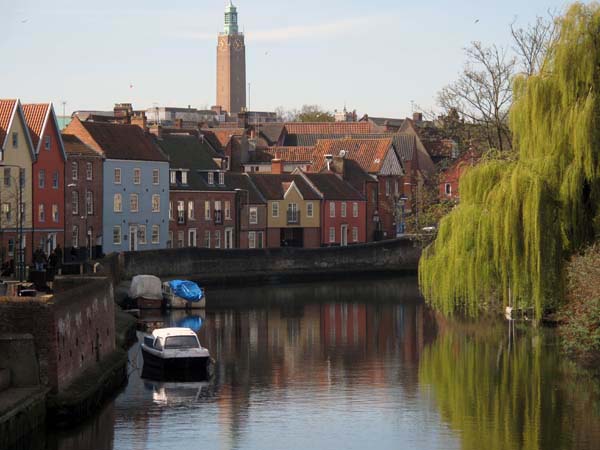
Crossing Duke Street by means of Dukes Palace Bridge, a brief detour via Colegate is necessary in order to reach Blackfriars Bridge by the Norwich School of Art before we arrive at Fye Bridge and Fishergate. Whitefriars Bridge comes next and the eponymous friary once stood on the site of the large edifice that looms before us: the Jarrolds Printing Works, built n 1834 and formerly a mill owned by the Norwich Yarn Company – a tall stately bulding with brickwork elegantly draped with Virginia Creeper and wisteria. Looking back, the clocktower on Norwich City Hall, which to my mind resembles a cut-price Marrakech minaret, rises into view beyond the weeping willows, newly in leaf, that sway dreamily over the torpid water beneath.

Beyond the printing works, a renga – a word map created by means of an ancient Japanese tradition of shared writing – strings a snake of words and phrases along green hoardings beside the river. A Renga for St James was created here on site in 2009 and utilises the local Norwich vernacular and reference points. Someone – a well-educated graffitist, who clearly understands the renga ethos – has scrawled ‘Perfidious’ above the word ‘Albion’, which in this instance refers to one of the few remaining wherries that used to ply East Anglia’s rivers.
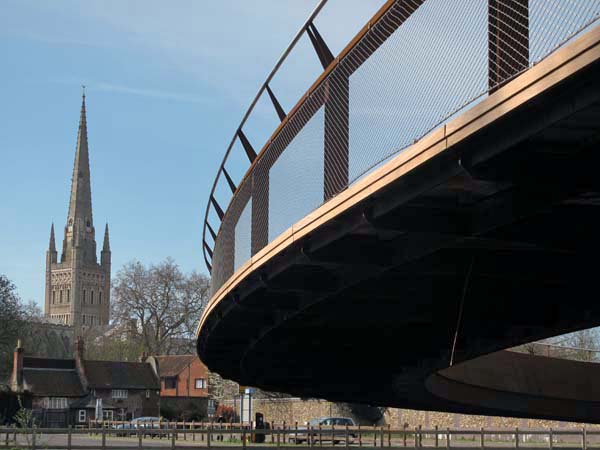
Continuing east the new bridge soon comes into sight. Peter’s Bridge, named after a former Jarrold’s chairman, has only been open a few months and, surprisingly, not a lot of people seem to know about it. Most of the Wensum’s bridges are so ancient that they are firmly embedded in the city’s psyche but there have been three new footbridges so far this millennium: this one, the 2009 Lady Julian Bridge close to the railway station, and the Novi Sad Friendship Bridge, opened by the Yugoslav ambassador in 2001, near Carrow Bridge (ironic, then, that NATO bombed and destroyed the far more substantial and economically important bridges of Norwich’s twinned Serbian city just two years earlier).

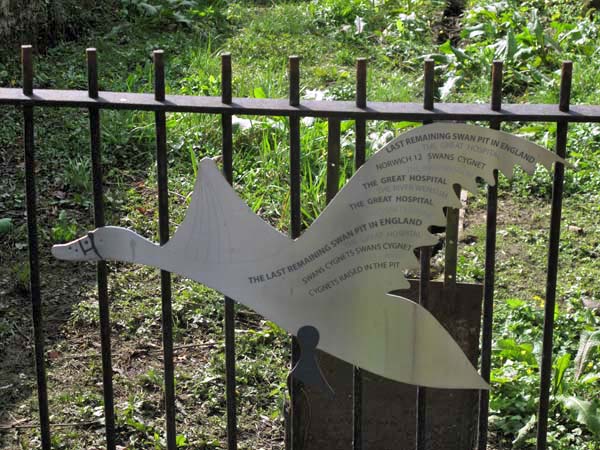
 Walking across this graceful, J (for Jarrold’s)-shaped footbridge, our riverside walk continues past Cow Tower towards Pull’s Ferry but before reaching this we pass what looks like a sluice leading into the river. This is, in fact, a rare 18th-century example of a swan pit, a tidal pool in which wild cygnets were kept and fattened for the table after having their wings clipped and beaks marked by their owners.

At Bishops Bridge, we leave the river behind to head for Cathedral Close and Tombland. A place called ‘Tombland’ next to a great church might reasonably be expected to be a place of the dead. But no, Tombland is Old English for ’empty land’ and this was the site of Norwich’s Anglo-Saxon market before the Normans came and shifted it to its present position next to St Peter Mancroft Church. Norwich Market has been operating there for over 900 years now and is still going strong, six days a week. Mind you, it did have a bit of an overhaul a few years back.

The Road to Moulmein

‘By the old Moulmein pagoda lookin’ lazy at the sea

There’s a Burma girl a-settin’ and I know she thinks o’ me’

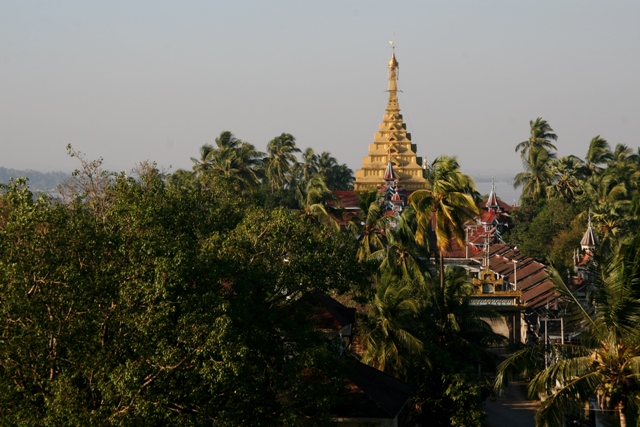
These words by Rudyard Kipling form the opening lines of the Road to Mandalay, an evocative poem that manages to capture the mysterious spirit of the East as seen through Western eyes. The work holds such an important place in the colonial canon that it comes as a surprise to discover that Kipling only spent a total of three days in Burma (now known as Myanmar). What is more, he never actually set foot in Mandalay itself. He did, however, briefly visit the southern coastal city of Moulmein (now known as Mawlamyine or Mawlamyaing) and it was the sight of a beautiful Burmese girl climbing the hill on her way to the city’s Kyaikthanlan Paya pagoda that inspired Kipling’s muse in this instance.

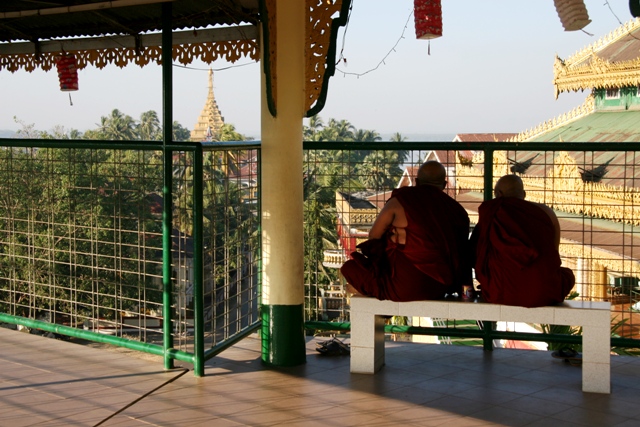
Kyaikthanlan Paya is the most prominent of a number of glistening Buddhist stupas that line the high ridge bisecting the city. Having arrived in Moulmein by means of a nine-hour train journey from Yangon in which the buckled rails made us bounce in our seats like cantering equestrians, a leg stretch seemed in order and there was just enough time to pay a visit to the pagoda before darkness fell. As things turned out I did not walk all the way up to the top as halfway up to the temple complex an elderly gentleman stopped to offer me a pillion ride on his motorbike. Such events are not out of the ordinary in Myanmar; after just a couple of days in the country I was already aware that thoughtful yet undemonstrative gestures like this were commonplace.

Watching the sun set over the sea from the viewpoint beneath the temple I met another old man who seemed delighted when I told him I was English. I am not sure if this was because he simply approved of my nationality or whether he was just pleased to have the opportunity to use the English he had learned long ago in school. Either way, the warmth seemed entirely genuine. ”It is a pleasure to see you here. I do hope we can meet here again”. (We did, the following day).

As previously mentioned, Kipling did not spend long in Moulmein – just enough time to pen his famous poem and take a fancy to a local beauty. The novelist George Orwell, on the other hand, had a far stronger relationship with the city. Orwell’s mother’s family came from Moulmein and it was also here that he underwent training with the Burma Police Force. This and subsequent Burmese experience would provide raw material for Burmese Days, his first novel and a damning account of British colonial life in which most of the colonial characters seems to be alcoholic, racist or both.

Moulmein also provides the background for Orwell’s 1936 memoir Shooting an Elephant, a work that opens with the arresting line:

‘In Moulmein, in Lower Burma I was hated by large numbers of people – the only time in my life that I have been important enough for this to happen to me.’

Wat Phou

Get there early – this is the sound advice usually given when visiting popular tourist sites. This is exactly what I did in Siem Reap, Cambodia when visiting Angkor Wat a week or so ago but it seems like several thousand others also had the same idea. As I tuk-tuked my way into the vast ancient complex the site was already crawling with a vast number of hot and sweaty camera-clicking visitors – mostly large tour groups obediently following their guides over the stones like human snakes. All I could do was join them in the fray.

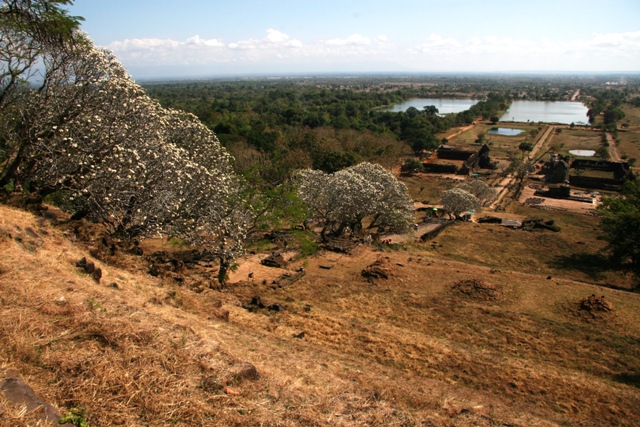
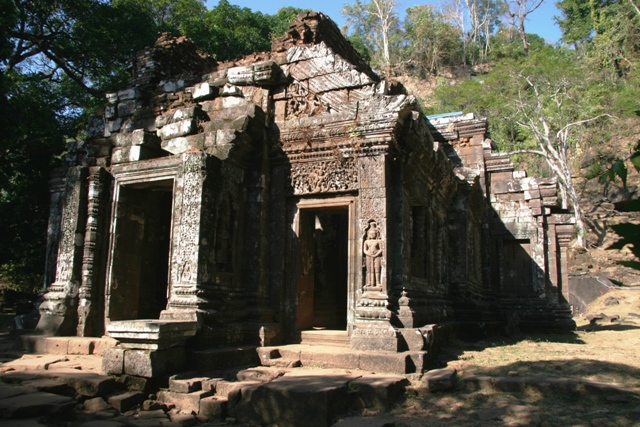
Wat Phou in southern Laos is another ancient Khmer site. While it may not have the enigmatic stone faces of Angkor Tom’s Bayon, or be as enormous in scale, it makes up for it with a gorgeous hillside location close to the Mekong River -that, and a lack of crowds.

A couple of days ago, I got up at sunrise – it is difficult to sleep late in steamy, low-lying Laos. After a quick breakfast watching the sun lift over the Mekong, I hired a bike – a much-abused machine that misleadingly bore the name ‘Turbo’ – to cycle the 10km to the site. Forty-five minutes later, I arrived at the entrance to Wat Phou on my squeaky ‘ladies’ shopper’. The dusty road that lead there was the sort of terrain that most cyclists would probably consider ‘off-road’ – but it was an interesting pedal alongside dry paddy fields and through tiny villages where the day was just starting as people burned joss sticks and prayed in front of the bird table-like spirit house that stands in front of every house, however modest, in the country.

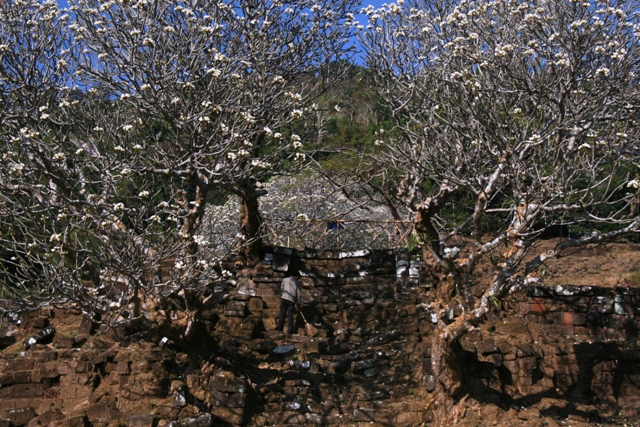
A processional way leads through the Wat Phou temple complex, passing between large baray or ceremonial ponds before climbing steps steeply up the hillside up to the sanctuary itself. The steps were lined with flowering frangipani trees so voluptuously aromatic that you could almost eat the air with a spoon. Pleasingly – or should I say, smugly – I seemed to be the first to arrive. First, apart from a few locals who were setting up their pitches at the top selling shrine offerings and soft drinks. With the place to myself, I made a leisurely tour of the sanctuary, originally Hindu, now Buddhist, seeking out the sacred Shiva spring, the rock-carved elephant and crocodile, and the library. I never did find the Buddha’s footprint but it was a pleasure to survey the shimmering plains below from this breezy elevated viewpoint beneath the deep shade of mango trees.

Eventually, a few others arrived – a friendly Lao-American family, a couple from Manchester who were staying at my guesthouse. Later still a few small tour groups turned up, French and German mostly. Even then it was hardly the circus that Angkor Wat seems to have become these days. Wat Phou may not be ‘undiscovered’ but it is certainly very low-key when compared to its sister site to the south in Cambodia. And let us not forget, Wat Phou is also the older of the two.

Mekong musings

This post comes from somewhere firmly east of Elveden – from Southeast Asia or, more precisely, the deep south of Laos.

Last week was spent travelling along the Mekong River from Ho Chi Minh City, Vietnam north into Cambodia. Then, courtesy of Lao Air, a quick crossborder turboprop hop from Siem Reap to Pakse in southern Laos.

Angkor Wat near Siem Reap was, of course, astounding but the vast crowds and grey-skied humidity were debilitating and within a few hours I found myself to be in that state universally known as ‘templed-out’. Angkor Wat, Angkor Tom and the other religious sites around Siem Reap are by far the country’s biggest draw but elsewhere Cambodia is a poor and savagely scarred place. Quite understandably, almost everyone over the age of 40 seems to have a haunted look, although these survivors of the Khymer Rouge period will tell you that contemporary Cambodian youth simply doesn’t want to know about the horrors of the past. The dreaded Killing Fields just outside Phnom Penh and the city’s infamous S-21 prison are just as bad as you might imagine – even worse perhaps. The continuing tragedy is the fact that several erstwhile senior Khymer Rouge officials still hold high-ranking government posts. These are the ones that parade around Phnom Penh in black-windowed Lexus, eating at fancy air-conditioned restaurants while the vast majority of the population barely scrapes a living farming rice in the hinterland.

Laos – or rather the People’s Democratic Republic of Laos – feels different. Poor certainly, but seemingly a happier place despite its unenviable reputation as being, in per capita terms, the world’s most heavily bombed country of all time – this, during The Vietnam War (or, as they call it in Vietnam, ‘The American War’).

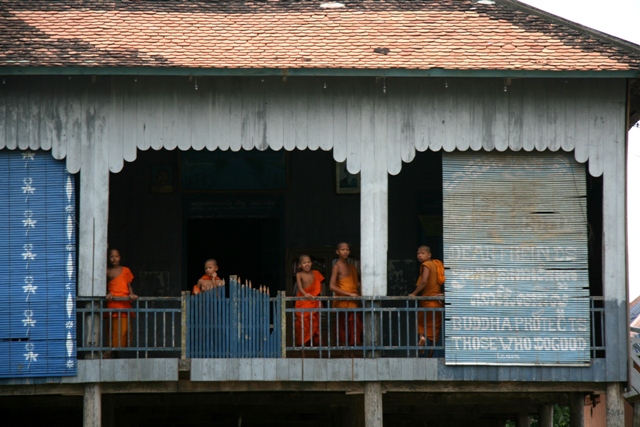
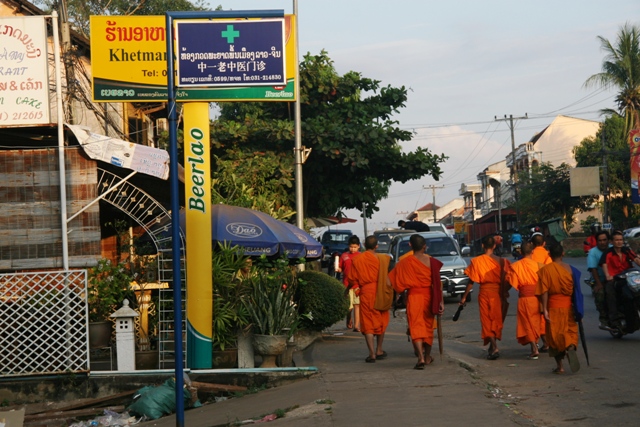
Stopping for a coffee this morning at a place that serves as an outlet for local organic coffee production there was no coffee to be had as the machine had just broken. So I drank tea instead and listened as a table of saffron-clad Buddhist monks start chanting as soon as they had finished their noodle soup. No-one reacted in the slightest: monks are everywhere here; an almost quotidian part of Laotian daily life. In Laos, the future may be orange, but so was the past.

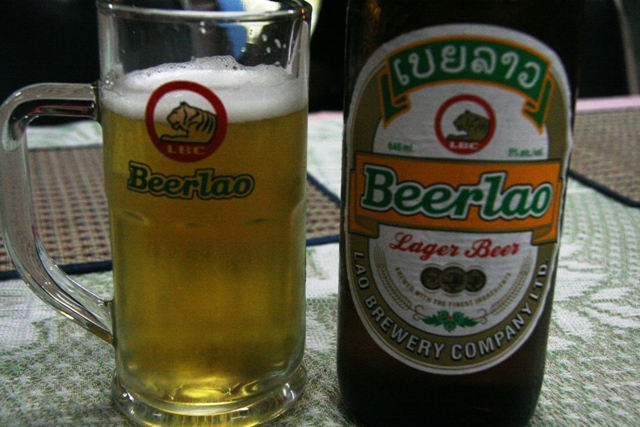
Another ubiquitous sight here is advertising for Beerlao, the nation’s favourite beer.  The beer – pretty tasty by the way – is sold everywhere in no-nonsense 640ml bottles. Everywhere, too, are the yellow signs that advertise the brew, as well as beer mats, table cloths, menu covers, waitresses’ aprons and café clocks. Its cheerful yellow and green logo is so widespread here in Laos that Beerlao appears to fill a semiotic niche even more comprehensively than Coca-Cola manages throughout much of the rest of the developing world. Unusually, signs advertising the familiar fizzy sweet are nowhere to be seen.

As the Hermetic philosophers might say:

As above, so Beerlao.

Elveden – Gateway to the Land of Nod

So why Elveden? And why east of it? Obviously there’s the name itself – E(lve)den, close enough to Eden for a cheesy pun – and let us remember that in Biblical terms the territory that lies ‘on the east’ of Eden is the Land of Nod, where Cain was exiled after murdering his brother. Of course, as well as a place of banishment for betraying siblings the Land of Nod also has connotations as a mythical place of sleep. Given Elveden’s real life position at the western end of the Suffolk-Norfolk border perhaps one of the Snorings (Little Snoring or Great Snoring – take your pick) forty miles or so to the north in West Norfolk could substitute for the aforementioned slumberland? (A real-life Land of Nod actually does exist in the East Riding of Yorkshire – it’s a tiny hamlet apparently).

Elveden itself is not without interest. The Suffolk village straddles the A11 just south of Thetford. There are traffic lights there these days and it has subsequently become quite a well known spot for traffic delays. In the bad old days, though – before the traffic lights and imposed speed limit – the stretch of single carriageway here was an infamous accident black spot. Norfolk-knockers like that nice Jeremy Clarkson have always been quick to point out that Norfolk is one of the few counties in the country that does not have a motorway leading to it and for many years there has been a strong campaign to get the whole of the A11 dual-carriagewayed right up to Norwich. As things currently stand, the A11 between Mildenhall and Thetford is one of the few remaining stretches of single carriageway. However, now that the powers that be have finally agreed to allow road widening to go ahead around Elveden, it looks as if a continuous dual carriageway will become a reality in the near future. No doubt the five minutes that will be knocked off the current London to Norfolk journey time will quickly elevate Norwich’s currently modest economy to Shanghai-like heights.

Those whizzing past the village in the future might want to consider a little of Elveden’s, frankly strange, history as it flashes past in an automotive blur. Here’s a brief extract from my Slow Norfolk and Suffolk book:

Elveden

Situated astride a busy road just beyond the Little Ouse in Suffolk, to most people this is little more a sign on the A11 and an inconvenient bottleneck for traffic. It used to be an accident black spot too before traffic-calming measures were introduced. Some will tell you that there have been more people killed on the A11 since World War II than there are names on the obelisk-like war memorial south of the village. Elveden is a small estate village centred upon Elveden Hall, a somewhat bizarre private residence. The estate, which has the largest arable farm in the country, is in the possession of the Earl of Iveagh but the hall itself was emptied of its contents in 1984 and stands empty.                                                   

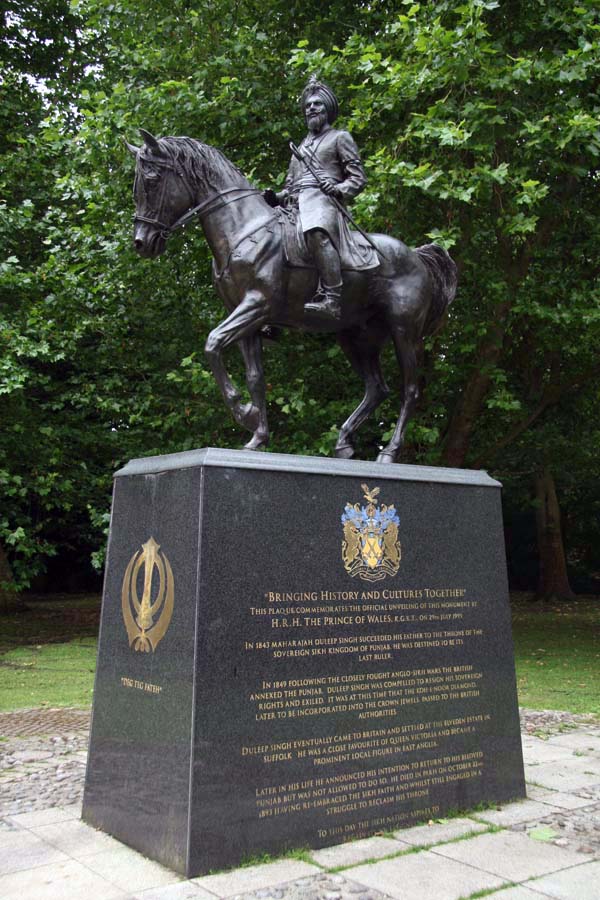
Elveden Hall is best known as the home of Maharajah Duleep Singh, a deposed Sikh prince from the Punjab who was exiled to England for his part in the Sikh Wars during Queen Victoria’s reign. The Maharajah purchased the estate in 1863 and refurbished the Georgian hall in lavish Moghul style using Italian craftsmen – a North Indian tradition apparently. He also built an aviary where he kept exotic birds and in an unselfconscious effort to outdo the English squirearchy he took up the habits of English country life with a passion, leading parties that shot thousands of pheasants on his estate on an almost daily basis. Naturally, if you have a 17,000-acre estate and a vast private fortune, you can do that sort of thing without worrying too much about the cost of it all. The Maharajah was always keen to impress the inhabitants of his adopted home and tended not to do things by halves. He was even good enough to hand over the Koh-i-Noor diamond to QueenVictoria and to cheerfully convert to the Anglican Church such was his willingness to fit in. An equestrian statue of the Maharajah stands in Thetford and, although he died in Paris in 1893, his surprisingly modest grave lies in the churchyard of Elveden’s St Andrew and St Patrick Church.

Elveden Hall passed into the hands of the Guinness family after Duleep Singh’s death and the first Earl of Iveagh went even further, building a new wing and adding a replica Taj Mahal to the complex. If the hall sounds as if it it would make a perfect film set then you are quite right as, since its interior was emptied in 1984, Elveden Hall has been used as a location for films such as Tomb Raider, the Bond movie The Living Daylights and Stanley Kubrick’s Eyes Wide Shut. The bad news is that the hall is not open to the public. You might try getting a job as a film extra here, as a friend of mine did on Eyes Wide Shut. He reports that he didn’t see much of the interior but did learn that Tom Cruise was unable to find any suitable accommodation in the area and had to be helicoptered in each day from afar for filming. You can just about get a glimpse of the hall from the rear of the village churchyard and make out its green dome.

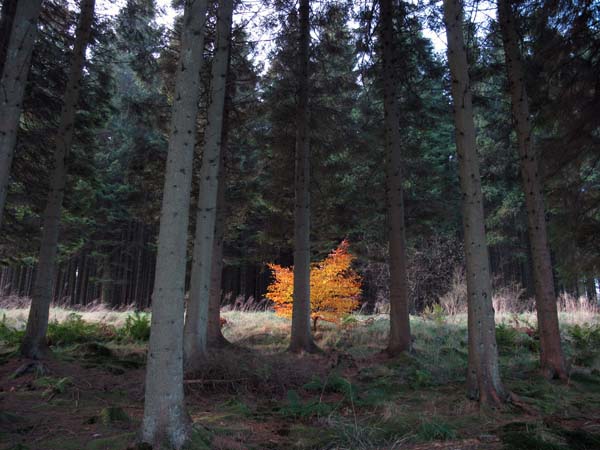
NB: The photograph at the top of this post does not represent Elveden. It was taken east of it though – at Brockdish in the Waveney Valley. I just liked its ‘fish out of water’ feel.

Lost Highway

Enough westering. Let’s return back across the Atlantic for this post: to Northumberland north of Hadrian’s Wall, the once lawless Reivers country where northern England meets Scotland. Not exactly east of Elveden but certainly east of Eden, the river that flows southeast from Carlisle on the Solway Firth and bisects the upland areas of the Lake District to the west and the north Pennines that lie to the east. Immediately north of here are the Cheviots, the ancient rounded hills of the Scottish Borders.

Kielder Water, a large reservoir created in the 1970s to provide a water supply for industry, has all sorts of superlatives associated with it. The reservoir itself is the largest artificial lake in the United Kingdom, while the forest that surrounds it is said to be the largest man-made area of woodland in Europe. The village that gives the reservoir its name is considered to be one of the most isolated villages in England and the area is also deemed have the clearest night skies in the UK. There is so little settlement in the vicinity that the area is relatively unsullied by light polution and, as testament to this, an astromony observatory has been constructed close to the reservoir’s northern end.

Artificial perhaps, Kileder Water is still a glorious place of long vistas and a distinct sense of isolation in winter. Alongside huge stands of Norwegian and Sitka Spruce and other would-be Christmas trees are raised banks of mature beeches and lofty stands of Scots Pines surrounding the reservoir’s cold waters. Red squirrels frolic elusively in the tops of the pines while crossbills wrench the seed from cones with their strange twisted beaks. Lying beneath the water are a scattering of buildings that once belonged to the farmland that was sacrificed to a sub-aqua future when the dam was completed. There is no sign of these now; no obvious architectural ghosts other than patterns in the water whipped up by the wind that seem to imply a regular linear structures beneath the surface – old farm walls perhaps?

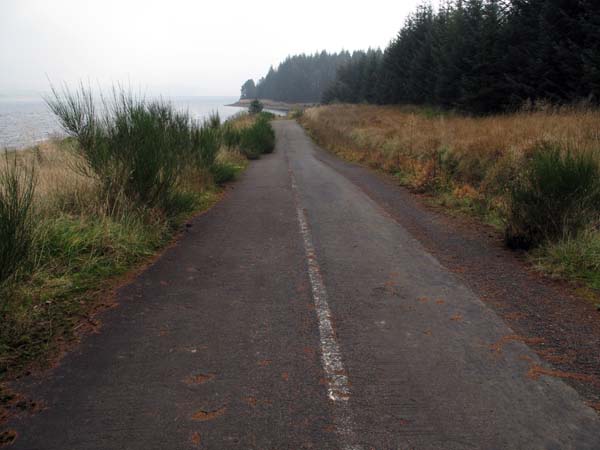
What can be seen here and there though are fragments of the main road that used to run along the North Tyne Valley in the days before ‘the flood’. A modest tarmac road with a dividing white line (no cats’ eyes), this surfaces for a short stretch along part of the shore of the Bull Crag penisula at the southern end of Kielder Water. Once upon a time, this lonely road would have carried traffic north from Bellingham to Kielder village, from where it would climb higher into the Cheviots and over the Scottish border. These days, the road sees no through traffic – just a handful of walkers and mountain bikers enjoying the facilities of the forest park. The fragment that remains begins and ends in water. This palimpsest of an earlier human landscape is now, quite literally, a road to nowhere.

East of Everett – Riding the Empire Builder

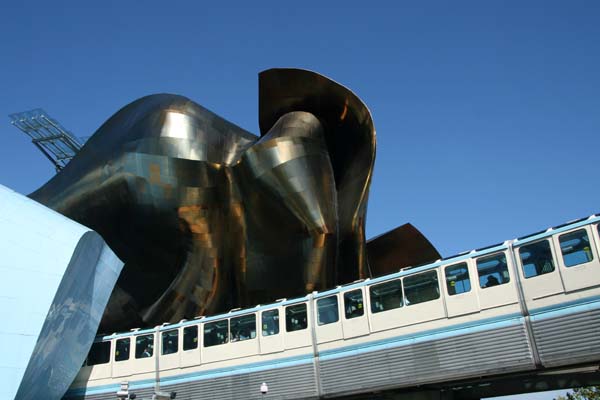
Arriving in Seattle, having spent the last two weeks on a small boat, it was time to make use of other forms of transport to get home. Flying all the way Seattle-New York-London would have been straightforward enough but after a fortnight at sea where 8-10 knots was routine I was keen to not only feel the earth beneath my feet for awhile but also to continue at a relatively stately pace. So I opted for the train: first to Chicago, then to New York City from where I would, begrudgingly but inevitably, finally take to the air to cross the Atlantic. By way of a prelude to all this cross-continental railroading I made use of the few hours I had in the city by taking the Seattle Centre Monorail to visit the Space Needle – an all-too-short run across the city centre that actually passes through the multi-coloured sheet metal flanks of Frank Gehry’s Experience Music Project Museum before arriving at its terminus.

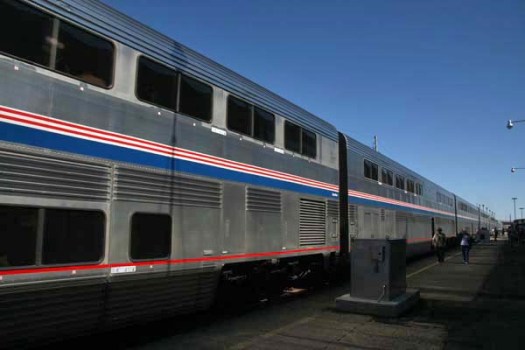
Amtrak‘s Chicago-bound Empire Builder leaves every afternoon from Seattle, taking around 46 hours – the best part of two days and nights – to reach the windy city on Lake Michigan’s shore. A parallel service runs from Portland in Oregon and both trains join up in the middle of the night at Spokane, Washington. On my first evening on the train I decided to head for the dining car just after passing through Everett, Washington. Here, I met up with Anne (Amtrak waiters insist on grouping solo travellers together at tables – dining on a train in the US is a sociable event whether you like it or not), a grandmother from Seattle on her way to visit various offspring way out east. Travelling in the United States, instant life stories and the brandishing of family photographs to total strangers are pretty much the norm and a shared meal is viewed as a welcome opportunity to make new friends. Anne was no exception. We were all friends here on the train – relaxed friendliness being the default setting of any sort of public transport in the USA. As our conductor would announce later on that night, “Ladies and gentlemen please ensure that you have not put your belongings on the neighbouring seat. We are expecting quite a few travellers to get on at Leavenworth and so you will probably have a new friend joining you when we get there. Let’s make them feel welcome.”

No-one came to sit next to me at Leavenworth but at Wenatchee an hour or so later I was joined by an elderly man called Dale who had just come from a week-long Lutheran Church retreat in the wilds of Washington State. “I see we’ve got us a groaner here”, were his first words to me as he wearily slumped down alongside, throwing a casual nod at the source of the shrill metallic wail that was emanating from the carriage wheels beneath us and had been doing so intermittently since leaving Seattle several hours earlier. Lean and bearded with plaid shirt and baseball cap, Dale might have looked like a typical retired Mid West farmer but was, in fact, a lay preacher in the no-nonsense undemonstrative Lutheran tradition. Despite an outward appearance that might give the impression of being a little ‘ornery’ Dale was the gentlest of men, with a playful, twinkly charm and a thoughtful, considered take on the world. We got talking about Alaska. He had spent a year there as a preacher on an isolated island close to the Arctic Circle just 40 miles from Russia (“And I mean 40 miles, not like that fool idea that that Sarah Palin woman had that she could see Russia from her house in Wasilla”). Dale’s northern sojourn had given him the greatest respect for the native people that endured the difficult living conditions of Alaska’s far north although he acknowledged that there were serious problems of alcohol abuse. “It was supposed to be a dry island but people being people they snuck it in somehow.”
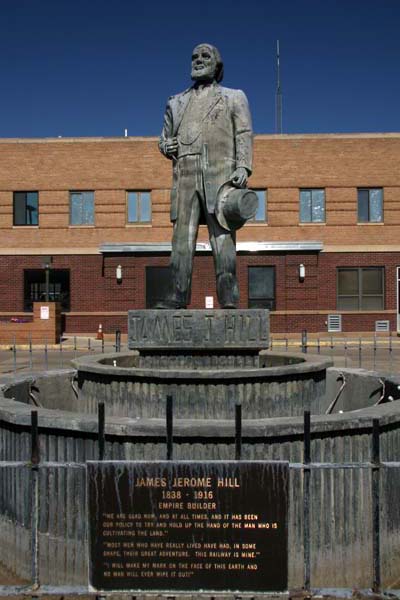
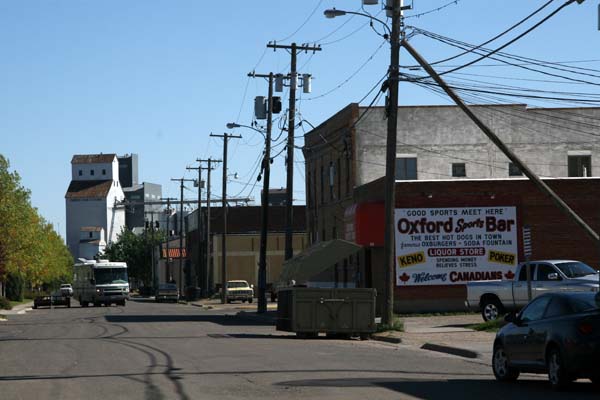
Catching a glimpse of western Montana’s Glacier National Park early the next morning – and adding on an hour as we reached the USA’s Mountain Time zone – the landscape soon settled down to the flat prarieland that we would be passing through for the rest of the day. This was cattle country but the grass looked thin and parched after a hot, dry summer. After Shelby, Montana, we entered cereal-growing territory, with newly harvested wheatfields rolling away to the horizon and tall grain silos by the roadside. Stopping at Havre, there was enough time to stretch our legs on the platform and examine the statue of James J. Hill, the founder of the Empire Builder route, in front of the station. A small group of Amish dressed in 19th-century added a touch of local colour. Amish generally spurn modern technology but are nothing if not pragmatic and for long distances it seems the train is an acceptable alternative to travel by horse and cart. Leaving Havre, we reached Glasgow (Montana, that is) two and a half hours later and passed into North Dakota and the Central Time zone in the early evening. North Dakota looked very much like eastern Montana had done and the view out of the window would not really change that much until we reached the industrial cities of the Great Lakes the following morning.

An entire day spent passing through relentless treeless praries has an unsettling effect. It instills a sense of melacholia. Perhaps it is not so much its appearance but its sheer scale that affects one so: the isolated farming settlements, the unknown family dramas lived out behind closed doors; small lives in a big landscape. It is humbling to think that the pioneer settlers who ventured this way in the 19th century had little idea of what lay beyond the next mile west other than almost inevitable danger of one sort or another.

As a reminder of the early days of this great western migration we stopped at Fargo, Minnesota in the early hours, although most of us were asleep at the time. The city, originally called ‘Centralia’, later became ‘Fargo’ in honor of Northern Pacific Railway director and Wells Fargo Express Company founder William Fargo. The arrival of the Northern Pacific Railroad here bestowed the city with the reputation as ‘Gateway to the West’.

Early next afternoon we shuffled through the endless urban sprawl of Milwaukee. Famous for its brewing industry (inspiring the song, What’s Made Milwaukee Famous Has Made a Loser Out of Me), the city’s huge car parks and warehouses put me in mind of a super-sized Swindon, although to my knowledge no tragic country anthems have ever been written about the Wiltshire town. Two hours later we pulled into Chicago, just twenty minutes behind schedule. Chicago’s Union Station lies in the heart of the city’s downtown district, towered over by some of some of the tallest buildings of the world. After southeast Alaska, where tall buildings and even tall people are scarce, this was the most urban environment imaginable. Quite a stark contrast from the tranquil waters of the Inside Passage I had been sailing through just a few days earlier. There again, so was Seattle.