The Mountains of Persia

101_2693

There is a bar in Belgrade called the World Traveller’s Club. It is in the basement of an apartment block in the city centre and to gain entrance you are required to ring the door bell at street level and state your business over the intercom. These days the club, which is alternatively known as the Federal Association of Globetrotters, is just one of many quirky bars in the city – homespun decor, art school daubings on the walls, miscellaneous furniture that includes Singer trestle sewing machines for tables, posters of iconic foreign destinations like Paris and Rome. The bar, as it proudly declares on its menu, was established in 1999. The date is significant.

In 1999 Belgrade was the capital of a land still known as Yugoslavia, a much depleted country that by that stage of the breakup consisted of just Serbia, Montenegro and Kosovo. Internationally, the country was considered as a pariah state thanks to the continuing ultra-nationalist regime of Slobodan Milošević. 1999 was also the year that NATO bombs fell on Belgrade and other Serbian cities. It was neither a good place to be nor somewhere that was easy to escape from – a Yugoslav passport, once a document that allowed easy access to both West and Eastern bloc, no longer held any currency. Such a document would get you nowhere.

It goes without saying that not everybody in Serbia was happy with Milošević’s stubborn and didactic rule. Most young people in Belgrade just wanted to do what young people did everywhere – live, love, make mistakes, have fun, travel. Many of these were still possible to some extent but travel was clearly out of the question. As a reaction to this difficult state of affairs a few people came together to create the World Traveller’s Club, a safe welcoming environment where people could meet to travel in their imagination if not in real space. Initially membership was by invitation only. These days anyone can visit although the bar’s original purpose no longer holds much significance other than a reminder of difficult times.

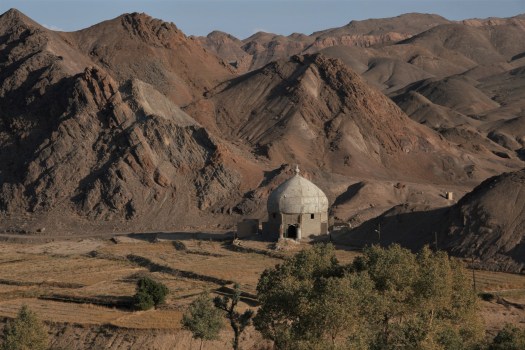
Turn the clock back thirty years, back to a time when foreign journeys required a wider leap of the imagination. In the pre-Internet age any inspiration for travel for its own sake was dependent on books, photographs and the anecdotes of others. In the 1970 film Performance, the Turner character, a reclusive rock star played by Mick Jagger as a caricatured version of himself, reads aloud from a Persian text, The Old Man of the Mountains. A postcard is displayed entitled The Mountains of Persia. Both text and image represent a sort of paradise – that which is unattainable, a dream destination for the two men thrown together in self-isolation in Turner’s Notting Hill Gate basement. Turner is living as a recluse, hiding from fame and perhaps the fear that his powers are diminishing; Chas, the James Fox character, is keeping a low profile to avoid the attention of fellow gangsters. The idealised mountains of Persia represent a sanctuary where both men might manage to escape their past lives.

The curtailment of free movement as in late 1990s Yugoslavia is hard to imagine these days. Many of us in the developed world take travel for granted almost as a birthright. This is especially true in an age in which jet travel is both cheap and easily available, and a journey, a holiday or even an off-the-peg adventure, can be booked with the click of a return key. Now, suddenly, in the light of a rapidly worsening pandemic, we need to think anew. We must accept that for a while at least, probably some considerable time, we are not going anywhere. Perhaps now is the time to form our own fraternities and sororities of imagined exploration? Any globetrotting must be virtual and digital. For the foreseeable future wanderlust is going to be just that, a lust for something unattainable. In this respect I am lucky I suppose. For a number of reasons, in recent years I have come round to thinking that it is just as fruitful to explore my own backyard as it is any exotic far-flung destination. I have grown weary of airports and the mechanical human processing that takes place, the tiresome, albeit necessary, security measures. As B. B. King sang of another sort of love affair, The Thrill Is Gone. The notion of ‘slow travel’ and all that it represents has for me become something that has gone beyond simply an attractive-sounding travel franchise. These days I really do prefer to slow down, to cover a smaller area, to discover the beauty of the local, to chart the quotidian. Less is undoubtedly more but that is easy to say for someone like me who already has the T-shirts, the passport stamps, the photographs, the anecdotes, the well-thumbed guidebooks on the shelves.

In the plague-year situation that the world now finds itself in to complain about restricted movement seems, at the very least, churlish. As we enter what seems like late capitalism’s final closing down sale (‘Everything Must Go!’) we have become, as the columnist Marina Warner has recently written, ‘a nation of shopfighters’. While shoppers squabble over toilet paper in supermarket aisles and some wealthier hoarders, like newly arrived Beaker folk mocking the simple ways of those who still rely on cupped hands, purchase additional freezers for the storage of their panic-shopped supplies, we should maybe reflect on what we (or, rather, some of us) have become. It is an opportunity perhaps to show a little more respect to the land that we walk upon, for the earth that feeds us; a little more kindness to those we share it with. For the time being we can just look out of the window and dream. At the other end of all this the mountains of Persia will still be there.
101_2707

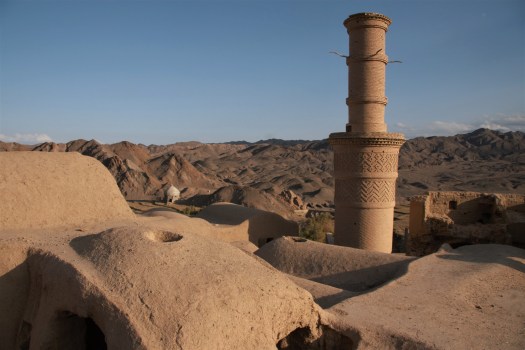
Photographs: Karakhanad, Yazd region, Iran 2008  ©Laurence Mitchell
Patience (After Sebald) – Walking The Rings of Saturn

About a year ago I wrote a post about an Aldeburgh Music weekend at Suffolk’s Snape Maltings that celebrated the life and works of the writer W G Sebald. A new film by Grant Gee, Patience (After Sebald), was also previewed on that occasion but it has taken a full year for it to have been finally been put out on general release in the UK. After such a long wait, ‘Patience’ might seem a wholly appropriate choice for a title but I finally got the chance to see the film last Sunday at a sell-out screening at Cinema City, Norwich.

The film is based on what is probably Sebald’s best known work, The Rings of Saturn, which  describes a long meditative walk in the Suffolk coastal region. In German translation the book is subtitled ‘Eine Englische Wollfahrt – an English pilgrimage’, but this is misleading as The Rings of Saturn is not really about pilgrimage at all, nor is it a work that concerns itself that much with landscape, although the shingle and wide skies of coastal Suffolk do make a cameo appearance.

Although genres such as travel, history and memoir are appropriate up to a point, The Rings of Saturn is a work that boldly defies categorisation and which cannot easily be placed into any single literary pigeonhole. Sebald’s Suffolk odyssey is really as much an internal journey through one man’s mind as anything else. Far from the normal notion of travelogue, The Rings of Saturn is more a psychogeographic exploration of one corner of East Anglia. Certainly, the physical geography here is spectral, a melancholic landscape of ghosts, personal reflection and dark cultural memory. The term ‘Proustian’ might be used to define Sebald’s style to some extent but a better word would be Sebaldian: W G Sebald is one of those rare writers, like Dickens, Kafka and Ballard, whose name can be confidentally used as an adjective thanks to a distinctive mournful style and typically digressive, fragmentary narrative.

Part of the Sebaldian trope is to include images – black and white photos and line drawings – as part of the narrative flow; images, sometimes unsettling, that are tangential to the geography of the walk yet central to the narrative’s solipsistic digressions. Many of the book’s already familiar images are replicated in Patience (After Sebald), serving as a backdrop for talking heads like Robert Macfarlane, Iain Sinclair and Andrew Motion who have been recruited among others to give their personal take on Sebald’s oevre. Other images on display in the film are immediately resonant to those who have read The Rings of Saturn even though they do not appear as photographs within the pages of the book itself. A brief glimpse of a naked couple lying on a beach clearly represents the lovers that Sebald stumbled upon at Covehithe and, panicking, described as ‘like some giant mollusc washed ashore… a many-limbed, two-headed monster’. A shot of a distressed-looking plate of food undoubtedly refers to the joyless pub meal taken by the author in Lowestoft, which contained a fish that had ‘doubtless lain entombed in the deep-freeze for years’ along with tartare sauce ‘turned grey by sooty breadcrumbs’. Apart from an occasional colour inset frame showing a walker’s boots on the tarmac (the film-maker himself perhaps?), the images used are monochrome throughout, as grey as Sebaldian tartare sauce.

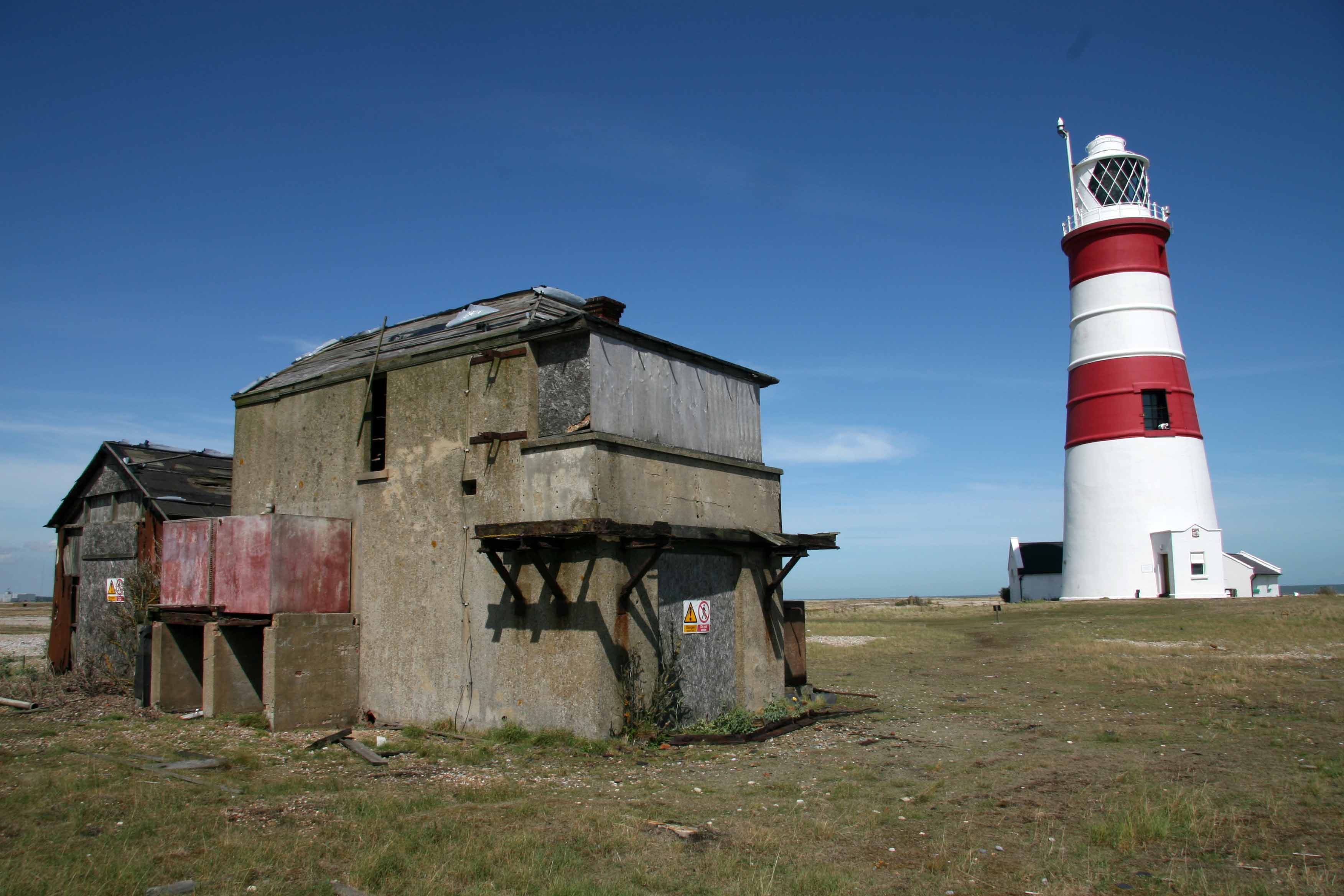
Also permeating the film are grainy 8mm-like shots of some of the locations that Sebald passed through on his long walk – places that get scant mention in The Rings of Saturn but which clearly inform its telling; places familiar to anyone who knows the Suffolk coast reasonably well – Southwold’s Sailors’ Reading Room, Boulge church, Yoxford, the ruins of Dunwich and the formerly top secret research pagodas of Orford Ness. If anywhere could be described as an archetypal Sebaldian landscape it would surely be Orford Ness.

Patience (After Sebald) complements Sebald’s book admirably. It encourages those unfamilar with his work to read The Rings of Saturn for the first time, while those already smitten can find nourishment in the distinctly Sebaldian imagery of the film and the generous personal accounts of the man himself. To be nitpicking, there are a couple of small details that some Sebaldophiles might find slightly incongruous – Andrew Motion reading his poem about the merman of Orford, perhaps, and a scene near the end that involves a puff of smoke at the roadside where Sebald died in a car accident. The latter I found quite thrilling although some might consider it borderline tacky – I can say no more.

Sometimes writers can seem to influence the reader’s view of landscape to such an extent that it is hard to come to it with innocent eyes. Once The Rings of Saturn has been read and absorbed, coastal Suffolk – in the right conditions – can easily transform into a Sebaldian landscape for those passing through it. Yet, as Robert Macfarlane recounts in Gee’s film, it is imposible to replicate Sebald’s journey exactly. Macfarlane’s own well-intentioned attempt to retrace Sebald’s steps was thwarted by sunny, distinctly non-Sebaldian weather and by simply having too much fun swimming at Lowestoft.

Even with fine weather and a light heart, it seems impossible for anyone who has read The Rings of Saturn and walked the Suffolk coast to not have some sort of Sebaldian connection. Whether we like it or not, his prose and dark historic musings have encouraged us to see the coastal landscape in a thousand shades of (tartare) grey whatever our proclivities. But we cannot replicate Sebald – and why should we? Even following those exact same footsteps, we all do our own walk, make our own pilgrimage. The psychogeographical dimension of any walk through any landscape is as dependent on the mindset of the walker as it is on the territory itself.

On a personal note, the book’s geography resonates more than I might ever have imagined: the site of the old Norfolk and Norwich Hospital where Sebald opens the text (finding himself there with a back problem a year after the completion of his Suffolk walk) is located immediately across the road from where I live.