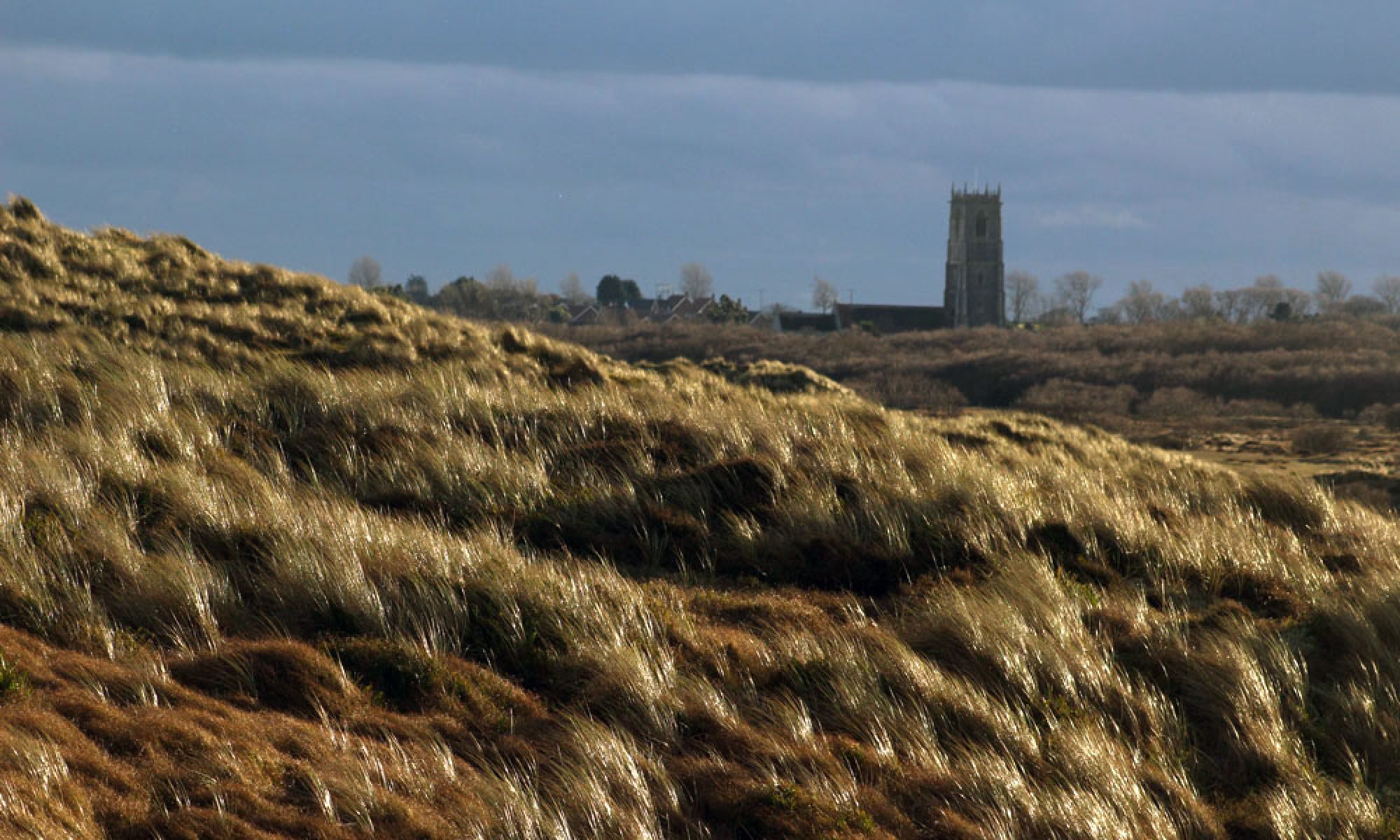

This rain that has been falling almost incessantly here for the past 48 72 hours seems to have followed me back home from the Balkans. Travelling coast to coast, from Adriatic to Black Sea, over a three week period I experienced completely rain-free days only at the very beginning and end of my trip.
After a sunny start in Zadar on the Croatian coast a low blanket of rain cloud followed me all the way from Dalmatia to Srem, then eastwards to the Serbian capital. Rainfall dampened most of my days in Belgrade, pooling the pot-holed pavements of the Old Town, swelling the Danube and Sava rivers, soaking my inadequately-clad feet. The view from my apartment window was drear, smeared by a greasy film of droplets forever abseiling earthwards. Rain’s moist music filled my ears: gurgling drainpipes, the subliminal hiss of drizzle; the soft tintinnabulation of raindrops on roof tiles whenever it started to fall a little more heavily; in the distance, the rhythmic swish of car tyres riding wet cobbles. Any ventures outdoors necessitated frequent dodging into doorways and regular respite of strong coffee in smoky kafanas. Smudged ink in notebooks, vital scribblings rendered Rorschach by an ever-leaky sky – uninterpretable, beyond analysis. Water dissolving… and water removing, the song goes. There is water at the bottom of the ocean! Yes, but there was water in the streets too; thoroughfares transmogrified to shallow streams, solid surface rendered fluid.
I followed the Danube east then south along the Romanian border, enjoying a brief interregnum of fine weather before thick cloud and more rain greeted me at the east Serbian city of Zaječar. Reaching Niš, a balmy afternoon gave way to a brutal evening storm, with rainfall as dramatic and sudden as an opened sluice, lightning flashes illuminating the street like magnesium flares. Southern Serbia was a little better – just drizzle in Vranje and hazy sunshine in Pirot, although after dark it rained some more. Railroading into Bulgaria I thought I might have finally left the bad weather behind me but it was sheeting down in Sofia when I arrived, too wet to venture far from the shelter of the railway station while I waited for the overnight train to Burgas.
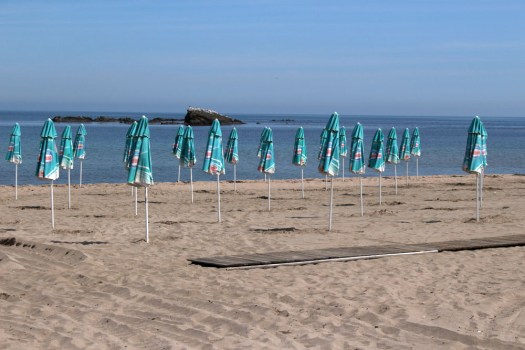
Mercifully, I finally managed to escape the rain on the Black Sea coast. I took a minibus to Ahtopol, the most southerly town on the Bulgarian littoral. By my reckoning this would be about as far away as possible from the concrete over-development that plagues much of the coastline. Ahtopol turned out to be refreshingly low-key: a quiet resort that still possessed a modest fishing fleet and a measure of unspoiled charm. Although summer had arrived the town was still locked in preseason inertia. The town’s beaches were virtually deserted, serried ranks of sunshades still unfurled. The sky – at long last – was blue, as was the water (not black at all). Tiny boats bobbed out to sea on gentle waves. Wild flowers bloomed on the cliff tops. Hyperactive flocks of house martins swooped low along the shore collecting flies to feed their young. In the overgrown scrubby area that led down to the beach, hidden nightingales sang, their joyous bubbling out-competing the construction noise of workmen trying to coax a new-build hotel into service for the season.
I had a couple of days before my flight home and so made the most of this long-awaited clement weather. Even so, I scanned every passing cloud, even the most flimsy and innocent-looking, for any sign of rain to come.
 The small city of Kruševac in south-central Serbia is probably best known for its fortress and 14th-century church, a fine example of the highly decorative Morava school. This was Prince Lazar’s capital in the late 14th century and it was from here that the Serbian army under the command of Prince Lazar set off to fight the ill-fated Battle of Kosovo in 1389. The Turks won yet it still took another 60 or so years for the city to fall under Ottoman control. Later on Kruševac became known as the ‘city of the sock-wearers (čarapani)’ because of an incident during the First National Uprising when Serbian rebels removed their boots to slip silently into town at night unheeded by the Turkish guards. Today Kruševac is an easy-going sort of place that, church aside, serves as a textbook case of Tito-era urban planning with its extensive use of concrete and scattered high-rises that loom like grey termite mounds over the city centre.
  This was my third visit in a decade and on this occasion I was prompted to seek out something that I had hitherto not even been aware of. A short distance out of town to the south lies a monument park dedicated to the victims of Nazi shootings during World War II. This was close to a former German prison camp and the scene of mass shootings between 1941—4, most especially in the summer of 1943 when over a thousand Serbs partisans and civilians were executed mostly by Bulgarian and Albanian troops. The Slobodište Memorial Complex, designed in the early 1960’s by architect, politician, one-time Belgrade mayor and anti-nationalist critic of Slobodan Milošević, Bogdan Bogdanović (1922—2010), occupies the same low hill just outside the city where the killings took place. The monuments of the complex serve as focus for a location already tainted with dark memory and collective suffering.
 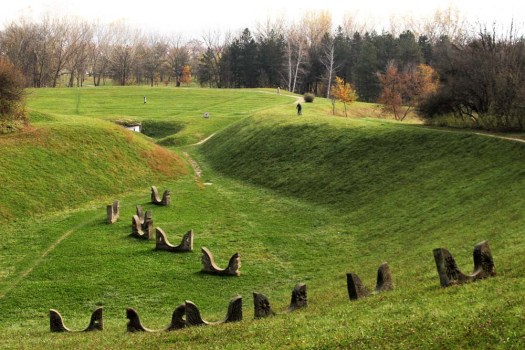 The monument park is reached on foot by way of a route through Kruševac’s outskirts. The city edgeland arrives suddenly: a roundabout, a small airfield marked by a jet fighter on a plinth, an out-of-town retail hangar with supersized advertising depicting super-fit sportsmen. As elsewhere in Serbia, the edgeland is the realm of Roma – the poorest of the poor in this none-too-wealthy country – who, as always, are involved in the recycling business. Perpetually sorting through waste – paper, metal, plastic – skilfully assessing its value, their make-do shanty shelters seem barely separated from the middens of 21st-century detritus that they live among.
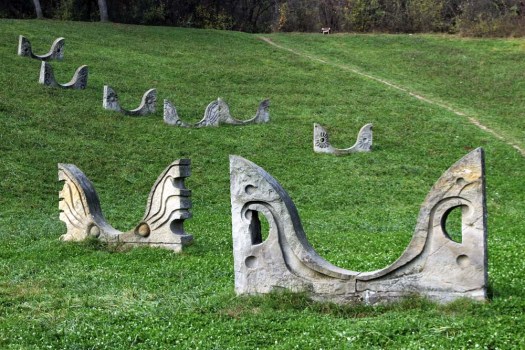
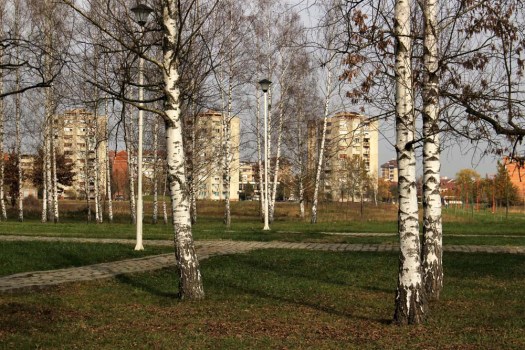
 At first there is nothing to see other than landscaped grassy mounds in the distance. Walking through a birch plantation I am entertained by the head-cracking antics of a Syrian woodpecker that hammers away remorselessly at a tree stump. Crows in all their variety – rooks, jackdaws, magpies and jays – call harshly, their voices like creaking tree trunks in a gale. I make for the grassy mound ahead and from the top can see a curved chain of stone sculptures stretched up the hollow of a hillside. The monuments resemble birds – owls to be precise – buried up to their beaks in the earth, but rising from rather than sinking down into it. They might also be angels. As I walk closer to investigate I notice a man with a bicycle at the top of the rise who is waving and beckoning to me. We manage some sort of rudimentary conversation using an inelegant polyglot mixture of German, Serbian and what might be Russian, and I learn that he lives locally in one of the housing estates that fringe the park and uses its pathways as a shortcut to the shops.
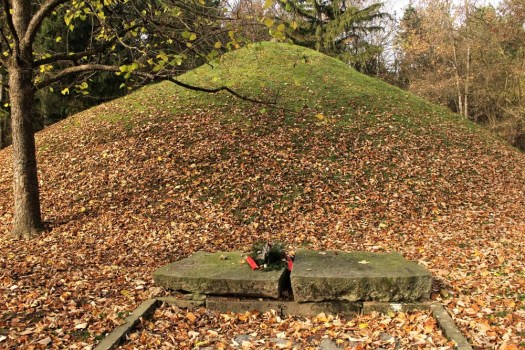
  Conversation, and commonality of language, exhausted the man cycles off and I turn round to trace the pathway back to its beginning. What is actually supposed to be the entrance to the memorial complex – the ‘Gate of the Sun’ – serves as my exit: an incomplete arch reminiscent of an Andy Goldsworthy dry-stone creation. Flanking the entrance just beyond this are two pyramidal mounds like Neolithic cairns. In front of each is a low stone funerary slab upon which rest wreaths and polythene-wrapped flowers. Whether or not these are actual burial mounds or merely a symbolical representation does not really seem to matter – this whole site is a memory field of death and the act of remembrance is the important thing. And remembered it is: memory is honoured; this site still holds melancholic charge for townsfolk and visitors alike despite its mundane use as a place for cycling, exercising and walking dogs.
 There is one more monument to see: the cenotaph. I find a curious, vaguely zoomorphic statue that brings to mind a Mayan glyph, or a totem – or perhaps another owl. It stands alone and inscrutable in front of some administrative offices that have been landscaped into the naturalistic contours of the park. Within one of the offices I spot a man working on a computer. I cannot decide whether I am envious of his workplace or not. No doubt it is peaceful enough tucked away in the folds of this green domain but the heft of dark memory weighs heavy here – a place to visit certainly but not one in which to repose.
 A few days ago I visited the monastery of Rača close to the border town of Bajina Bašta in western Serbia. The monastery lies at the edge of the Tara National Park that stretches south west from just beyond the town to the River Drina and the border of Bosnia-Herzegovina. The day was quintessentially autumnal, with a slight chill in the air, the sky flecked with stray cumulus, the leaves of the beech and hornbeam forest that cloaked the steep hillsides transformed to a palette of precious metals – gold, bronze, copper.
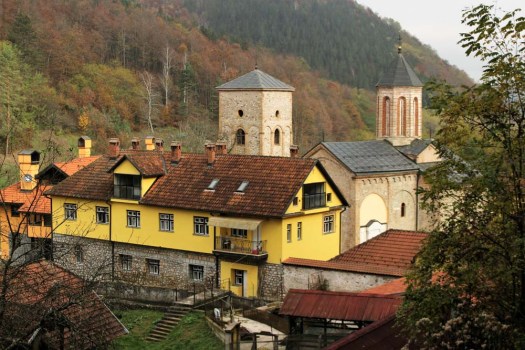 From the monastery I took the signed path that lead through forest to the spring of Ladjevac. A thirty-minute walk, the sign said, but perhaps because I was stopping frequently to take photographs, or I was just slow, it took longer. The path was difficult underfoot in places too – washed away by small landslides at a couple of points to leave treacherous grey mud of great viscosity that was tricky to navigate. The track was almost deserted – I saw only two other walkers there and back – but in summer this would have been a far busier place as energetic day trippers and monastery visitors would beat their way through the woods to the spring that has numerous health claims attributed to its water.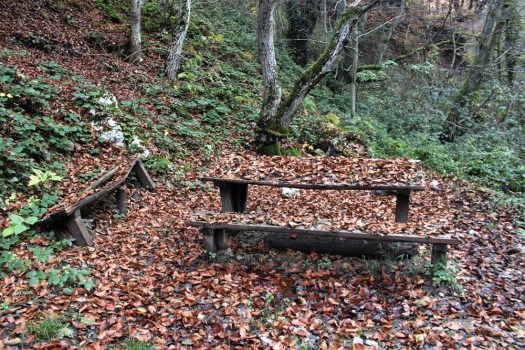
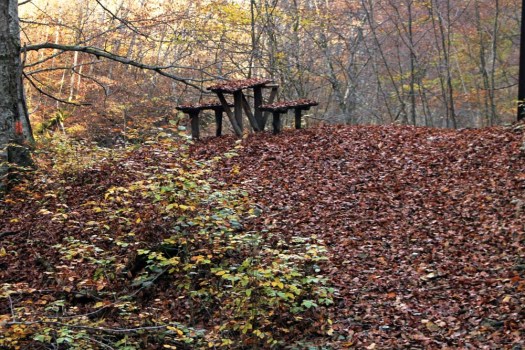
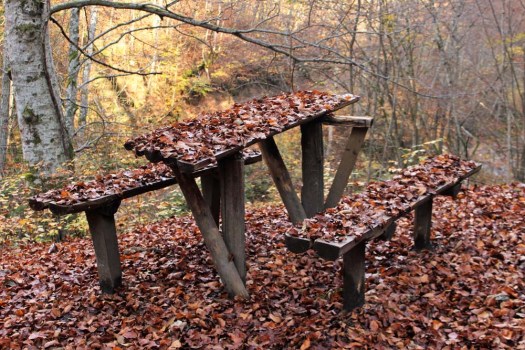 What struck me strongly was how considered it all looked, as if some unnamed landscape artist had patiently glued each leaf in place to create a work of art. But no, this was happenstance, a serendipitous confluence of meteorology and season. Man may be the craftsman, the carver of wood, but sometimes it is nature that is the artist. Humankind creates; nature embellishes.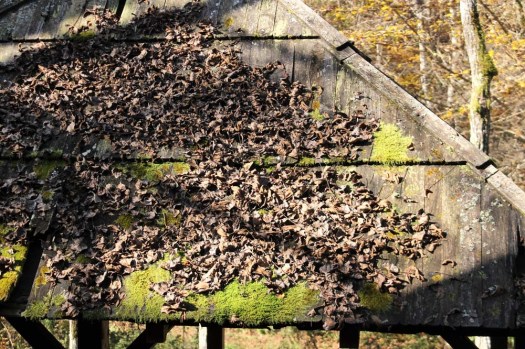
 This was bear country. No doubt about it. Over breakfast Alfred from the guesthouse had said, “You should make sure that you talk when you go walking there – or maybe sing – that way you won’t take them by surprise. My wife and I saw a mother bear with cubs in those woods earlier this year but don’t worry too much, just make sure that you don’t take them by surprise.”
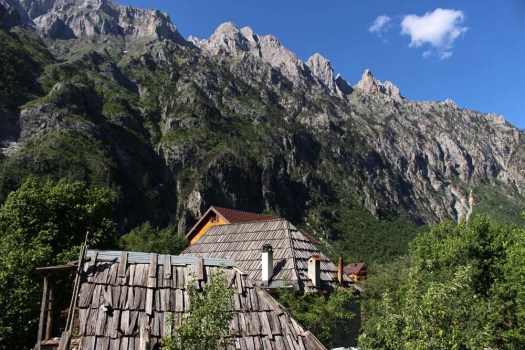 The drizzle had stopped by the time we left the guesthouse to walk east along the bank of the Valbona River. The day before we had come across four snakes in the space of a couple of hours, including a sluggish horn-nosed viper that had the tail of an unfortunate lizard protruding from its mouth, but today, perhaps because of the lack of warm sunshine, they were nowhere to be seen. Undoubtedly they were still close by, skulking beneath rocks, sleeping the deep reptilian sleep that comes with the digestion of a heavy meal… of reptiles. No snakes, but we did see an extraordinary large lizard – a European green lizard (Lacerta viridis) as we later identified it – with strikingly beautiful markings that morphed like a potter’s glaze from sky blue on the head to copper-stain green along its back and tail. Among our fellow guests at the guesthouse were a couple of German amateur herpetologists and, confronted by reptilian magnificence as this, it was easy to understand the appeal. Bear country it may have been but this was snake and lizard territory too.
 In a meadow just beyond the footbridge that led across the racing river to the tiny hamlet of Čerem, stood a monument to Bajram Curri. Bajram Curri (pronounced ‘Tsuri’ like the English county rather than the universal Indian dish) also gave his moniker to the principal market town of this far northern border region of Albania, its name only 20 years ago a watchword for lawlessness and gun-running – a KLA stronghold that was more closely connected to what was then war-torn Kosovo than its own national capital in Tirana. These days, Bajram Curri is a quiet provincial town that only ever becomes animated on market days when hard-bargaining farmers might raise their voices over the price of sheep. Like the rest of Albania, it is now as safe as anywhere in Europe – safer probably – yet still there were those who looked askance whenever Albania was mentioned as if the country was still lawless and dangerous and run by shady mafia figures. It is not… but there are bears in the woods.
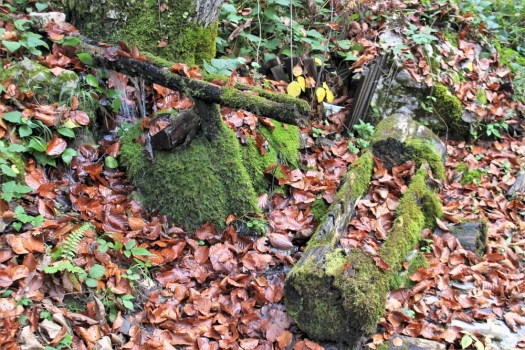
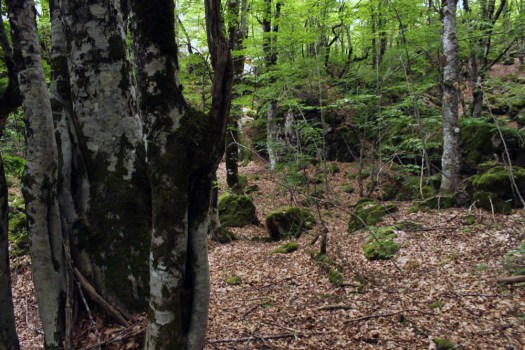 Further on a wooden sign pointed steeply uphill towards ‘The Cave of Bajram Curri’, the cave where the Albanian hero and patriot was said to have once taken refuge whilst fleeing his enemies. We followed this up through woodland for a short while before taking another path to the left that signposted the springs at Burumi i Picamelit. This track, marked by occasional red and white ciphers painted on trees like Polish flags, lead through dense beech woodland scattered with huge boulders that had long ago thundered down from the cliffs far above. It was an evocative place, a numinous realm of shade and fecundity – the light tinged green by filtration through the high leaf canopy and by the thick carpet of moss that coated every surface. Here and there were saprophytic ghost orchids poking through the coppery leaf mold – pale, bloodless plants that had no truck with the chlorophyll that otherwise permeated the woodland like a green miasma.
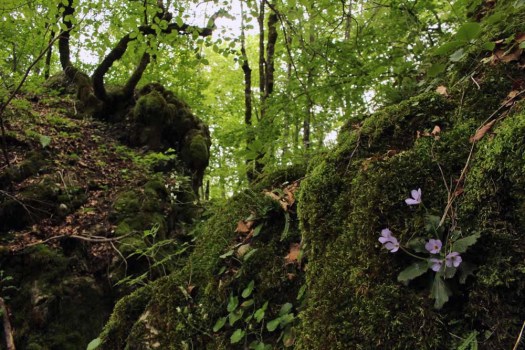
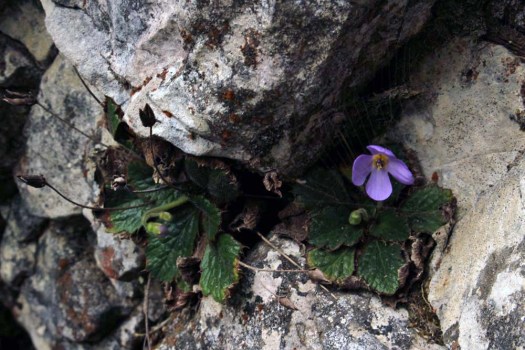
 The path eventually bypassed a glade where large moss- and fern-covered rocks formed a natural outdoor theatre. Dead dry branches snapped noisily underfoot as we made our way across to the largest of the rocks – silence was not an option and any lurking bears would have been duly warned of our intrusion by our clumsy, crunching progress. Growing high on one of the larger rocks was a solitary Ramonda plant, a small blue flower and rosette of leaves anchored to the moss. The plant had an air of rarity about it – and scarce it was: a member of a specialised family found only in the Balkans and Pyrenees. Growing in solitary isolation and providing a discrete focal point in this hidden glade it almost felt as if this delicate blue flower had lured us here – the trophy of a secret quest, an object of worship. Indeed, the whole glade had the feel of the sacred: an animist shrine or secret gathering place; the location for a parliament of bears perhaps?
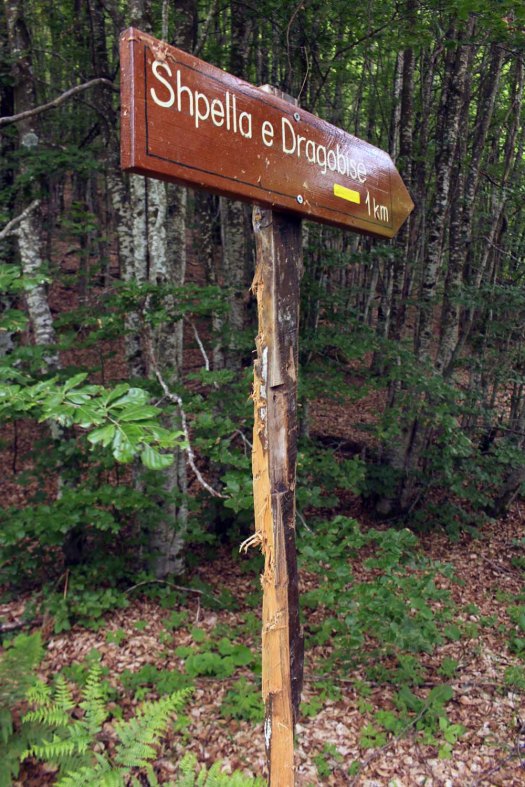
 We looked for evidence of ‘bear trees’ and eventually we found it: beside the track we discovered a conifer that had a large patch of bark missing from its trunk, freshly removed by the action of claw sharpening – or maybe as some sort of territorial signifier. At the junction of tracks further on was more visceral evidence in the form of a footpath sign that has been quite brutally attacked by a bear (or bears), the support post whittled away to a fraction of its former girth by unseen fearsome claws. Why this post had more bear-appeal than live growing trees of similar size was a mystery. Did bears have a preference for scratching away at machined timber? Was the unnatural square profile of the post especially tempting? Or did the bears somehow understand what signposts were for – to direct clod-footed human walkers into their territory. Fanciful and absurdly anthropomorphic though this might seem it did somehow hint at a thinly disguised warning – a re-purposing of man-made signposts to advertise the bears’ own potential threat: ursine semiotics. The day had, of course, been characterised by a total absence of bears – and woodpeckers too, despite numerous dead trunks riddled with their excavated holes – but their unseen presence in this secretive bosky world was nonetheless all too tangible. All the signs were there to be read.
 We ventured on to visit the springs at Burumi i Picamelit where underground water emerged straight from the limestone to race downhill in a fury towards the Valbona River below. Tucked away in a crevice beneath one of the rocks was another Ramonda growing just inches from the fast-flowing water.
 Heading back we become temporarily lost in the woods and spend ten minutes walking in circles looking for the trail before finally rediscovering it. Shortly after, we met the German reptile enthusiasts from the guesthouse walking the other way. We stopped to compare notes. None of us had seen any sign of bears in the flesh (in the fur?) but we had all seen the evidence that beckoned us: the claw-scratched trees, the mauled signpost. We concurred that it was probably best that way: an absence of bears on the ground but a strong sense of their presence as we politely trespassed their territory.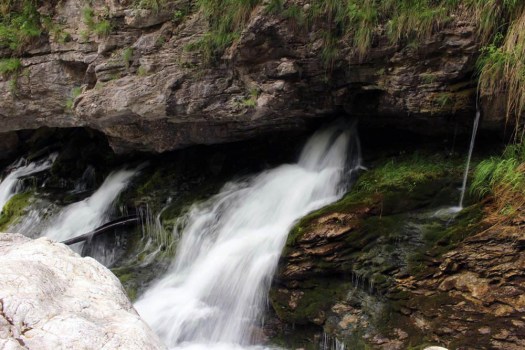





![1849[1]](https://eastofelveden.com/wp-content/uploads/2013/08/18491.jpg)
 East of Elveden