Hotel Titanic, Nagorno-Karabakh

With only the forthcoming Jubilympics stealing more media thunder so far this year, it has been nigh on impossible to ignore the fact that April 2012 marks the centenary of the sinking of a certain trans-Atlantic passenger liner. One hundred years ago this month, RMS Titanic, a vessel considered virtually unsinkable, disappeared beneath the North Atlantic’s icy waters on its maiden voyage, along with most of its crew and lower class passengers. The cause of this tragic event was seemingly the combined effect of hubris and a sneaky, yet massive, iceberg.

What does this have to do with a little-known corner of the Caucasus? Well, it is partly connected with the sense of irony so readily displayed in the post-Soviet territories of the Caucasus region. I remember spotting a restaurant on my first visit to Baku that was called, of all things, ‘Lady Diana’ (smallish helpings presumably) but even this pales into insignificance when compared to a hotel I once stayed at in the unrecognised territory of Nagorno-Karabakh.

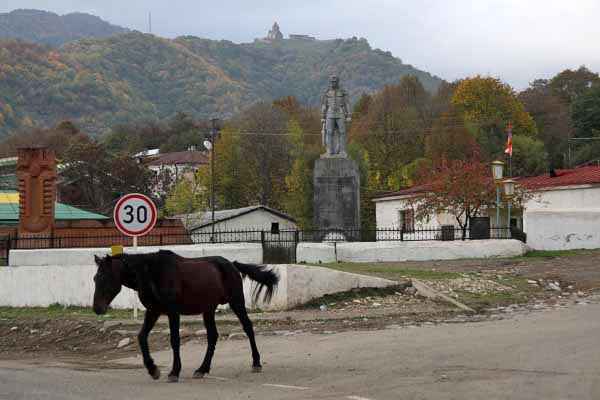
Nagorno-Karabakh, formerly part of Azerbaijan, now a de facto independent state (but only recognised by three fellow non-UN states – Abkhazia, South Ossetia and Transnistria), is a very odd place – and a sad place too, with visible traces of war damage almost everywhere. Given the state’s poverty, isolation and lack of infrastructure it might seem surprising to come across a hotel of any description in a small village, let alone one called ‘The Titanic’, but the small lumber village of Vank in northern Nagorno-Karabakh not only has a guest house that answers that description but also one that is actually built in the form of a ship.

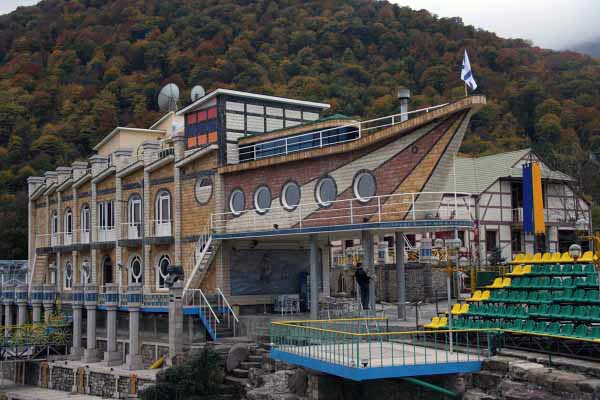
The Titanic Hotel – officially Hotel Eclectica but everyone seems to calls it ‘Titanik’ and that is what it said on my restaurant receipt – is a striking edifice built in the form of a ship. This brick-built simulacrum even goes as far as having port-holes for some of its windows. In front of it stands a small swimming pool (no icebergs!) that must, almost certainly, be the only one in all of northern Nagorno-Karabakh. The hotel must be a thoroughly disturbing phenomenon to come across out here in the boondocks if you were not expecting to find it; it’s an arresting enough sight even when anticipated.

The Hotel Eclectica/Titanic is one of the most surreal sites you are ever likely to see but the village is the oddest of places too. Vank is the birthplace of a Moscow millionaire lumber baron called Levon Hayrapetyan who as well as asphalting the 12km-long road to the village has ploughed plenty of money back into his home village, building a school, a lumber mill and this highly incongruous hotel. Part of Hayrapetyan’s vision for the village of his birth is to develop tourism in the area, hence the hotel. It seems a long shot considering its isolation and the fact that Nagorno-Karabakh is the remnant of a frozen conflict and officially does not even exist. Technically speaking, Nagorno-Karabakh still belongs to Azerbaijan, although virtually all ethnic Azeris have left since the bloody conflict of the 1990s.

I spent a few days in Nagorno-Karabakh back in 2008, having first obtained a visa in Yerevan, the Armenian capital. The colourful ‘visa’, which I took the precaution of not sticking into my passport, was hardly glanced at when I arrived at the border post in the crowded marshrutka that plies daily between Yerevan and the Nagorno-Karabakh capital Stepanakert.  After a couple of days in Stepanakert – a bit of a threadbare Soviet theme park without really trying to be – I took another marshrutka to Vank for an overnight stay.

The village lies deep in a wooded valley with wispy strands of low clouds kissing the nearby hills, atop one of which stands the mysterious Gandzasar Monastery. I managed to get a room at the Titanic, although they didn’t really seem very keen on having a lone foreigner like me stay, perhaps disbelieving that I might seriously want to spend the night there. After paying 7,000 Armenian drams ($20) and leaving my bag I walked up the neatly tarmaced road to the monastery on the hill, which was swathed in mist so thick that it was impossible to see the church until the very last minute of ascent. In the monastery grounds I encountered a friendly trio of chain-smoking Armenian men but, after we had posed for group photographs together and they had sped off down the hill in their Lada, I was completely alone once more – the resident monks were either absent or keeping a very low profile. Not quite alone though. Mooching around, I noticed a small curved-beaked bird poking around on the stone of the gable. A sparrow? No, a wallcreeper – an exotic-looking mountain bird more at home on isolated cliff faces than the stone walls of churches. Perhaps, like me, it had become disoriented by the swirling mist that flanked the monastery like the overenthusiastic use of dry ice in a Hammer Horror production?

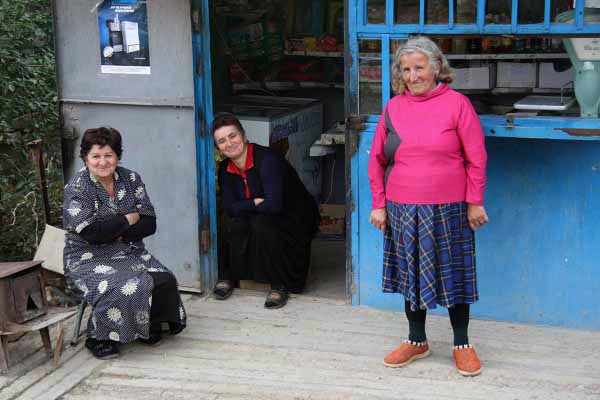
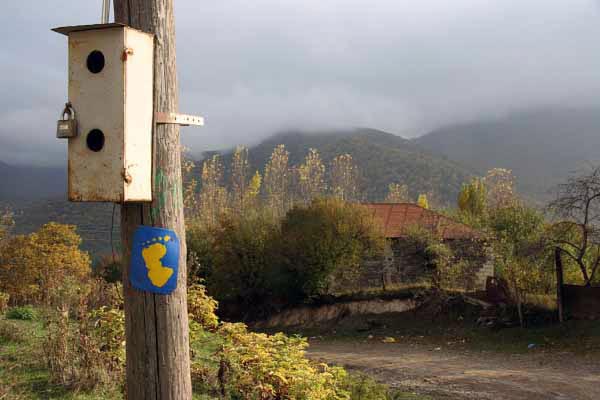
Later, walking up out of the village through lovely wooded countryside along a section of the long-distance Janapar Trail I came across a few more locals: friendly Armenian women at a village kiosk who wanted me to take their photograph and another villager who beckoned me into his garden to drink vodka with him. Less welcoming though, was the policeman who gruffly insisted on seeing my dokumenti. As he was dressed in civilian clothes I countered by asking to see his identification, which pissed him off a bit but made his friend roar out loud with laughter. I stood my ground and soon the policeman just walked off in a huff trailed by his still giggling accomplice.

By the time I got back to the hotel late afternoon the place had been virtually taken over by a wedding party and so things had become pretty chaotic. Nevertheless, I was hungry. The hotel’s ‘Van Gogh’ restaurant had a Chinese couple working there (who knows how they found their way here to Vank?), which might have been a good sign, although it seemed they were only capable of providing food for themselves and pre-ordered wedding feasts. Eventually, after much negotiation and shaking of heads, I managed to order an overpriced plate of barbecued mutton, which arrived after a full hour’s wait accompanied by a huge dish of fresh coriander.

One night was enough. I caught the early morning marshrutka back to Stepanakert the next day. Among the suspicious faces that turned my way when I took my seat was the policeman from the previous day. This time he was in uniform – quite high-ranking it would seem judging by the pips on his lapel. He didn’t bother asking for my passport this time.

Postscript: I am aware that Vank is not the only place in the world with a Titanic Hotel. There’s also a luxury beach hotel resort called Titanic in Antalya in Turkey, another beach resort in Hurghada, Egypt, a business hotel in Istanbul and others in Albania, Vietnam and Poland. You would be hard pushed to find this particular one on TripAdvisor though. The Hotel Titanic, Vank, Nagorno-Karabakh is not only a very odd place to stay, it is the Caucasus region’s very own Fawlty Towers.

For those interested in finding out more about the long-distance Janapar Trail you can look at my feature for Walk magazine here – the title Global Walk: Azerbaijan was not my idea.

Dacha

Reading a recent article on the excellent Earthlines blog about Gerry Loose, and then finding out more about the Scottish hutting movement and specifically the Carbeth hutters community in Stirlingshire, I have come to the conclusion that I am probably something of a closet hutter at heart. The best that I can ever probably hope for though is to have my own shed one day.

It is a common enough passion – indeed, books have been written about British (predominantly male) shed culture. But, with no rear garden and a backyard too small to comfortably squeeze a shed into, the closest I currently get to fulfilling my fantasy is my city allotment where I have inherited a tumbledown structure without door or window glass that is filled with garden tools and grumpy secretive spiders. Too small and decrepit to serve as a comfortable retreat, this shed is clearly no place to linger but at least I have a plastic chair en plein air for whenever I need a rest from wrenching couch grass out of the ground. 

In northern Europe, and especially in Scandinavia and Russia where even the middle classes live in apartment blocks,  the situation is quite different. Here, many city dwellers have a wooden hut and a patch of ground to call their own – a simple rural haven where they can enjoy a little R&R and temporary respite from urban life. No nation embraces this tradition more than Russia, where a country dacha is seen not only as a place to grow vegetables but something akin to a holiday home: a base for collecting berries and mushrooms in autumn, for fishing, for sunbathing; a place for friends and family to gather around food, to drink vodka, play games and sing. A dacha is a place to spend summer weekends al fresco, a place where city children can learn about nature. In Russian society, a dacha serves a function that is a combination of allotment garden, beach hut and social club. To have a dacha is not a Walden-like solitary pursuit but, rather, something that proudly shouts out ‘community!’

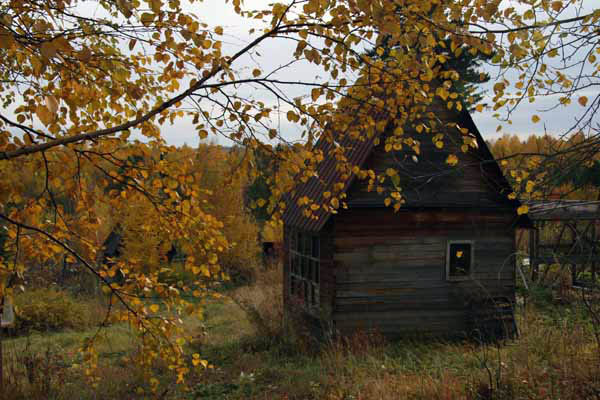
I was lucky enough to visit a dacha a couple of years ago on a long, late-summer Russian journey from Pskov, close to the Estonian border, to Irkutsk near Lake Baikal in eastern Siberia. At Krasnoyarsk, 18 hours west of Irkutsk on the the Trans-Siberian railway, I had arranged to stay in the family apartment of a local tour guide and political science lecturer called Anatoliy. After picking me up at the station and meticulously showing me all the permutations of the city bus route to and from his identikit Khrushchevki apartment block (the very last stop, thankfully) he took me out to show me his country dacha that, coincidentally, was close to the railway tracks that I had just travelled along. 

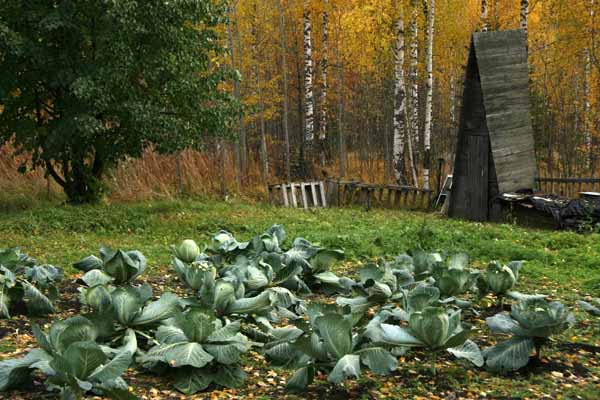
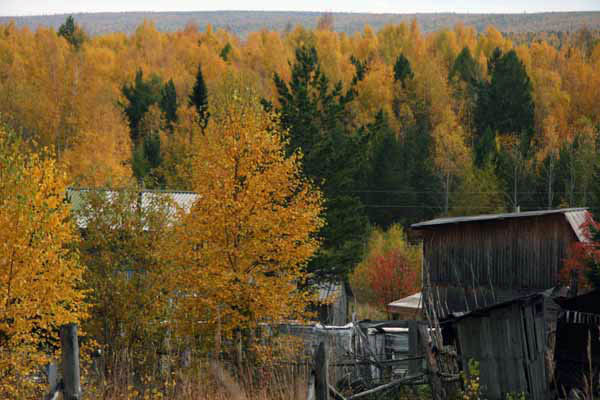
There is more to Siberia than gulags and permafrost but life is hard nonetheless. In the few months of the year when the ground is not snow-covered there are plenty of other things to contend with, notably predatory mosquitoes and nasty infective ticks everywhere in the grass. Given such limitations, I was hugely impressed by the size and vigour of Anatoliy’s cabbages and also by the efforts he took to tend them given that we had driven for more than an hour to reach the dacha. Even more  impressive was the air of autumnal tranquility that seemed to hang over the place like a healing balm. In Siberia, autumn may be just a brief golden precursor to a long dark winter but  September is the most glorious of months.

A River Wensum Walk

Early April in Norwich. It’s cool but the sky is blue and daffodils are glistening in Wordsworthian tribute to the bright spring sunshine. What better then than a morning stroll through the city along the banks of the River Wensum?

Like many cities – even London – these days, Norwich has largely turned its back on the river that runs through its centre. Once essential for transport and industry, the River Wensum that meanders through the city now seems to have little use other than as a backdrop for attractive new riverside apartments. Look a little closer though and you will still find plenty of reminders of Norwich’s medieval past along its course.

Hard to imagine now, but Norwich once held second city status in England and the banks of the River Wensum that dissect the city are still littered with traces of that period – medieval churches, priories, old bridges and defensive walls – as well as reminders of the city’s half-hearted dabble with Victorian industrialisation.

We begin our walk on St Benedict’s Street at St Lawrence’s Church. From the alley at the side of the church’s western gable you can see a little stone plaque set in the flint that depicts St Lawrence strapped to a grid iron, the means of his subsequent martyrdom. Understandably, he doesn’t look too happy about this but is blissfully unaware (well, perhaps not blissfully) that he will go on to become one of the earliest Christian martyr saints; indeed, the patron saint of comedians and chefs no less (and butchers and librarians too, apparently).

Descending the steps to cross Westlegate we pass the swish apartment block that in a previous incarnation used to be the Anchor Brewery. An enormous brick chimney once scraped the sky here – I still have a black and white photograph of it somewhere. As recently as thirty years ago Norwich used to be redolent of malt and hops (and chocolate too, from Rowntree’s, now Chapefield Shopping Centre) but its source did not originate from here as the Bullards brewery closed back in the 1960s.

We cross Coslany Bridge over the Wensum and  follow the pedestrian access along the river’s north bank. Across the water stands the disused warehouse where the entire text of Thomas Moore’s Utopia is scrawled in white paint across the brickwork as if it were the work of a hyperactive 16th-century graffitti artist with a taste for political philosophy.

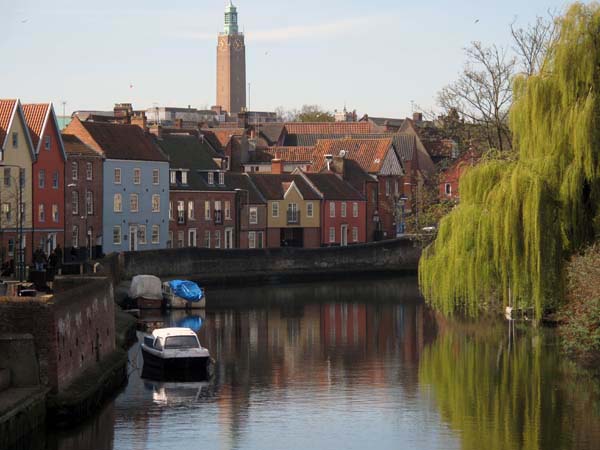
Crossing Duke Street by means of Dukes Palace Bridge, a brief detour via Colegate is necessary in order to reach Blackfriars Bridge by the Norwich School of Art before we arrive at Fye Bridge and Fishergate. Whitefriars Bridge comes next and the eponymous friary once stood on the site of the large edifice that looms before us: the Jarrolds Printing Works, built n 1834 and formerly a mill owned by the Norwich Yarn Company – a tall stately bulding with brickwork elegantly draped with Virginia Creeper and wisteria. Looking back, the clocktower on Norwich City Hall, which to my mind resembles a cut-price Marrakech minaret, rises into view beyond the weeping willows, newly in leaf, that sway dreamily over the torpid water beneath.

Beyond the printing works, a renga – a word map created by means of an ancient Japanese tradition of shared writing – strings a snake of words and phrases along green hoardings beside the river. A Renga for St James was created here on site in 2009 and utilises the local Norwich vernacular and reference points. Someone – a well-educated graffitist, who clearly understands the renga ethos – has scrawled ‘Perfidious’ above the word ‘Albion’, which in this instance refers to one of the few remaining wherries that used to ply East Anglia’s rivers.

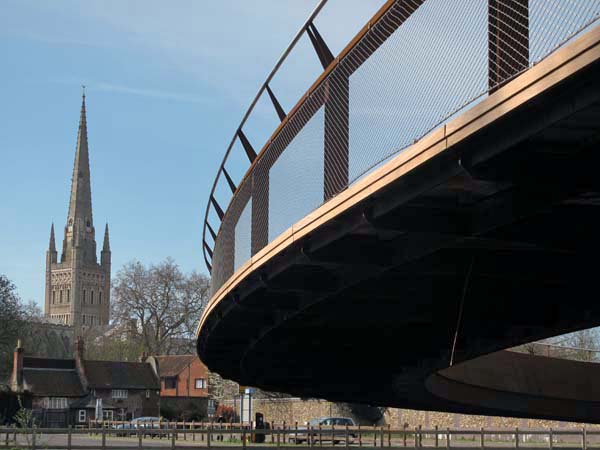
Continuing east the new bridge soon comes into sight. Peter’s Bridge, named after a former Jarrold’s chairman, has only been open a few months and, surprisingly, not a lot of people seem to know about it. Most of the Wensum’s bridges are so ancient that they are firmly embedded in the city’s psyche but there have been three new footbridges so far this millennium: this one, the 2009 Lady Julian Bridge close to the railway station, and the Novi Sad Friendship Bridge, opened by the Yugoslav ambassador in 2001, near Carrow Bridge (ironic, then, that NATO bombed and destroyed the far more substantial and economically important bridges of Norwich’s twinned Serbian city just two years earlier).

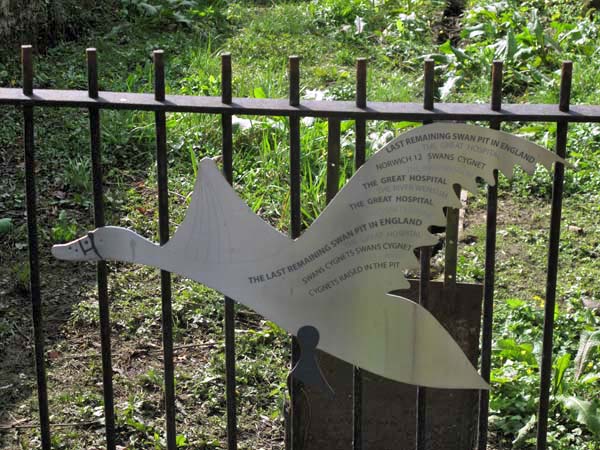
 Walking across this graceful, J (for Jarrold’s)-shaped footbridge, our riverside walk continues past Cow Tower towards Pull’s Ferry but before reaching this we pass what looks like a sluice leading into the river. This is, in fact, a rare 18th-century example of a swan pit, a tidal pool in which wild cygnets were kept and fattened for the table after having their wings clipped and beaks marked by their owners.

At Bishops Bridge, we leave the river behind to head for Cathedral Close and Tombland. A place called ‘Tombland’ next to a great church might reasonably be expected to be a place of the dead. But no, Tombland is Old English for ’empty land’ and this was the site of Norwich’s Anglo-Saxon market before the Normans came and shifted it to its present position next to St Peter Mancroft Church. Norwich Market has been operating there for over 900 years now and is still going strong, six days a week. Mind you, it did have a bit of an overhaul a few years back.

North-South divide?

Back in 2007, Danny Dorling of the University of Sheffield wrote a piece on the nature and geographical extent of the so-called North-South divide in Britain. This was nothing new: as most of us already knew, the north-south socio-economic divide was not simply a matter of drawing a horizontal line through Watford, nor was it a case of delineating the southern boundaries of Yorkshire, Lancashire and Cheshire. Rather, it was more complex – a meandering line between the River Severn to the southwest and the Humber to the northeast.

According to Professor Dorling, the transition from north to south is not as gradual as one might expect, and shows little sign of that psychogeographic favourite, a borderline ‘zone of liminality’. The imagined divide is, in fact, a fractal line sharply defined by all manner of factors – voting patterns, house prices, wealth, health (average life expectancy is a year less north of the line), life chances, Oxbridge university access, language – particularly vowel sounds – and even preferences for flat or sparkled beer. Of course, the line roughly follows distinct features of physical geography too – the division between upland and lowland Britain, and pastoral and arable farming – features that have stongly influenced British history and culture. The divide also delineates the territory colonised by Saxon invaders and follows uncannily close to the route traced by the Roman Fosse Way.

I was reminded of this theoretical divide twice this week. First, by an article in the Big Issue written by Professor Dorling to accompany a feature on George Orwell and then by a BBC Radio 4 programme, the second part of a documentary called North and South: Across the Great Divide presented by Ian Marchant, in which the writer travelled to various places either side of this imaginary line to investigate what local people thought of the notion.

What was pleasing was that Marchant looked closely at some of my own old stomping grounds. I was born in Stourbridge in the West Midlands and grew up in Redditch, a small town just north of the divide that became a new (and suddenly much larger) town just before I left (and which earned the dubious honour of once being dubbed ‘the most boring place in the known universe’). Marchant interviewed people in Henley-in-Arden, a posh, leafy Tudor-beamed town that lies just south of Redditch across the north-south frontier in Warwickshire. The view of the Henleyites was that people from Redditch tended to be more common, while that of the Redditchers was that they would love to live in Henley given half the chance but they simply could not afford to. Hardly groundbreaking stuff but, certainly, growing up in workaday Redditch, places like Henley – and Stratford upon Avon and Warwick – did seem to belong to another, altogether more glamorous world despite their relative proximity. But then, so did Worcester (which actually lies north of the line) and even some parts of Birmingham.

If this north-south orientation is correct then, having journeyed east and slightly north in adult life to move to Norwich from the West Midlands, I have actually crossed the divide – the Tudor line, as Dorling sometimes calls it – southwards. A geographical paradox perhaps – West Midlands to East Anglia, sort of north to kind of south. I still say bath not ‘barth’ but, there again, I do prefer my ale unsparkled.

Marchant ended the program in Gloucestershire’s Forest of Dean, a small but very distinct enclave, squeezed between the Severn and Wye, which stands at the most southerly ‘northern’ point of this cultural divide. I used to know this area quite well and was always impressed by its strong sense of place, wilful isolationism and warm-hearted yet tough natives. To me it always seemed somehow closer to the spirit of South Wales than to the rest of Gloucestershire. Despite having the same latitude as Watford, with working-class forestry and mining traditions, and hardly a trace of tweeness in its villages, there are plenty of stereotypical ‘northern’ characteristics on display here. The ‘Forest’, as natives always call it,  really does seem a very different place compared to the opulent sandstone villages of the Gloucestershire Cotswolds just across the River Severn.

In essence, the BBC4 programme is as much about social class as it is about geography but it raises some interesting points. You can listen again here. For a very different point of view, you can read what Simon Jenkins makes of Dorling’s analysis here. The fact that he scathingly dismisses the Sheffield professor as ‘geographer royal by appointment to the left’ might give you some idea as to what to expect.

Patience (After Sebald) – Walking The Rings of Saturn

About a year ago I wrote a post about an Aldeburgh Music weekend at Suffolk’s Snape Maltings that celebrated the life and works of the writer W G Sebald. A new film by Grant Gee, Patience (After Sebald), was also previewed on that occasion but it has taken a full year for it to have been finally been put out on general release in the UK. After such a long wait, ‘Patience’ might seem a wholly appropriate choice for a title but I finally got the chance to see the film last Sunday at a sell-out screening at Cinema City, Norwich.

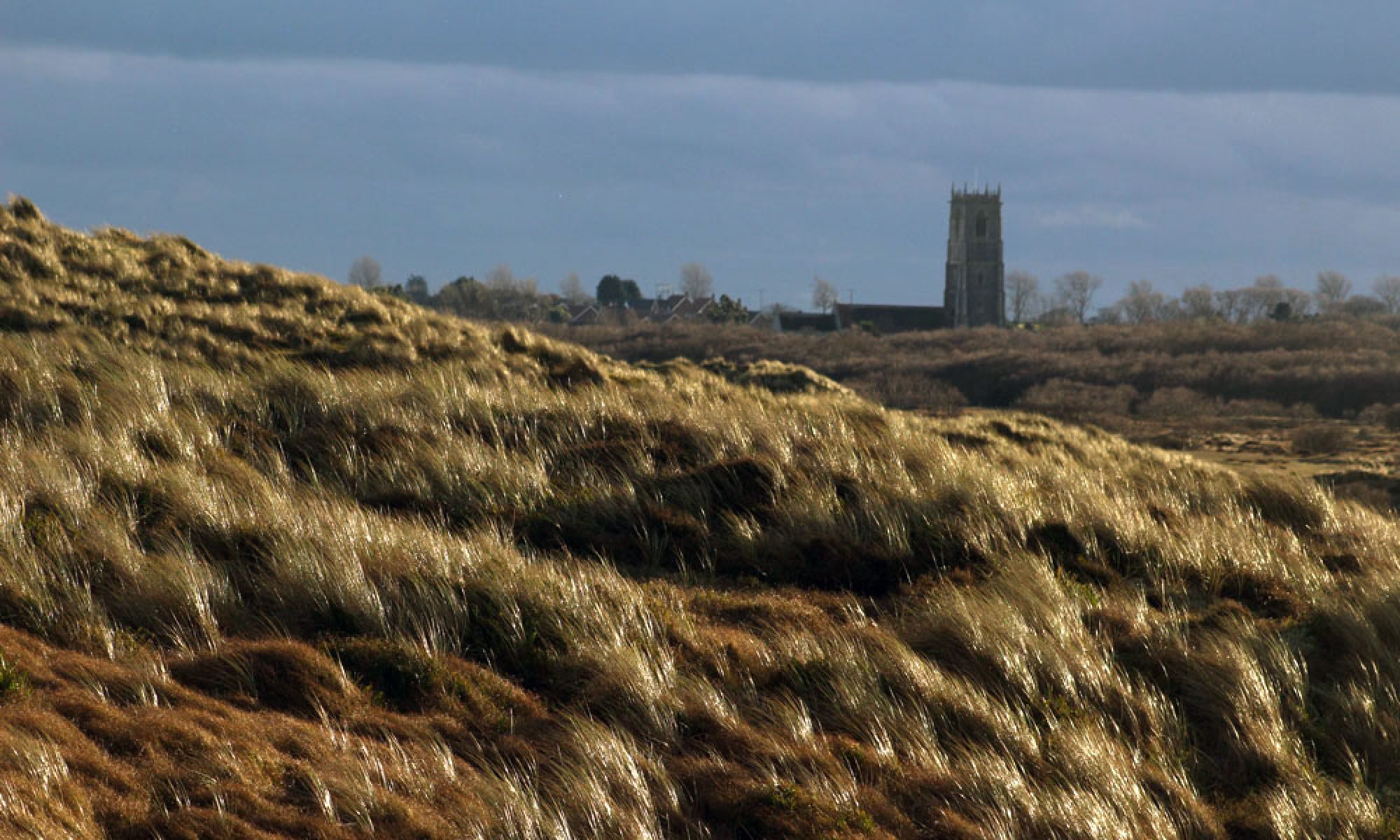
The film is based on what is probably Sebald’s best known work, The Rings of Saturn, which  describes a long meditative walk in the Suffolk coastal region. In German translation the book is subtitled ‘Eine Englische Wollfahrt – an English pilgrimage’, but this is misleading as The Rings of Saturn is not really about pilgrimage at all, nor is it a work that concerns itself that much with landscape, although the shingle and wide skies of coastal Suffolk do make a cameo appearance.

Although genres such as travel, history and memoir are appropriate up to a point, The Rings of Saturn is a work that boldly defies categorisation and which cannot easily be placed into any single literary pigeonhole. Sebald’s Suffolk odyssey is really as much an internal journey through one man’s mind as anything else. Far from the normal notion of travelogue, The Rings of Saturn is more a psychogeographic exploration of one corner of East Anglia. Certainly, the physical geography here is spectral, a melancholic landscape of ghosts, personal reflection and dark cultural memory. The term ‘Proustian’ might be used to define Sebald’s style to some extent but a better word would be Sebaldian: W G Sebald is one of those rare writers, like Dickens, Kafka and Ballard, whose name can be confidentally used as an adjective thanks to a distinctive mournful style and typically digressive, fragmentary narrative.

Part of the Sebaldian trope is to include images – black and white photos and line drawings – as part of the narrative flow; images, sometimes unsettling, that are tangential to the geography of the walk yet central to the narrative’s solipsistic digressions. Many of the book’s already familiar images are replicated in Patience (After Sebald), serving as a backdrop for talking heads like Robert Macfarlane, Iain Sinclair and Andrew Motion who have been recruited among others to give their personal take on Sebald’s oevre. Other images on display in the film are immediately resonant to those who have read The Rings of Saturn even though they do not appear as photographs within the pages of the book itselfA brief glimpse of a naked couple lying on a beach clearly represents the lovers that Sebald stumbled upon at Covehithe and, panicking, described as ‘like some giant mollusc washed ashore… a many-limbed, two-headed monster’. A shot of a distressed-looking plate of food undoubtedly refers to the joyless pub meal taken by the author in Lowestoft, which contained a fish that had ‘doubtless lain entombed in the deep-freeze for years’ along with tartare sauce ‘turned grey by sooty breadcrumbs’. Apart from an occasional colour inset frame showing a walker’s boots on the tarmac (the film-maker himself perhaps?), the images used are monochrome throughout, as grey as Sebaldian tartare sauce.

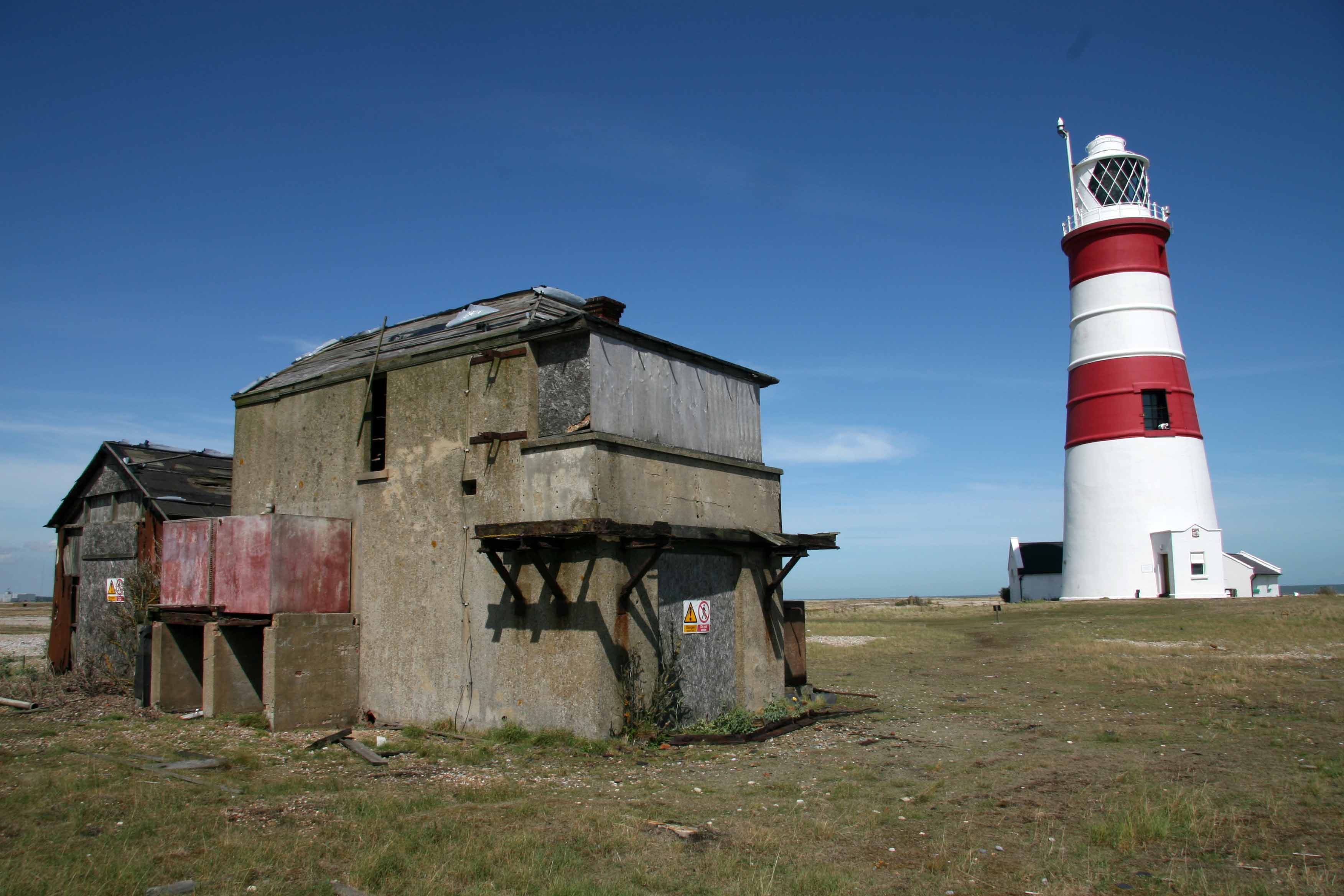
Also permeating the film are grainy 8mm-like shots of some of the locations that Sebald passed through on his long walk – places that get scant mention in The Rings of Saturn but which clearly inform its telling; places familiar to anyone who knows the Suffolk coast reasonably well – Southwold’s Sailors’ Reading Room, Boulge church, Yoxford, the ruins of Dunwich and the formerly top secret research pagodas of Orford Ness. If anywhere could be described as an archetypal Sebaldian landscape it would surely be Orford Ness.

Patience (After Sebald) complements Sebald’s book admirably. It encourages those unfamilar with his work to read The Rings of Saturn for the first time, while those already smitten can find nourishment in the distinctly Sebaldian imagery of the film and the generous personal accounts of the man himself. To be nitpicking, there are a couple of small details that some Sebaldophiles might find slightly incongruous – Andrew Motion reading his poem about the merman of Orford, perhaps, and a scene near the end that involves a puff of smoke at the roadside where Sebald died in a car accident. The latter I found quite thrilling although some might consider it borderline tacky – I can say no more.

Sometimes writers can seem to influence the reader’s view of landscape to such an extent that it is hard to come to it with innocent eyes. Once The Rings of Saturn has been read and absorbed, coastal Suffolk – in the right conditions – can easily transform into a Sebaldian landscape for those passing through it. Yet, as Robert Macfarlane recounts in Gee’s film, it is imposible to replicate Sebald’s journey exactly. Macfarlane’s own well-intentioned attempt to retrace Sebald’s steps was thwarted by sunny, distinctly non-Sebaldian weather and by simply having too much fun swimming at Lowestoft.

Even with fine weather and a light heart, it seems impossible for anyone who has read The Rings of Saturn and walked the Suffolk coast to not have some sort of Sebaldian connection. Whether we like it or not, his prose and dark historic musings have encouraged us to see the coastal landscape in a thousand shades of (tartare) grey whatever our proclivities. But we cannot replicate Sebald – and why should we? Even following those exact same footsteps, we all do our own walk, make our own pilgrimage. The psychogeographical dimension of any walk through any landscape is as dependent on the mindset of the walker as it is on the territory itself.

On a personal note, the book’s geography resonates more than I might ever have imagined: the site of the old Norfolk and Norwich Hospital where Sebald opens the text (finding himself there with a back problem a year after the completion of his Suffolk walk) is located immediately across the road from where I live.

Gloomy Sunday

It is Sunday in Edinburgh and the city streets are filled with Frenchmen in blue shirts and black berets all come for the Six Nations rugby match against Scotland at Murrayfield stadium. Preferring the game that favours a more spherical ball it seems like a good opportunity to take the train to Glasgow for the day.

The previous day, on our mentioning Scotland’s largest city, Colin, our bed and breakfast host, remarked, “Well, I’m Edinburgh man so I’m biased but I think Glasgow makes the most of what it’s got to be fair.” It is no secret – Edinburgh and Glasgow may be less than 50 miles apart – one hour on the train – but there is a cultural gulf between the two cities. Or so they would have you believe: rough, working class Glasgow versus genteel, middle-class Edinburgh; Billy Connolly versus Miss Jean Brodie; deep-fried pizza versus herb-infused foccacio. This is, of course, a misleading generalisation but it cannot be denied that the two cities do have a markedly different feel. Edinburgh is no longer ‘Auld Reekie’ but a stylish European capital with a beautiful skyline. Glasgow, on the other hand, remains a Victorian city par excellence – famously, the second city of the British Empire. While Edinburgh seems to thrive on its glorious past and embody the spirit of the Georgian Enlightenment, Glasgow, like Manchester and Sheffield over the border in England, is a place in post-industrial transition, a city trying to find its rightful place in the 21st century. Despite its City of Culture makeover a decade or so ago, Glasgow still manages to look a bit threadbare around the edges in a way that central Edinburgh does not. This is only part of the picture though – take a bus out to one of the outlying ‘schemes’ in either metropolis and peripheral Edinburgh looks every bit as unattractive and dysfunctional as the wastelands of outer Glasgow.

In Glasgow, the Willow Tearooms still operates in the city centre, a working shrine to the distinctive secessionist style of Charles Rennie Mackintosh, one of the city’s most famous sons. The Glasgow School of Art designed by Mackintosh when he worked as an architect in the city lies just around the corner. The ‘Room de Luxe’ at the top of the stairs is a delight – elegant high-backed chairs, roses in vases and a view through stained glass windows down onto Sauchiehall Street below.  The window glass (original we are told) distorts a little, affording a slightly twisted view of a boarded-up Pound-Mart store opposite, humdrum 1960s and peeling paint. A solitary busker, clearly audible from the tearoom, plays the trumpet to passers-by, belting out jazz standards like Summertime in fast rotation. But summertime it is not – the day is dreich and chilly, the sky the colour of cold porridge – Gloomy Sunday might be a more apposite choice.

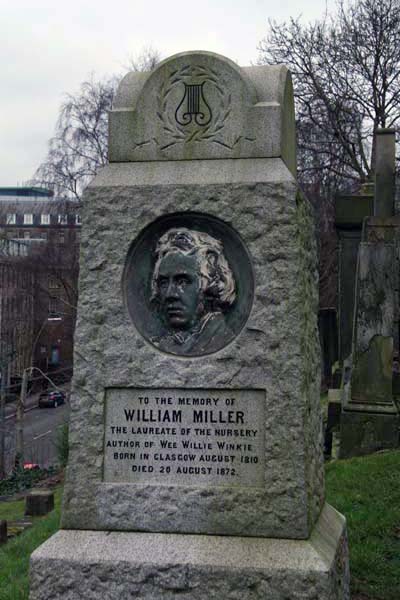
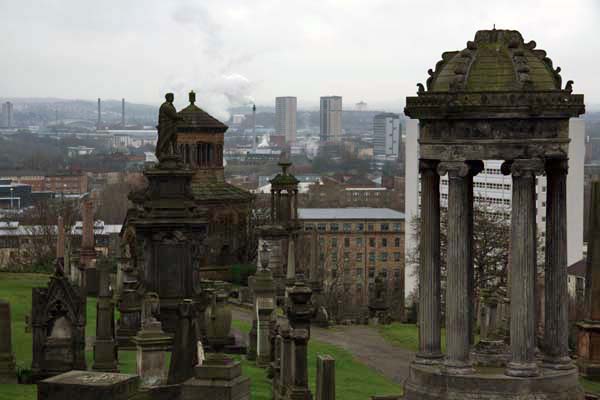
A mile or so to the east, beyond Queen Street Station and George Square with its Modern Art Gallery, St Mungo’s Cathedral sits next door to the Royal Infirmary, a proximity that is surely no mere coincidence. Beyond the dark glowering sandstone of the cathedral and across a footbridge (‘the Bridge of Sighs’ utilised by funeral processions) lies the Necropolis – Glasgow’s city of the dead. The most obvious monument, looming high on a Doric column at the top of the hill is a memorial to John Knox, the Protestant reformer but the first that we pass on the winding road uphill is a monument to William Miller, ‘The Laureate of the Nursery’ responsible for the children’s nursery rhyme Wee Willie Winkie, which was originally written in Scots:

Wee Willie Winkie rins through the toon,
Upstairs and doonstairs, in his nichtgoon,
Tirlin’ at the window, cryin’ at the lock,
“Are the weans in their bed? For it’s now ten o’clock.”

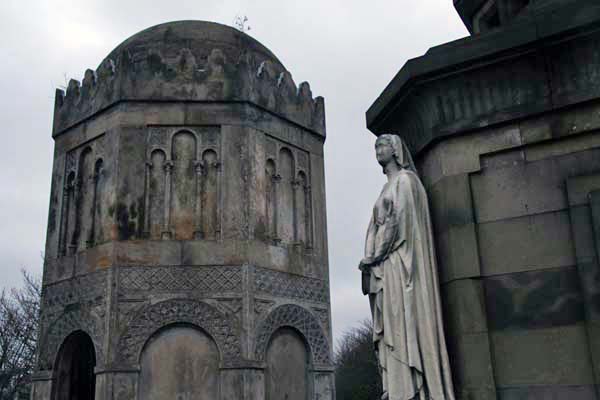
We climb the path to the top. Low cloud has drained all colour from the view apart from that of the glowing rust brown of the neo-Norman Monteath mausoleum, which brings to mind an Armenian church but was apparently modelled on the Knights Templar Church of the Holy Sepulchre in Jerusalem. Further up, the William Rae Wilson mausoleum is decidedly Moorish, a fitting monument to someone who travelled and wrote about the Middle East. Next to this, the entrance of the Graeco-Egyptian mausoleum of John Houldsworth is flanked by stern white angels, Hope and Charity, while Faith lies within glowing almost praternaturally in the gloom.

The view is the thing here. From the vantage point of the Necropolis it is easier to grasp the scale of Scotland’s largest city, even on a dull day such as this. The concrete, brick and stone of the city centre sprawls to the west beyond St Mungo’s spire and buttresses. Elsewhere, the land dips and rises gently to trace the valleys of Glasgow’s rivers, the Clyde and Kelvin. High-rise housing schemes dot the horizon east and north, an architectural echo of the serried ranks of tombs that line the Necropolis thoroughfares – a world of folk that once belonged to Glasgow’s inner city but now find themselves detached and isolated. If you believe the clichéd image, a realm of ne’er do wells – bampots, malkies, and chiv-wielding neds – but also pensioners, terminally unemployed steel workers, young single mothers and beleaguered immigrants. Whatever the reality, it is a long way from the fancy designs of Charles Rennie Mackintosh and certainly no place for Wee Willie to wander alone at night.

Heading back to Edinburgh our train squeezes past another returning to Glasgow at Croy station. Not quite as crowded as those we saw heading for Edinburgh on the way there, its carriages are full of middle-aged men in kilts and Scotland rugby shirts. They look somewhat subdued – clearly Scotland has lost the rugby.

Suffolk Coast Walks 2

Just to update the previous post – Nick Marsh, countryside officer at Suffolk Coast and Heaths AONB, went on BBC Radio Suffolk a couple of days ago to talk about my new Cicerone guide and the walking potential that the Suffolk coastal region offers. You can listen again here (fast-forward to around 2:37). It is available online until March 5.

Suffolk Coast Walks

If I might be allowed a little shameless self-publicity, my new book Suffolk Coast and Heaths Walks: Three Long-distance Routes in the AONB is published today by Cicerone. A bit of a  mouthful, I know – let’s just call it ‘Suffolk Coast Walks’ for the sake of brevity.

The book gives a detailed account of all three long-distance trails within the Suffolk Coast and Heaths AONB (Area of Outstanding Natural Beauty). All three routes make for excellent walking, either in their entirety or as selected day stages.

OS map extracts for the various stages are included and the book also has considerable background information outlining the history, geography and wildlife of this attractive region.

It is lavishly illustrated too, with photographs taken by yours truly (the cover shows the River Blyth at Southwold).

For a look inside the book, a sample chapter and downloadable PDF file you can visit the Cicerone website here. It is also on Amazon.co.uk here.

Here’s a brief sample from the introduction and a few images from the book.

Introduction

The sky seems enormous here, especially on a bright early summer’s day, and the sea beyond the shingle almost endless. Apart from the gleeful cries of children playing on the beach, the aural landscape is one of soughing waves and the gentle scrape of stones, a few mewing gulls and the piping of oystercatchers. Less than a mile inland, both scenery and soundscape are markedly different – vast expanses of heather, warbling blackcaps in the bushes, and a skylark clattering on high; the warm air is redolent with the almond scent of yellow gorse that seems to be everywhere. This is the Suffolk coast, and it seems hard to imagine that somewhere quite so tranquil is just a couple of hours’ drive away from London.

The big skies, clean air and wide open scenery of the Suffolk coast has long attracted visitors – holiday makers certainly, but also writers, artists and musicians. The Suffolk coast’s association with the creative arts is longstanding, and its attraction is immediately obvious – close enough to the urban centres of southern England for a relatively easy commute, yet with sufficient unspoiled backwater charm for creativity to flourish.

It is not hard to see the appeal – east of the A12, the trunk road that more or less carves off this section of the East Anglian coast, there is a distinct impression that many of the excesses of modern life have passed the region by. The small towns and villages that punctuate the coastline and immediate hinterland are by and large quiet, unspoiled places that, while developed as low-key resorts in recent years, still reflect the maritime heritage for which this coast was famous before coastal erosion took its toll.

The county of Suffolk lies at the heart of East Anglia, in eastern England, sandwiched between the counties of Norfolk to the north, Essex to the south and Cambridgeshire to the west. The county town is Ipswich, by far the biggest urban centre in the county, while other important centres include Bury St Edmunds to the west and Lowestoft to the north. Much of the county is dominated by agriculture, especially arable farming, but the coastal region featured in this book has a wider diversity of scenery – with reedbeds, heath, saltmarsh, shingle beaches, estuaries and even cliffs all contributing to the variety. There is also woodland, both remnants of ancient deciduous forests and large modern plantations. Such a variety of landscapes means a wealth of wildlife habitat, and so it is little wonder that the area is home to many scarce species of bird, plant and insect.

This region can be broadly divided into three types of landscape – coast, estuary and heathland, or Sandlings as they are locally known – and the three long-distance walks described in this guide are each focused on one of these landscape types.  All three have plenty to offer visitors in terms of scenery, wildlife and historic interest, and the footpaths, bridleways and quiet lanes found here make for excellent walking.

Almost all of the walks featured here fall within the boundaries of the Suffolk Coast and Heaths Area of Outstanding Natural Beauty (AONB), which stretches south from Kessingland in the north of the county to the Stour estuary in the south. The whole area – both coast and heaths – is now one of 47 Areas of Outstanding Natural Beauty in England, Wales and Northern Ireland, having received AONB status in 1970, a designation that recognises, and protects, the area’s unique landscape.

Pink

I  will let the pictures do most of the talking in this post.

Buddhist nuns in Myanmar always dress in a fetching pink colour. A nun’s life is tough but they seem cheerful enough, collecting alms in the market, studying Pali sutras or sorting out clothes at the nunnery. The commitment is actually finite, as most Burmese girls only join the nunnery for a period of a few weeks at a time.

As with Burmese boys, time spent in monasteries is viewed as a right of passage and it is considered an honour for the family to have their child wear robes for even a short period. Naturally, it brings good karma too.

Young nuns at Mingun nunnery and at Amarapura market, Myanmar

The character below is actually a boy, despite the makeup and pink get-up. He is on his way to a monastery to become a monk for a few weeks. The boy is accompanied by villagers who sing stirring valedictory songs to him as he rides along on his pony. Most of the village seems to go along for the ride – it is a party atmosphere and drink (palm toddy perhaps) has certainly been taken by some of the happy entourage. Remarkable as it may seem, this is the sort of chance event that you stumble upon every day of the week in Myanmar.

Young novice processing to Buddhist monastery near Hpa-an, Myanmar

The Road to Moulmein

‘By the old Moulmein pagoda lookin’ lazy at the sea

There’s a Burma girl a-settin’ and I know she thinks o’ me’

These words by Rudyard Kipling form the opening lines of the Road to Mandalay, an evocative poem that manages to capture the mysterious spirit of the East as seen through Western eyes. The work holds such an important place in the colonial canon that it comes as a surprise to discover that Kipling only spent a total of three days in Burma (now known as Myanmar). What is more, he never actually set foot in Mandalay itself. He did, however, briefly visit the southern coastal city of Moulmein (now known as Mawlamyine or Mawlamyaing) and it was the sight of a beautiful Burmese girl climbing the hill on her way to the city’s Kyaikthanlan Paya pagoda that inspired Kipling’s muse in this instance.

Kyaikthanlan Paya is the most prominent of a number of glistening Buddhist stupas that line the high ridge bisecting the city. Having arrived in Moulmein by means of a nine-hour train journey from Yangon in which the buckled rails made us bounce in our seats like cantering equestrians, a leg stretch seemed in order and there was just enough time to pay a visit to the pagoda before darkness fell. As things turned out I did not walk all the way up to the top as halfway up to the temple complex an elderly gentleman stopped to offer me a pillion ride on his motorbike. Such events are not out of the ordinary in Myanmar; after just a couple of days in the country I was already aware that thoughtful yet undemonstrative gestures like this were commonplace.

Watching the sun set over the sea from the viewpoint beneath the temple I met another old man who seemed delighted when I told him I was English. I am not sure if this was because he simply approved of my nationality or whether he was just pleased to have the opportunity to use the English he had learned long ago in school. Either way, the warmth seemed entirely genuine. ”It is a pleasure to see you here. I do hope we can meet here again”. (We did, the following day).

As previously mentioned, Kipling did not spend long in Moulmein – just enough time to pen his famous poem and take a fancy to a local beauty. The novelist George Orwell, on the other hand, had a far stronger relationship with the city. Orwell’s mother’s family came from Moulmein and it was also here that he underwent training with the Burma Police Force. This and subsequent Burmese experience would provide raw material for Burmese Days, his first novel and a damning account of British colonial life in which most of the colonial characters seems to be alcoholic, racist or both.

Moulmein also provides the background for Orwell’s 1936 memoir Shooting an Elephant, a work that opens with the arresting line:

‘In Moulmein, in Lower Burma I was hated by large numbers of people – the only time in my life that I have been important enough for this to happen to me.’