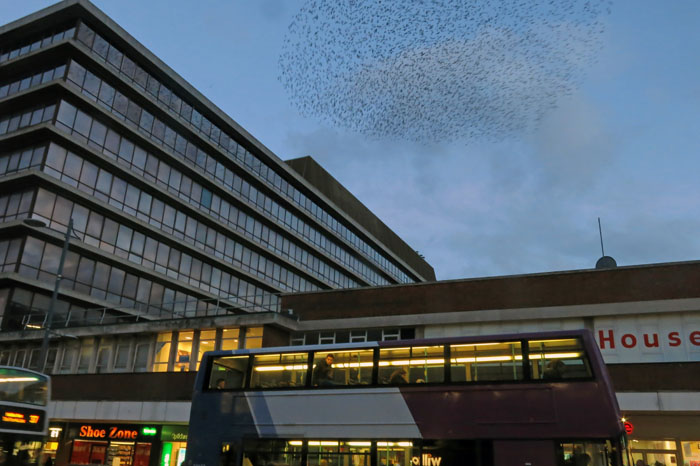
 Norwich, mid January. At dusk over the past few weeks an avian spectacular has been witnessed taking place in the sky over St Stephen’s Street. As the daylight dwindles around the four o’clock mark a swirling murmuration of roosting starlings may often be seen in the sky above this busy city centre shopping street. There’s a pleasing degree of unpredictability to such behaviour, and some afternoons the starlings seem to be conspicuously absent, but as a rule the birds circumscribe a giddy figure eight in the sky above the old Norwich Union office block, Surrey Street bus station, the Marsh Insurance building and Queens Road.
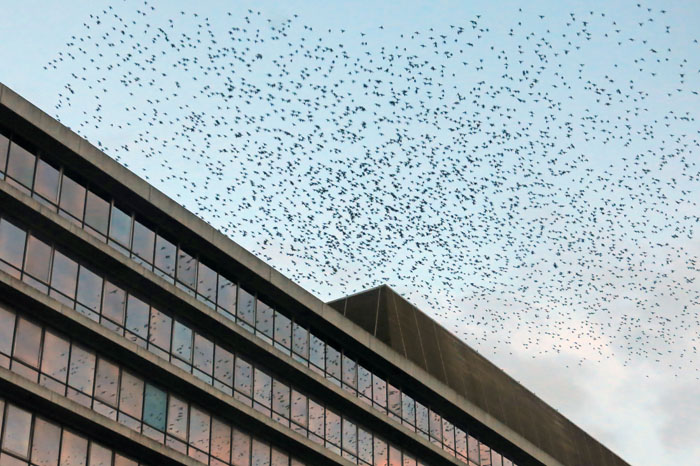 For many of the shoppers and workers hurrying home on the bus this phenomena takes place virtually unnoticed. Even so, there are those who stop to look and wonder at such wild exuberance in what is to them a familiar and quotidian urban environment. While shopping is bought and buses are boarded in the street below the massed starlings dance above – a joyous ensemble piece that twists and turns like a single organism, choreographed by some sort of instinctive group consciousness. As the light fails the birds finally settle, with what seems like a collective spontaneous decision, on the roof of a disused office building where they will spend the night. Darkness falls: the spectacle is over for another day.
True, this is not a particularly grand example of the murmuration phenomenon – perhaps just a thousand birds or so: it is hard to say – but beauty and wonder is relative and this modest display has a personal dimension in that it can even be glimpsed from the windows of my home. Such a spectacle within a stone’s throw of one’s own doorstep can only be seen as a gift.
 East of Elveden