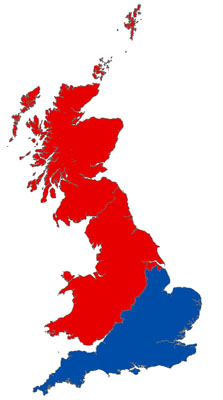
 Back in 2007, Danny Dorling of the University of Sheffield wrote a piece on the nature and geographical extent of the so-called North-South divide in Britain. This was nothing new: as most of us already knew, the north-south socio-economic divide was not simply a matter of drawing a horizontal line through Watford, nor was it a case of delineating the southern boundaries of Yorkshire, Lancashire and Cheshire. Rather, it was more complex – a meandering line between the River Severn to the southwest and the Humber to the northeast.
According to Professor Dorling, the transition from north to south is not as gradual as one might expect, and shows little sign of that psychogeographic favourite, a borderline ‘zone of liminality’. The imagined divide is, in fact, a fractal line sharply defined by all manner of factors – voting patterns, house prices, wealth, health (average life expectancy is a year less north of the line), life chances, Oxbridge university access, language – particularly vowel sounds – and even preferences for flat or sparkled beer. Of course, the line roughly follows distinct features of physical geography too – the division between upland and lowland Britain, and pastoral and arable farming – features that have stongly influenced British history and culture. The divide also delineates the territory colonised by Saxon invaders and follows uncannily close to the route traced by the Roman Fosse Way.
I was reminded of this theoretical divide twice this week. First, by an article in the Big Issue written by Professor Dorling to accompany a feature on George Orwell and then by a BBC Radio 4 programme, the second part of a documentary called North and South: Across the Great Divide presented by Ian Marchant, in which the writer travelled to various places either side of this imaginary line to investigate what local people thought of the notion.
What was pleasing was that Marchant looked closely at some of my own old stomping grounds. I was born in Stourbridge in the West Midlands and grew up in Redditch, a small town just north of the divide that became a new (and suddenly much larger) town just before I left (and which earned the dubious honour of once being dubbed ‘the most boring place in the known universe’). Marchant interviewed people in Henley-in-Arden, a posh, leafy Tudor-beamed town that lies just south of Redditch across the north-south frontier in Warwickshire. The view of the Henleyites was that people from Redditch tended to be more common, while that of the Redditchers was that they would love to live in Henley given half the chance but they simply could not afford to. Hardly groundbreaking stuff but, certainly, growing up in workaday Redditch, places like Henley – and Stratford upon Avon and Warwick – did seem to belong to another, altogether more glamorous world despite their relative proximity. But then, so did Worcester (which actually lies north of the line) and even some parts of Birmingham.
If this north-south orientation is correct then, having journeyed east and slightly north in adult life to move to Norwich from the West Midlands, I have actually crossed the divide – the Tudor line, as Dorling sometimes calls it – southwards. A geographical paradox perhaps – West Midlands to East Anglia, sort of north to kind of south. I still say bath not ‘barth’ but, there again, I do prefer my ale unsparkled.
Marchant ended the program in Gloucestershire’s Forest of Dean, a small but very distinct enclave, squeezed between the Severn and Wye, which stands at the most southerly ‘northern’ point of this cultural divide. I used to know this area quite well and was always impressed by its strong sense of place, wilful isolationism and warm-hearted yet tough natives. To me it always seemed somehow closer to the spirit of South Wales than to the rest of Gloucestershire. Despite having the same latitude as Watford, with working-class forestry and mining traditions, and hardly a trace of tweeness in its villages, there are plenty of stereotypical ‘northern’ characteristics on display here. The ‘Forest’, as natives always call it, really does seem a very different place compared to the opulent sandstone villages of the Gloucestershire Cotswolds just across the River Severn.
In essence, the BBC4 programme is as much about social class as it is about geography but it raises some interesting points. You can listen again here. For a very different point of view, you can read what Simon Jenkins makes of Dorling’s analysis here. The fact that he scathingly dismisses the Sheffield professor as ‘geographer royal by appointment to the left’ might give you some idea as to what to expect.


 East of Elveden