Get there early – this is the sound advice usually given when visiting popular tourist sites. This is exactly what I did in Siem Reap, Cambodia when visiting Angkor Wat a week or so ago but it seems like several thousand others also had the same idea. As I tuk-tuked my way into the vast ancient complex the site was already crawling with a vast number of hot and sweaty camera-clicking visitors – mostly large tour groups obediently following their guides over the stones like human snakes. All I could do was join them in the fray.
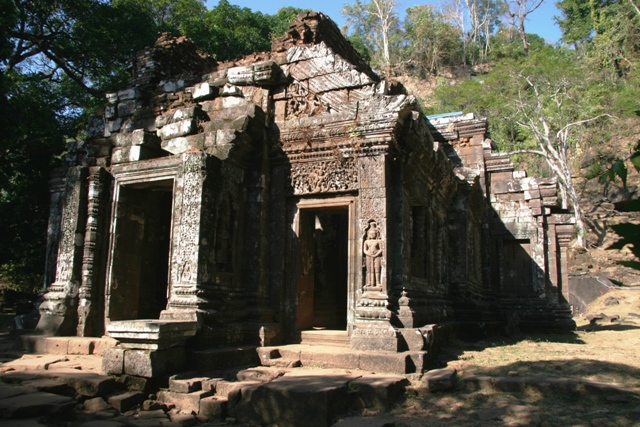
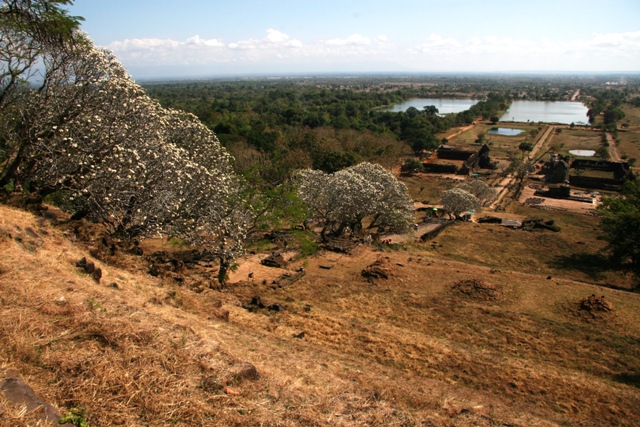
Wat Phou in southern Laos is another ancient Khmer site. While it may not have the enigmatic stone faces of Angkor Tom’s Bayon, or be as enormous in scale, it makes up for it with a gorgeous hillside location close to the Mekong River -that, and a lack of crowds.
A couple of days ago, I got up at sunrise – it is difficult to sleep late in steamy, low-lying Laos. After a quick breakfast watching the sun lift over the Mekong, I hired a bike – a much-abused machine that misleadingly bore the name ‘Turbo’ – to cycle the 10km to the site. Forty-five minutes later, I arrived at the entrance to Wat Phou on my squeaky ‘ladies’ shopper’. The dusty road that lead there was the sort of terrain that most cyclists would probably consider ‘off-road’ – but it was an interesting pedal alongside dry paddy fields and through tiny villages where the day was just starting as people burned joss sticks and prayed in front of the bird table-like spirit house that stands in front of every house, however modest, in the country.
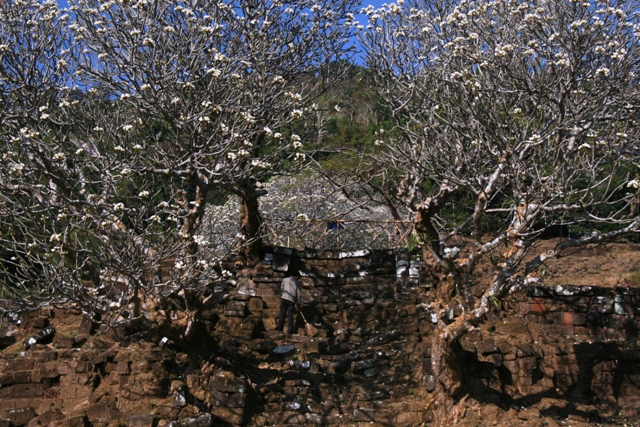
A processional way leads through the Wat Phou temple complex, passing between large baray or ceremonial ponds before climbing steps steeply up the hillside up to the sanctuary itself. The steps were lined with flowering frangipani trees so voluptuously aromatic that you could almost eat the air with a spoon. Pleasingly – or should I say, smugly – I seemed to be the first to arrive. First, apart from a few locals who were setting up their pitches at the top selling shrine offerings and soft drinks. With the place to myself, I made a leisurely tour of the sanctuary, originally Hindu, now Buddhist, seeking out the sacred Shiva spring, the rock-carved elephant and crocodile, and the library. I never did find the Buddha’s footprint but it was a pleasure to survey the shimmering plains below from this breezy elevated viewpoint beneath the deep shade of mango trees.
Eventually, a few others arrived – a friendly Lao-American family, a couple from Manchester who were staying at my guesthouse. Later still a few small tour groups turned up, French and German mostly. Even then it was hardly the circus that Angkor Wat seems to have become these days. Wat Phou may not be ‘undiscovered’ but it is certainly very low-key when compared to its sister site to the south in Cambodia. And let us not forget, Wat Phou is also the older of the two.

 As
As  East of Elveden